KNOWLEDGE
Case StudiesBlogsEventsSupport & Starting
Support Articles & HubSupport Videos (Youtube)Try Leadoo Free (Leadoo Lite)Partners & Careers
PartnershipsCareersSecurity & Privacy
Security at Leadoo AIGeneral Terms & ConditionsData & GDPRKNOWLEDGE
Case StudiesBlogsEventsSupport & Starting
Support Articles & HubSupport Videos (Youtube)Try Leadoo Free (Leadoo Lite)Partners & Careers
PartnershipsCareersSecurity & Privacy
Security at Leadoo AIGeneral Terms & ConditionsData & GDPRThe European Union’s General Data Protection Regulation (GDPR) is one of the most important international legislative changes in data protection in decades. The purpose of the regulation is to increase the individual’s rights to manage and process their personal data and to harmonise legislation within the European Union.
Leadoo is firmly committed to the GDPR Data Protection Regulation.In addition to complying with the regulation ourselves, it is important for us to help our customers with their compliance efforts. This goal is achieved through training, instruction, and technical development of our software.
Leadoo’s updated GDPR compliant terms come to force on the 1st of May 2020:
Data processing Agreement (Customer)
Privacy Policy
Leadoo’s clients generally act as controllers for the personal data registers and data they are processing in Leadoo. The aim of the controller (client) is to define the purpose of the register, and the processor (Leadoo) is responsible for helping the client in the processing of information in an intended manner. Simply put, this means that the customer uses Leadoo for their intended purpose and Leadoo assists the customer in implementing this purpose. This means that we are also doing updates to the software so that this is going to be fast and easy.
The controller (customer) is responsible for ensuring that data is processed technically and administratively in accordance with the requirements of the regulation. The regulation includes significant changes to how and when registers can be maintained. In addition, the controller must ensure that their own activities are transparent towards the data subject, the data is valid, and correct restrictions are applied to the use of personal data. It is particularly important to remove unnecessary information and to safeguard the data subject’s legislative rights. According to the regulation, the data subject has the right to ask for their registered data, to update it and, in certain circumstances, to demand it’s deleted.
If you are a controller, we encourage you to review the content of the regulation. The European Data Protection Supervisor provides vast resources and up-to-date information on its website.
We also encourage you to analyse your situation with the assistance of a lawyer, as the services or training they provide may give you instructions directed specifically at your organisation. The responsibility to take care of this is on the controller (client) so we strongly advise to put some effort in.
We are proud to say that we have put a tremendous amount of work to make sure that everything is in order in respect to the European Union’s General Data Protection Regulation (GDPR). We have put in enterprise-level effort to look after our data protection and privacy as we understand the importance of this matter. This way also our enterprise customers can rely on us to do our part in the data protection chain.
Leadoo’s data protection mechanisms have been entrusted to the management of the entire company, as well as to a DPO (Marcin Lis) who is responsible for operations as part of the management team.
The tech team has set up and implemented the changes required by the regulation. Their task is to implement the data protection processes and changes and make them part of the company’s overall functions and services.
In order to use Leadoo to collect personal data, a privacy policy needs to be in place. The Leadoo software will provide even better tools for building the necessary kind of policy a customer needs to ensure they’re doing data collection by the book also for your competitions etc.
In order to avoid storing old and unnecessary data, Leadoo will set an expiration date for personal data by default. Our customers can change the expiration date by request according to their business needs and regulatory requirements.
The GDPR enforces even stricter requirements for consent when collecting the data. By using Leadoo and strictly required fields, everyone can be sure that the data that enters the system is collected with proper permissions.
The GDPR gives more rights to individuals over their personal data. We at Leadoo provide possibility for our customers to find out what personal data is stored in their account and therefore fulfill requests coming from individuals. This includes the ability to by request print out a report on personal data by the individual, delete all related personal data etc.
While we have always accessed customer data only purposefully and with the agreement of our customers, we have developed stricter controls on who can access the data inside the company.
Storing relevant backups is crucial to us for disaster recovery purposes. However, backups tend to hold information even after it is deleted from production systems. This is why we periodically run our backups through certain filters to ensure they contain only information we and our customers have permissions to store.
Our objective is to provide the safest and highest quality service to our customers. Like many other SaaS services, we also use subcontractors and partners to provide our service. This means that our subcontractors also take part in the processing of personal data on a case-by-case basis. All our subcontractors go through an audit process, which ensures that they share our own tight security and privacy requirements. For more detailed answers, please contact our Data Protection Officer (Marcin Lis, [email protected]). Here are the partners used today:
| Name of controller | Categories of processing | Third countries data is transferred to | Safeguards | Agreements |
|---|---|---|---|---|
| Amazon Web Services | Storage and processing of all customer data | Servers in Ireland / US based company | Automatic wiping of data after customer defined time delay. Encryption throughout. More at https://leadoo.com/security/ | DPA |
| Clearbit | OPTIONAL:Gathering company information from IP addresses to enrich the customer’s lead data | US | Only IP address, not considered as personal data, is sent over the wire to acquire company name | Signed SCC |
| Zapier | OPTIONAL:Integrations to the customer’s own 3rd party systems such as CRMs, ATSs etc. | US | Only implemented on the request of the customer in order to integrate with their 3rd party system, in which case the customer is in charge of fulfilling their privacy and GDPR related duties for transferring data into a 3rd party system and Leadoo only works as a proxy. | DPA |
| Cyclr | OPTIONAL:Integrations to the customer’s own 3rd party systems such as CRMs, ATSs etc. | United Kingdom | Only implemented on the request of the customer to integrate data to/from Leadoo with some other 3rd party system the customer has. | DPA |
| Cronofy | OPTIONAL:Calendar and email sending for calendar node in bot discussions | United Kingdom | Only implemented on the request of the customer to sync calendar data to Leadoo. | Non-public DPA (Privacy docs |
| Microsoft | OPTIONAL:AI chat module that uses ChatGPT or similar LLM model to answer chats. | Servers in Sweden | Only implemented on the request of the customer. May be used by customers to add any personal data in free text form. | Non-public DPA |
| Scaleway | Backup server | France | Storage of all data | Non-public DPA |
| Benhauer sp. z o.o. (dba SALESmanago) | All data | Poland | Customer success and group services through the same group company | Non-public DPA |
As part of a data processing agreement, our customers must accept our subcontractors’ use of personal data.
We fully understand our important role as a processor of valuable and confidential personal data and are serious about the responsibility that our customers give us. We have built a processing agreement with our customers in accordance with the Data Protection Regulation, which identifies the customer’s processing instructions for the registry. These guidelines are the foundation for all our processing operations.
We require all our customers to accept our data processing agreement so that we can ensure safe and lawful processing of personal data. We will process personal information you provide to Leadoo only and solely in accordance with the regulation. These terms you can find at the upper part of this page.
Leadoo employees undertake to participate in data protection and processing training to ensure that your data is reliably managed. All our employees are also subject to duty of confidentiality with respect to our customers’ data when they start working at Leadoo.
Leadoo provides a possibility for retrieving and removing individual data subject’s items. Also, if your customer relationship with us will nevertheless end, or if you want to retrieve or remove any personal information, we will provide you with the possibility to do this. Retrieving events, data subject, and other personal information is done by request.
You can submit a request for this to support(at)leadoo.com. In addition, on request, we can ensure that your personal data is removed on our own and on our subcontractors’ data bases upon termination of your customer relationship. We will permanently remove your information within the stated deadline unless we have a legitimate reason in public interest to maintain the data.
Leadoo reserves the right to process information covered by its own registers in countries outside the European Union or the European Economic Area, provided that adequate security and data protection of these services is appropriately undertaken. We also try to minimise the amount of data that is being processed outside the EU, but because of the open nature of the Internet, we cannot completely restrict the processing.
Leadoo’s team provides assistance in questions to do with the data protection regulation. In addition, our customer success managers and customer service personnel provide user support and help with Leadoo’s data protection features.
This post has been brought to you by our friends from Cookie Information! They are true experts when it comes to cookie consents and staying extra safe with GDPR.
98% of your website visitors just leave, without any kind of conversion. What if you could turn some of these 98% into loyal customers? Here’s how you can better understand your customers’ journey to target new audiences and retarget existing clients.
The rest just come and go.
Wouldn’t you like to know who they are? And how you make them convert?
So do we.
That’s why we are always looking for new ways to get to know our potential clients a little better. Understanding customer journeys has been the soul of online marketing for years; and it continues to be.
Getting to know your customers requires a lot of data. This probably is not news to anyone. After GDPR it has become crucial to ask website visitors for a consent to collect their data.
Why?
We are constrained by law.
Yes, privacy laws like the ePrivacy Directive (the European cookie law) and the GDPR require us to obtain valid consent from our visitors before we collect their data.
This rule applies to us all.
Transparency and privacy are key factors for how buyers perceive your business.
So, now we’re going to show you how you can collect your users’ data to better understand your customers’ journey; all while being GDPR compliant!
First, you should look for a good CMP.
What’s a CMP you might ask?
A Consent Management Platform (CMP) is a tool that collects your users’ valid consent to cookies on your websites and apps.
But why should you get a Consent Management Platform?
Because obtaining consent to cookies isn’t simply showing your visitors a banner on your website saying: “we use cookies – ok”.
GDPR consent is much more complex.
So, here is GDPR consent in a simplified form:
When you use cookies on your websites or apps that collect your visitors’ personal data (cookies from Google Analytics, Facebook, LinkedIn, TikTok or any other third-party service), you must:
And of course, remember to store all the consents securely for 5 years so you can show them to the Data Protection Authorities if they come knocking at your door. They do that sometimes.
Still sounds complicated?
Don’t worry, it’s not.
You can easily collect valid GDPR consent.
There are actually only a handful of Consent Management Platforms in the world that will enable you to collect a cookie consent that complies with the GDPR.
Cookie Information is one of them.
· Collect valid GDPR consent to cookies from your users
· Stay compliant with national cookie rules and the GDPR
· Get the support you need to implement and maintain your Consent Solution
· Get through an audit by the Data Protection Authorities (we have your back!)
With a solution like Cookie Information, your websites and apps are always up to date with current legislation, so you can focus on collecting the data you need to grow.
Data, of course, is only information until you put it together in the right way. At that point it becomes insights; something you can act upon.
One of the ways to transform all the data you collect into insights is by using a Conversion Platform.
Now, what’s that?
A conversion platform is a tool designed to collect and analyse your website’s conversions.
“Yeah, but I got Google Analytics“, you might say.
Sure, it’s undoubtedly a great tool. Still, GA will only take you so far if you sell B2B.
A conversion platform is more than just endless amounts of raw data in graphs and pie charts. It activates and converts your visitors with deeper insights and automation.
A conversion platform has many built-in conversion tools to convert and nurture your website visitors.
One platform we have been happy to discover is Leadoo.
Leadoo is a Conversion Platform. It collects and displays your potential buyers’ data so your marketing and sales department can understand each step of the buyers’ journey.
Leadoo activates and engages your leads, so you start building a rapport with them. This means that you can nurture them all the way to a hard conversion. 🚀
And that is the goal of any business, right?
But as said earlier, collecting data requires attention to data privacy regulations like the GDPR.
When you use a conversion platform like Leadoo, it is built on the premise that you ask your website visitors’ permission to collect and use their data.
When Cookie Information is your Consent Management Platform, it’s easy to integrate it with Leadoo.
You can use this simple javascript, which is actually the only thing you need to do to integrate the two tools.
if (!window.ldanalytics) window.ldanalytics = [];
window.ldanalytics.push(function(a) {
    a.toggleTracking(true, false);
});Spark up a discussion with our friendly little helper right here 👇🏻
Ah, cookies. Figuring out the correct approach to using cookies on your website can really cause your hair to turn grey if you’re unsure about how to do it.
Here’s our guide to help you understand and tick all the boxes with cookie consent. Get your copy below and stay 100% GDPR-compliant.
The General Data Protection Regulation (GDPR) has been around for more than two years now, and it would not be an overstatement to say that it has shaken up the whole marketing industry. In this post, we will address the use of various tracking technologies in a GDPR-compliant manner – to offer interest-based advertising and stay accountable at the same time.
Although cookies are the most known technologies, websites also use other means to support functionality and track users, such as HTML5 local storage, Local Shared Objects, fingerprinting techniques, etc. However, we will use cookies as an umbrella term in this discussion, keeping in mind that it also covers other technologies.
It is also worth noting that we discuss here compliance with the EU privacy rules on cookies, which will not necessarily apply in the same way to the California Consumer Privacy Act (CCPA) and the Lei Geral de Proteção de Dados (LGPD). Using web analytics in the US, for example, is more relaxed and does not require prior consent. You should understand well which laws govern your activities.
Before moving to a question of lawfulness, it is crucial to differentiate cookies by categories based on the purposes they serve.
Leadoo and any other web analytics service provider uses cookies to recognize users’ behavior and deliver their services. However, each website owner’s responsibility as a data controller is to ask and collect visitors’ consent before starting tracking. It is essential to ask for permission, and whether all cookies require approval, we will discuss below.
It may come by surprise, but the GDPR is not the only and, more importantly, not the first law to consider before using cookies. The GDPR sets forth the fundamentals of personal data protection: principles of processing, data subject’s rights, controller and processor’s duties, etc. In contrast, the ePrivacy Directive (aka a Cookie Law) guarantees respect for private life and protects personal data in electronic communications in particular.
In practice, it means that the ePrivacy Directive prevails over the GDPR in situations where electronic communications are involved. However, unlike the GDPR, the ePrivacy Directive does not have a direct effect, i.e., each EU country has its national law implementing the Directive’s provisions. While it might lead to some deviations between different jurisdictions, the core rules will remain the same.
Under the ePrivacy Directive, there is a general requirement to ask for user’s consent before using any cookies. Importantly, it does not matter whether any personal information is processed or not for it to apply. It is because placing cookies on a user’s device is considered as interference with that user’s private space and thus requires prior permission.
Notably, it is the GDPR that defines consent. Accordingly, it must be any freely given, specific, informed and unambiguous indication of wishes by which a data subject, by a statement or by clear affirmative action, signifies agreement to the processing of personal data. This wording contains quite a lot of meaning to grasp, and it could be a subject for a separate blog post to explain what a GDPR-compliant consent entails.
Leadoo has prepared a detailed, up-to-date guideline on asking for cookie consent to help its customers comply. As a preview, consider that a widespread practice of assuming or implying user’s permission from a mere act of browsing a website is no longer legal in Europe.
From the categories mentioned above, only essential cookies fall under the ePrivacy Directive consent exception. The document refers to them as strictly necessary to provide an information society service explicitly requested by the subscriber or user. Noticeably, it is a very narrow exception. Most of the cookies that facilitate the use of a website, but are not strictly necessary and not explicitly requested, still need user consent. There is no mercy for analytical cookies, either.
The current situation is about to change soon as a new ePrivacy Regulation is coming to replace the Directive. Similarly to the GDPR, it will be directly and uniformly applicable in all EU countries. Among the offered novelties are two additional cookie consent exceptions of our interest:
Consequently, it is mandatory to ask for the visitors’ consent to use any cookies other than strictly necessary. If you would like to receive detailed guidelines on how to do it correctly, contact your customer success person at Leadoo or download our comprehensive guide below! ⤵️
Leadoo is fully GDPR compliant. In addition to complying with the regulation ourselves, it is important for us to help our customers with their compliance efforts. This goal is achieved through training, instruction, and technical development of our software. See our full GDPR statement here.
In essence, you can decide for yourself how to use Leadoo – you can use it in fully anonymous mode, in which case no marketing tracking is done. Most often, however, you will want to use it for marketing and analytics purposes – just like you’re using Google Analytics today – and this requires permission from the user. Leadoo bots can do this for you, or your own website can ask for consent and hand over that information to Leadoo.
When you start using the Leadoo service, your customer success manager will help you ensure that your website complies with GDPR.
For our own site, Leadoo.com, Leadoo operates as both the Processor and Controller for the data. However, for our customer’s sites, we only operate as the Processor. To understand what this means you can go to the specific explanation in our Privacy Policy here.
If you want to know more in-depth how we keep your data safe read this.
AI chatbots have never been more accessible. At Leadoo AI, we’ve seen great success with our AI-powered conversational tools and our internal AI Bot Builder feature that lets customers draft new bots from scratch with AI.
With modern LLMs, no-code tools, APIs, and AI development frameworks, it’s now possible for some in-house marketing and development teams to build website chatbots themselves.
Teams understandably ask “Can we build this?” when looking at conversational marketing solutions. But as we’ll lay out here, the real questions are:
Just because you can build it – should you? And what will it ultimately cost?
Because while launching a basic AI chatbot is easier than ever, building one that actually performs, scales, stays compliant, continuously improves, and doesn’t balloon in cost is significantly harder than most teams expect.
In reality, many companies discover that the hidden costs, operational burden, and long-term ownership challenges make in-house AI chatbot development far less viable than initially imagined. And the horror stories of when in-house chatbots go wrong are very damaging indeed.
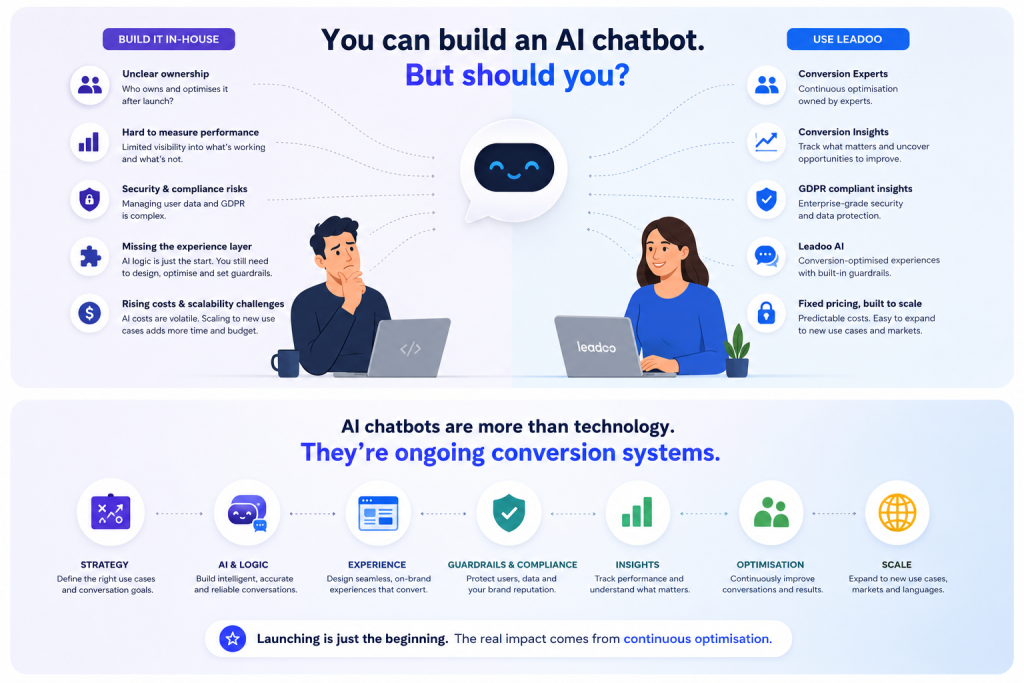
Most AI chatbot projects begin with excitement.
A team experiments with OpenAI, Anthropic, or Gemini APIs. They connect a chatbot to the website. They upload some documentation. Maybe they even launch a pilot within a few weeks. Technically, it works.
But then the real questions start appearing:
This is the moment many businesses realise:
AI chatbots are not just software projects. They’re ongoing conversion systems.
And successful conversion systems require strategy, optimisation, analytics, governance, and continuous improvement.
One of the biggest challenges with in-house chatbot projects is ownership. At launch, there’s usually enthusiasm and cross-functional collaboration. It is the newest and shiniest thing on the website after all.
But several months later, ownership often becomes unclear, especially as the difficult questions above start popping up. Without clear accountability, many AI chatbot projects quietly stagnate.
The chatbot remains live, but nobody is truly responsible for improving it. This is where businesses often underestimate the value of a specialist conversion partner.
With Leadoo AI, optimisation doesn’t stop after implementation. All our standard packages include dedicated Conversion Experts whose role is to continuously improve performance, refine journeys, identify friction points, and maximise ROI.
Because launching a chatbot is not the finish line. It’s the starting point. Check out the quality and value of our customer service for yourself on review sites like G2.
“With new AI-driven capabilities and continued investment in our platform, we’re focused on helping our customers achieve even greater results. I want to personally thank every customer – those who have been with us for years and those just getting started, for the trust they place in us.”
Many businesses measure chatbot success incorrectly or incompletely. They focus on number of conversations, engagement rates, or time on site.
But none of these metrics necessarily translate into business outcomes. The real question is:
Are my chatbots driving conversions? And if not:
Most DIY AI stacks provide logic and infrastructure, but very little meaningful conversion insight.
This creates a dangerous situation where teams assume the chatbot is successful simply because it exists. Leadoo AI approaches this differently.
Through advanced Conversion Insights, businesses can clearly understand how conversational journeys influence pipeline generation, lead quality, conversion rates, and customer behaviour.
More importantly, optimisation becomes continuous rather than reactive. Because AI without performance visibility quickly becomes expensive guesswork.
Security and compliance are unfortunately sometimes treated as secondary concerns during AI experimentation. Until legal teams get involved.
Or customer data starts flowing through prompts…
AI chatbots frequently process personally identifiable information. And many businesses underestimate the operational complexity of managing this securely and compliantly.
Key questions that any AI chatbot builder or provider MUST be able to answer include:
These concerns become even more significant for companies operating across multiple regions and jurisdictions. And in-house teams frequently cannot answer these without getting into an uncertain legal minefield. Leadoo’s platform is built with GDPR-compliant insights and enterprise-grade governance in mind – reducing risk while allowing businesses to scale conversational experiences confidently. Because compliance is not something you bolt on later.
This is one of the most overlooked challenges in AI chatbot development. Most AI tools provide the intelligence layer.
But they don’t solve the experience layer. And the experience layer is what users actually interact with. It includes: UI and conversational design; timings and triggers; mobile responsiveness; brand consistency; guardrails and fallback handling; and escalation paths.
In practice, companies often spend far more time designing and refining user experiences than building the AI itself. And without careful optimisation, AI chatbots can easily become inconsistent, off-brand or just generic (see the famous Air Canada example).
Worse still, poorly implemented, or just non-optimised, AI experiences can actively harm conversion rates and customer trust.
Leadoo AI combines conversational intelligence with conversion-optimised user experiences and built-in safeguards. Helping businesses deploy AI experiences that are not only intelligent, but commercially effective, with the help of Conversion Experts.
Because users don’t judge your chatbot on its architecture. They judge it on the experience. Here’s an example of how Leadoo AI can dramatically improve UX – even in a highly regulated industry.
Many companies pursue in-house AI chatbots because they assume it will reduce costs.
Initially, this can appear true. The first prototype may only require a developer and API access.
But costs rarely stay there. As adoption grows, complexity grows too. Before long, the organisation isn’t managing ‘a chatbot’. It’s managing an evolving AI platform.
And unlike Leadoo AI’s fixed package pricing, internal AI infrastructure costs are highly volatile with changes to AI models; token usage; and increasing computational requirements.
Internal teams also absorb hidden operational costs when it comes to maintenance, prompt tuning, analytics integrations and setup, QA and infrastructure monitoring.
What initially looked cheaper can quickly become significantly more expensive.
AI chatbots rarely operate in isolation. To create meaningful business outcomes, they need to connect with CRM, MA systems, analytics tools, or product databases.
Every integration introduces additional complexity, maintenance, and failure points. And when something breaks, diagnosing whether the issue sits within the AI or integration layers can become extremely time-consuming for internal teams. And can reignite the ownership question we mentioned earlier.
This is another reason most businesses eventually prefer managed conversational platforms over fragmented DIY stacks.
There’s no question that modern AI tools have democratised chatbot development. Businesses absolutely can build powerful AI experiences internally.
But the more important consideration is whether they should dedicate long-term internal resources to owning, managing, optimising, securing, scaling, and continuously improving those systems.
Because successful AI chatbots are not one-time projects. They are ongoing commercial programmes. And as shown, if they go wrong, it can be catastrophic for internal teams. For many businesses, the true challenge is not launching an AI chatbot. It’s sustaining one successfully over time.
That’s where Leadoo AI and our Conversion Experts shine.
Ready to find out more?
Updated: Jun 29, 2026
These Terms apply to the provision of the products, information and services available through leadoo.com or otherwise provided by Leadoo (“Service” or “Services”) to the firm, company, corporation, individual or other customer (“Customer”) and to all Contract(s). The Customer may not be a consumer and the Services are intended for business use only. Leadoo and the Customer are also referred to each as a “Party” and together as the ”Parties”. These Terms form an integral part of the Contract. The Customer’s purchase, procurement or other terms shall not apply to the Contract, even if referred in or attached to the Customer’s purchase order or other document submitted by Customer. In the event of a conflict between the Terms and other terms of the Contract added by Leadoo, the terms elsewhere in the Contract added by Leadoo shall prevail. The Customer represents and warrants that each person who takes the Services in use or uses the Services, the Documentation or the Software or clicks the acceptance of the Contract or the Terms or otherwise accepts the Contract or the Terms (or the modified version thereof) is authorized to conclude a binding agreement on behalf of the Customer and that the Customer is bound by the Contract (including but not limited to the Terms). If the Customer does not accept the terms of the Contract (including but not limited to the Terms), the Customer is not entitled to use the Services, the Documentation or the Software.
“Additional Fee” means the sum of money that Leadoo may charge the Customer in the event the Customer terminates the Contract using the Maximum Termination Period, corresponding to the sum of the Customer’s fees for the use of the Software for the remaining term of the Contract had it not been terminated. The Additional Fee does not apply if the Customer terminates the Contract due to circumstances for which Leadoo is liable.
“AI System” means the functionalities of the Software utilizing artificial intelligence technologies, including machine learning models, generative large language models, and predictive algorithms (e.g., Leadoo AI, AI Discussions), which constitute an AI system within the meaning of the AI Act and are made available to the Customer as part of the Services.
“AI Act” means Regulation (EU) 2024/1689 of the European Parliament and of the Council of 13 June 2024 laying down harmonised rules on artificial intelligence and amending Regulations (EC) No 300/2008, (EU) No 167/2013, (EU) No 168/2013, (EU) 2018/858, (EU) 2018/1139 and (EU) 2019/2144 and Directives 2014/90/EU, (EU) 2016/797 and (EU) 2020/1828 (Artificial Intelligence Act), Text with EEA relevance (OJ L, 2024/1689, 12.7.2024).
“Confidential Information” means any and all information of confidential nature supplied by a Party to the other Party, whether in writing, orally, electronically or otherwise, and whether marked as confidential or not.
“Contract” means an order, agreement or other contract in which the Parties agree on the provision of the Services to the Customer, such as (i) an agreement signed by the Parties, (ii) Leadoo’s binding offer accepted by the Customer, (iii) the Customer’s order accepted by Leadoo, e.g. by providing access to the Services to the Customer, or (iv) the Customer’s order on Leadoo’s website or other Leadoo’s ordering system, which order is accepted by Leadoo e.g. by providing access to the Services to the Customer.
“Contract Period” is defined in clause 7.
“Data Act” means Regulation (EU) 2023/2854 of the European Parliament and of the Council of 13 December 2023 on harmonised rules on fair access to and use of data and amending Regulation (EU) 2017/2394 and Directive (EU) 2020/1828 (Data Act).
“Derived Data” means any data, statistical models, insights, aggregations, or other output derived from or generated using Customer Data, Statistical Information or Platform Data, whether or not derived in combination with data from other customers or sources, such that the data cannot reasonably be used, whether alone or in combination with other reasonably available information, to identify the Customer or any of its Users or data subjects. Derived Data is not Customer Data.
“Documentation” means usage manuals and other documentation related to the Service in written or electronic form that are supplied by Leadoo to the Customer, are stored by Leadoo’s Help Desk for the purpose of use of Leadoo’s customers or are accessible through the Service, but excluding marketing materials.
“GDPR” means EU’s General Data Protection Regulation 2016/679.
“ICT” means information and communication technologies referred to in the Data Act.
“Information on jurisdiction” means the information on the jurisdiction to which the ICT infrastructure deployed for data processing within Leadoo’s individual services is subject, as referred to in Article 28 (1) (a) of the Data Act – contained in Appendix 1 to the Terms available on our website.
“Intellectual Property Rights” means patents, inventions, trademarks, domain names, rights in know-how, trade secrets, copyrights, database rights, rights related to copyrights and any other intellectual and industrial property rights, whether registered or not, and including without limitation the right to amend and further develop the objects of those rights and the right to assign the rights to third parties.
“Leadoo” means Leadoo Marketing Technologies Oy, business ID 2922046-1 registered at Paasivuorenkatu 3, 00530 Helsinki FINLAND, together with its directly and indirectly owned subsidiaries, e.g.: Leadoo Marketing Technologies Ltd, Company number 12201670.
“Maximum Notice Period” means a period of two calendar months.
“Maximum Transitional Period” means the period of 30 calendar days initiated after the Maximum Notice Period.
”Customer Data” means non-public any data, messages or other content submitted by or on behalf of the Customer or its website users into the Services of which the Customer or its users is the owner. Customer Data may include, unless expressly indicated otherwise by the context, Customer Personal Data. Leadoo’s processing of such Customer Personal Data will be governed by the Personal Data Processing Agreement. For the avoidance of doubt, Customer Data shall not include: (i) Platform Data; (ii) Derived Data or (iii) any data submitted by third parties not directly related to the Services provided to Customer.
“Customer Personal Data” means Personal Data submitted by Customer or its Users to the System, the processing of which by Leadoois governed by the Personal Data Processing Agreement.
“Service Fee” is defined in clause 5.
“Software” means software provided by Leadoo to the Customer for the purpose of the Customer installing on the Customer’s device(s) for the purpose of use of the Services.
“AI Discussions” means new initiated discussions, regardless of length of discussion, by one person. If Leadoo AI is added to the contract, it is capped to the amount defined on the contract. If no Leadoo AI is on the main contract it is not included in the package. If Leadoo AI is added without capping discussions the default capping of 1000 AI discussions per month is used.
“Basic integration” means integrations to Customer systems (such as a CRM) where there exists an integration connector for either native (Cyclr) or Zapier with existing templates and without modifications apart from field mappings. The basic integration includes updating or creating up to two objects in the Customer system such as Lead and Contact data. It includes updating/creating Contact information, discussion data, labels and variables. Work conducted outside this definition is billed according to the hourly pricelist under 6. Prices.
“Advanced integration” means everything in Basic integration plus up to 10 if clauses and any one-to-many data mapping or any integrations to custom systems through REST APIs or other custom APIs.
”Statistical Information” means (i) information on the way the Customer, its users and its website users use and access the Services, such as information on the time of use of different functionalities and on the ways to use the Services and (ii) the Customer Data, as such or as processed and/or combined with other data, but all (i) and (ii) in an aggregated form so that the Customer’s or the users identity cannot be identified directly from the Statistical Information. Leadoo shall own all rights, title, and interest in and to Statistical Information.
“Optimisation Meeting” (1hr meeting + optimisation): Your conversion expert analyzes collected data from your conversion tools (before the meeting), suggests optimizations based on it (during the meeting) and optimizes up to 10 of your conversion tools for you (after the meeting). Additional optimisation meetings can be added at a cost defined in the then-current Price List or as agreed in the Contract.
“Workshop” 1 hour. Your conversion expert performs a training workshop to enable you and your team to optimise your own conversion tools, increase efficiency with your existing functions and everything else you want to learn more about in Leadoo. Additional workshops can be added at a cost defined in the then-current Price List or as agreed in the Contract. Workshop Examples: A) How Company Identification can be utilized by sales teams for prospecting. B) Psychology behind successful conversion tools and how you build them. C) Conversion tool insights and what they tell us about your visitors. D) How you can use insights & data to personalize your approach for your visitors.
“Support” Between meetings with your conversion expert, you can take advantage of the Leadoo’s help center filled with helpful articles, guides, videos and documentation. You can always email our support if you encounter any issues: [email protected].
“Retrieval Period” – the period of data retention by Leadoo of 30 calendar days, beginning after the end of the transitional period agreed between the Customer and Leadoo in accordance with the Data Act.
“Platform Data” means all statistical, operational, and usage data derived from the operation or provision of the Services, including data regarding configurations, feature usage, log data, chatbot interaction data, and performance results. Leadoo shall own all rights, title, and interest in and to Platform Data.
The features of the Services provided to the Customer are described in the Contract. If no explicit Contract is made then these Terms of Service act as a Contract together with any choice made by Customer inside the application. If nothing else is explicitly agreed on the Contract the company identification feature is limited to 95 000 unique IP address calls per month. The Customer may make additional orders of features or Services and upgrade the Service tier to a higher tier (e.g. from Free-Tier Services to paid Services) during the term of the Contract, by using the functionalities within the Services or by making other additional orders. The Service may e.g. include separately priced additional features, services, products or other items which may be priced per item (e.g. per views or clicks) or per feature or bulk pricing (e.g. SMS messages in bulk of 1000 messages). All orders and upgrades are subject to Leadoo’s acceptance, are priced according to Leadoo’s then current price list and are governed by the Contract and these Terms. The Customer warrants that its users making orders have the right to make the orders. Downgrading to a lower tier with e.g. lower pricing or to Free-Tier Services is not possible during the then current Contract Period.
Subject to the terms of the Contract, Leadoo will use commercially reasonable efforts to provide the Customer with the Services. As part of the registration process, Customer will identify an administrative user name and password for the Customer’s company account. Leadoo reserves the right to refuse registration, and require change of passwords as it deems appropriate. Subject to the Terms hereof, Leadoo will provide the Customer with reasonable technical support services via email, phone or online chat on reasonable effort basis. As part of the technical support services, Leadoo investigates and fixes errors of the Services, but cannot guarantee that all errors can or will be fixed or the time schedule of fixes. Leadoo has the right to limit customers integration rules that cause extensive load to the platform and jeopardize system stability. Non commercial agreements come with no commitment for services or support. Leadoo’s responsibility for the Services and their functionality is limited to the functionalities of Leadoo’s own information systems. Leadoo cannot guarantee disruption-free access to the Services, or otherwise guarantee the availability or disruption-free use of the Services. Leadoo is not responsible for any restrictions on the use of the Service in any country. The Customer shall notify Leadoo of Leadoo’s breach of Contract without delay and latest within time that enables Leadoo to remedy the breach as to mitigate the adverse effects caused to the Customer by the breach. Leadoo may make any changes to the Services, subject to sec. 18.5.
The setup includes one kickoff meeting (1 hour), ten conversion tool implementations, going through the bots (1 hour) and two re-iterations of the bots based on customer feedback in one language, basic integrations (incl 2 hours of meetings) to CRM or marketing automation system and data synchronization to Google Tag Manager’s Data Layer. Additional services are billed according to the pricelist in 6.
Subject to the Customer’s payment of the prices payable for the Services (“Service Fee”), the Customer is granted a non-exclusive, non-transferable and non-sublicensable right to use the licensed features of the Services during the term of the Contract in the Customer’s own operations in accordance with the Documentation. Except for the Customer’s website users as allowed in the Documentation, the Customer may not use the Services to offer services to any third party, otherwise transfer the Services or allow access to the Services to any third party or allow any third party to benefit from the Services. The Customer shall follow the usage limitations set out in the Contract and the Documentation, regarding e.g. the functionalities of the Services provided to the Customer or other limitations. If the Customer, through the system, uses or makes use of either directly or indirectly of 3rd party images or icons the Customer agrees to the license terms of the said image provider such as but not limited to Unsplash.com. There are no implied licenses. The Customer may use the Documentation in order to use the Services, as long as the Customer’s right to use the Services is in force. The Customer is also granted a non-exclusive, non-transferable and non-sublicensable right to install the Software on the Customer’s devices and to use the Software in accordance with the Documentation in order to use the Services, as long as the Customer’s right to use the Services is in force. When the Customer’s right to use the Services expires or terminates, the Customer shall remove the Software permanently from its devices. The Customer’s users shall maintain their user names and passwords diligently and the user names and passwords may not be disclosed to third parties. The Customer is responsible for the use of Services by using its users’ user names and passwords. The Customer may not, directly or indirectly (a) reverse engineer, decompile, disassemble or otherwise attempt to discover the source code, object code or underlying structure, ideas, know-how or algorithms of the Services, the Software or any software used by Leadoo to provide the Services, (b) modify, translate or create derivative works of the Services (except to the extent expressly permitted by Leadoo in the Documentation), the Software or the Documentation, (c) use the Services, Software or the Documentation for time sharing or service bureau purposes or otherwise for the benefit of any third party, or (d) remove any proprietary notices or labels.
Leadoo provides tools based on artificial intelligence (AI Systems). These systems are designed and implemented in accordance with the requirements of the AI Act.
The Customer acknowledges that AI Systems generate content in an automated manner. The Customer undertakes to inform end recipients of the fact that content is generated by AI, if required by if required by Art. 50 of the AI Act or other applicable laws.
Leadoo may use anonymized Customer Data to develop and improve its Services, including training of artificial intelligence and machine learning models. This data constitutes “Statistical Information”, “Platform Data” and/or “Derived Data” as defined in Section 2 and is processed in an anonymized and/or aggregated form and does not identify the Customer or its users, or disclose trade secrets. Leadoo does not use sensitive chat content or any identifiable personal information. Leado does NOT use any Customer Data to train foundation models.
Leadoo declares that, to the extent required by law, it applies control measures to ensure that AI Systems do not generate discriminatory content or violate prohibited practices specified in applicable laws, in particular the AI Act. However, the Customer bears full liability for the final acceptance, verification and publication of content suggested or generated by the AI Systems.
The Contract will remain in force initially for twelve (12) months’ Contract Period from the date it became in force, after which it will continue to be in force for subsequent one-year terms (the initial and each subsequent one-year term is referred to as “Contract Period”), unless terminated by either Party by a written notice given to the other Party at least thirty (30) days prior to the end of the then current Contract Period. Thus, the minimum term of the Contract is twelve (12) months, unless otherwise agreed in the Contract. If the parties have agreed on a different term in the Contract, the subsequent contract terms will still be 12 months. The Customer has the right to terminate the Contract with the Maximum Notice Period at any time. In such a case, Leadoo is entitled to charge an Additional Fee. Either Party may terminate the Contract with immediate effect by giving the other Party a written notice if the other Party commits a material breach of the Contract and fails to remedy the same within thirty (30) days after receipt of a written demand from the other Party to cure the breach. Leadoo may terminate any Customer agreement that is free of charge, at its own discretion at any time. The Customer shall notify Leadoo by sending an email to [email protected].
The Customer warrants that Leadoo and its subcontractors (in particular Benhauer sp. z o. o. based in Cracow, ul. Klimeckiego 4, 30- 705) are entitled to store and otherwise process the Customer Data lawfully for the purposes of the Contract. Prior to submitting the Customer Data, the Customer shall take and maintain copies of the Customer Data if the Customer deems it important to maintain the Customer Data. The same applies to any output data (such as reports) that the Customer receives by using the Services. The Customer is liable for the Customer Data and its correctness. The Customer shall ensure that the Customer Data has been scanned by using an up-to-date date virus scanning before submitting. The Customer may use the Services only in accordance with good business ethics. The Customer may not use Service for any illegal or questionable use, e.g. to SPAM, for selling drugs or any other illegal uses in the country the Customer operates in. The Customer shall comply strictly with all applicable federal, state and other laws and regulations, including without limitation, marketing and electronic marketing regulations, the U.S. CAN-SPAM Act of 2003, the GDPR and laws and regulations regarding privacy and electronic communications. Violation of laws or regulations will constitute the Customer’s material breach of these Terms. It is the sole responsibility of the Customer to ensure that the service usage complies with local legislation. The Customer agrees to defend and indemnify Leadoo from and against any claim by a third party in connection with the Customer’s failure to comply with laws or regulations. No limitations of liability shall apply to such liability of the Customer.
As between the parties, Leadoo shall own all right, title, and interest in and to Statistical Information. Leadoo may use, operate, copy, modify, disclose and publish the Statistical Information, in an anonymized and/or aggregated manner, in any and all means and for any and all purposes including the training, optimization, and improvement of Leadoo’s machine learning algorithms and AI Systems – provided that it does not identify the Customer as the source of the Statistical Information (unless consented to by the Customer). For the avoidance of doubt, Statistical Information forms part of Derived Data as defined in these Terms, and Leadoo’s ownership of Statistical Information survives the expiry or termination of this Agreement. Leadoo does not sell or expose individual customer-level data to third parties. Leadoo reserves the right to delete all data for unpaid, unused accounts after 3 months of inactivity. As Leadoo’s technology is embedded on the website the technology may collect contact information from the website directly or indirectly to track analytics on e.g. conversions. The Customer grants that such usage of website conversion directly or indirectly from the Customer’s website is allowed. Furthermore, the Customer grants that Leadoo may collect the domain names of email addresses collected from the website in the above manner for internal company to IP address matching purposes.
The Customer agrees that Leadoo may use the Customer Data to create and generate anonymized and aggregated statistical or analytical data. Upon their creation, such anonymized and aggregated results shall be deemed a separate category of data (“Derived Data”) and shall no longer constitute Customer Data. As between the parties, Leadoo shall own all right, title, and interest in and to all Derived Data, including all derivative works thereof, all AI/ML models and algorithms trained or improved using Derived Data or Statistical Information, and all products or services developed or improved using the same. The foregoing ownership vests in Leadoo automatically upon creation and survives the expiry or termination of this Agreement. For the avoidance of doubt, Leadoo only processes fully anonymized and aggregated Customer Data, which cannot be used to identify any individual Customer, directly or indirectly.
The Customer, upon its request, is allowed by Leadoo to switch the provider of services covered by the Contract to a different provider of data processing service or to port all exportable data and digital assets, referred to in the Data Act, to an on-premises ICT infrastructure, without undue delay and in any event not after the mandatory Maximum Transitional Period, during which the service contract remains applicable. Leadoo shall in this case:
Leadoo supports, to the extent resulting from the Data Act, the Customer’s exit strategy relevant to the contracted services, including by providing all relevant information.
The Contract shall be considered to be terminated and the Customer shall be notified of the termination, in one of the following cases:
Leadoo shall erase all exportable data and digital assets generated directly by the Customer, or relating to the Customer directly, after the expiry of the Retrieval Period or after the expiry of an alternative agreed period at a date later than the date of expiry of the Retrieval Period, provided that the switching process has been completed successfully. The Parties agree that, due to technical limitations, all exportable data and digital assets generated directly by the Customer or directly relating to the Customer will be erased when they are no longer necessary, not later than after 12 months after the completion of the switching process, unless Parties agree otherwise.
The Customer may notify Leadoo of its decision to perform one or more of the following actions upon termination of the Maximum Notice Period:
Where the mandatory Maximum Transitional Period is technically unfeasible, Leadoo shall notify the Customer within 14 working days of the making of the switching request, and shall duly justify the technical unfeasibility and indicate an alternative transitional period, which will not exceed seven months. Service continuity shall be ensured throughout the alternative transitional period.
The Customer has the right to extend the Maximum Transitional Period once. In this case, the Customer and Leadoo will enter into negotiations to agree on an appropriate transitional period, taking into account all relevant and reasonable circumstances.
Notwithstanding the foregoing, the erasure obligations in this Clause 8 and in the Data Protection Agreement apply only to Customer Data and do not extend to Statistical Information, Platform Data, Derived Data, or Feedback (as defined in these Terms and in Clause 9a), which Leadoo shall retain and may continue to use in perpetuity, including after termination of this Agreement, in accordance with Clause 8 and Clause 8a. Leadoo’s rights over Statistical Information, Platform Data, Derived Data, Feedback and all AI/ML models and algorithms trained or improved using the same shall survive the expiry or termination of this Agreement.
1. Subject to the terms of this Agreement, Customer grants to Leadoo and its affiliates a worldwide, non-exclusive, royalty-free licence to use, host, store, reproduce, modify, transmit, and create derivative works of Customer Data, without attribution, solely for the purposes of: (i) operating, providing, supporting, improving, or developing the Services; (ii) improving or developing Services (including developing additional functionality or new services, training and optimizing machine learning algorithms and AI models in accordance with Sec. 5a. Artificial Intelligence (AI Act Compliance)); and (iii) conducting internal analysis, benchmarking, and quality assurance.
2. Where Customer Data constitutes Customer Personal Data, processing of such Customer Personal Data is governed exclusively by the Data Protection Agreement and applicable data protection law. The licence granted in Clause 8a.1 applies to Customer Data that does not constitute Customer Personal Data and to Statistical Information, Platform Data and Derived Data (as defined in these Terms). For the avoidance of doubt, Leadoo’s existing rights over Statistical Information under Clause 8 are not affected by this Clause 8A and continue in full force.
Title and any and all Intellectual Property Rights in and to the Services, the Software, the software used by Leadoo to provide the Services and the Documentation, and any copies, modifications, translations, amendments and derivatives thereof, are and shall belong to Leadoo and/or its licensors. Leadoo also holds the right to use Customer created publicly available content as templates for other Customers. Title and any and all Intellectual Property Rights to all data collected or input into the system by the Customer are with the Customer. For the avoidance of doubt, this does not apply to Statistical Information, Platform Data, or Derived Data, title to which vests in Leadoo pursuant to Clauses 8 and 8a.
To the extent that the Customer or any of its Users provides to Leadoo any suggestions, ideas, enhancement requests, recommendations, corrections, bug reports, or other feedback concerning the Services or the Software, whether submitted through support channels, product feedback mechanisms, user research sessions, direct communication, or otherwise (“Feedback”), Customer hereby unconditionally and irrevocably assigns to Leadoo all right, title, and interest in and to such Feedback, including all intellectual property rights therein. Customer acknowledges that Leadoo may use, disclose, reproduce, licence, distribute, and exploit any Feedback for any purpose whatsoever, including to improve the Services, develop new products or features, or train AI Systems, without any obligation of compensation, attribution, or confidentiality to Customer. For the avoidance of doubt, Feedback shall not include any personal data or Confidential Information of Customer that may be incidentally contained within a communication.
The Customer shall, at its own expense, acquire the equipment, devices, connections, data transfer services, hardware, software and information security that are required for its use of the Services, according to the compatibility requirements set by Leadoo from time to time. For the avoidance of doubt, Leadoo’s technical support services do not cover defects of the Services and Leadoo is not be responsible for defects of the Services that are caused by: (a) faulty use or third parties; (b) failure to follow these Terms or the usage instructions; (c) a modification or repair performed by anyone else than Leadoo; (d) any equipment, devices, connections, data transfer services, hardware, software or information security not manufactured by Leadoo, or for any changes in the same or for incompatibility issues with the same; (e) the Customer Data or the Customer’s instructions.
Each Party shall keep in confidence all Confidential Information received from the other Party, and may not use such Confidential Information for any purposes other than those set forth in the Contract. Leadoo may disclose the Customer’s Confidential Information to its subcontractors (in particular Benhauer sp. z o. o. based in Cracow, ul. Klimeckiego 4, 30- 705) for the purposes set forth in the Contract provided that the subcontractors are bound by a confidentiality obligation substantially similar as herein. However, Confidential Information does not include information: (a) which is generally available to the public or otherwise public information through no breach of this confidentiality obligation by the receiving Party; (b) which the receiving Party has received from a third party; (c) which was in the possession of the receiving Party prior to receipt of the same from the other Party; (d) which the receiving Party has independently developed without using the Confidential Information of the other Party; or (e) which has to be disclosed in accordance with a mandatory judicial or other governmental order or otherwise under law. This confidentiality obligation is in force with respect to each Confidential Information for five (5) years from the disclosure of the Confidential Information in question.
Leadoo may use the Customer and the Customer’s name and logo in Leadoo’s marketing collateral, websites and promotional materials to identify the Customer as a Service customer of Leadoo.
The amended Terms will become effective on the date announced by Leadoo. The Customer shall notify Leadoo of any changes in the Customer’s circumstances that may affect the provision of the Services, by email ([email protected]). Leadoo may make effective notifications to the Customer by push notifications, to the Customer users’ email addresses, phone numbers and other contact addresses, in the user interface of the Services and in other means. The Customer guarantees that each of its users is authorized to receive notifications and to accept changes of these Terms and other terms of the Contract on the Customer’s behalf.
Both parties aggregate maximum liability arising out of and related to the Contract and any and all Customer’s orders for any and all causes of action occurred during any Contract Period, and including the amounts of possible price returns, price reductions and service level credits, shall not exceed the amount of the Service Fee (without value added tax and other governmental charges) paid or payable by the Customer to Leadoo for the said Contract Period. Except as expressly set out in these Terms, a Party shall have no liability for any: (i) indirect, incidental, special, consequential, exemplary or unforeseeable damages, such as loss of profit, revenue, use, goodwill or savings, business interruption, damage to reputation or for damages payable to third parties, or (ii) loss or alteration of data or for any damages incurred as a result thereof, or for cost of procurement of substitute goods or services. The limitations of liability shall not apply to damages caused by gross negligence or intentional act or to breaches of the terms of use in clause 5. No action may be brought by the Customer against Leadoo more than two (2) months after the cause of action has arisen.
When Leadoo is a personal data processor on behalf of the Customer in the meaning of the GDPR, the terms of the Data Processing Agreement, as attached to the Agreement. The Customer agrees that Leadoo uses cookies, other tracking mechanisms or other ways of identifying users, to provide the Service. The Customer is solely responsible for the compliance of the Customer’s sites and services with data protection and other laws and regulations, even if the Services are used in connection with the site or services. Leadoo sometimes shares Customer Data with third party companies and services for the purpose of the provision of the Services. For Services used on any website by the Customer, the Customer must obtain the website users’ legally valid consent to the use of cookies and other tracking and local storage mechanisms and the collection, sharing and use of the users’ personal data for the purposes of the Services, where legally required. If the Customer believes the usage is illegal, the Customer is obliged to stop using the service. The relevant cookies’ and privacy policies shall be easily accessible to the website users all the time when they access the website. The Customer must clearly identify to the users each party that may collect, receive or use users’ personal data as a consequence of the Customer’s use of the Services.
Except for the Free-Tier Services, Leadoo provides technical support services for the Services in accordance with Sections 4 and 10. Leadoo disclaims warranties of merchantability, fitness for a particular purpose and non-infringement of the Services and disclaims warranties that any information obtained by the Customer as a result of the Services would be accurate or reliable. Leadoo cannot control what kind of material is downloaded or submitted for example by users of websites or what kind of other third-party material the Customer otherwise obtains by using the Services. Leadoo shall not be responsible or liable for any third-party material (such as malicious content or data) obtained by using the Services or for any damage to the Customer’s devices or for loss of data or other damages that result from any third-party material. For the avoidance of doubt, Leadoo is not responsible or liable for third parties’ applications, systems or services that are connected to or used with the Services (such as third parties’ messaging services).
The Contract shall be construed in accordance with the laws of Finland, excluding its choice of law provisions and the UN Convention on Contracts for the International Sale of Goods. Any dispute, controversy or claim arising out of or relating to the Contract shall be settled primarily through negotiation. If the Parties cannot find a satisfactory solution through negotiation within sixty (60) days from the start of the negotiation, the dispute, controversy or claim shall be settled in the Helsinki District Court in Helsinki, Finland. The Customer expressly waives the right to participate in a class action against Leadoo. Notwithstanding the above, Leadoo shall be entitled to seek equitable and/or injunctive relief to prevent or stop a violation of the terms and conditions in the Contract and take legal actions concerning overdue payments, in any court of law.
Either Party may not assign the Contract to a third party, without the prior written consent of the other Party. However, Leadoo may assign the Contract without the consent of the Customer to a transferee, when assigning the ownership of Leadoo’s business assets or part thereof, or to a Leadoo’s affiliated company, and, for the avoidance of doubt, in merger or demerger. Leadoo may subcontract its duties. Leadoo shall be liable for the work of its subcontractors as for work of its own.
Upon termination of the Contract, the provisions relating to title and Intellectual Property Rights, confidentiality, limitations of liability, warranty disclaimers and this clause “Miscellaneous” shall survive. Also, any other provisions which by their nature or wording contemplate effectiveness beyond the termination of the Contract, shall survive the termination.
The Contract (including but not limited to the Terms) constitutes the complete agreement between the Parties with respect to the subject matter hereof and supersedes all previous proposals, marketing materials and other communications between the Parties with respect to the subject matter hereof.
If any provision of the Contract is found to be contrary to law, the other provisions of the Contract will remain in force. The invalid provision shall be amended by the Parties, and the Contract shall be interpreted, so as to best accomplish the objectives of the original provision to the fullest extent allowed by law.
No change of the Contract shall be binding unless made in writing and signed by duly authorized representatives of each Party.
Leadoo may amend these Terms for important reasons, which are: a) changes in generally applicable laws affecting the provisions of the Terms; b) the issuance of a judgement or decision directly affecting the provisions of the Terms by a court or public administration authority; c) introduction of new functionalities of the Software or changes to them; d) changes to Leadoo’s data processing practices, data use rights, or AI development activities, provided that such changes do not materially change the core nature of the Agreement or expand the categories of Personal Data processed under the Data Protection Agreement; (e) changes to pricing or fair-use limits for AI-powered features (effective from the next renewal term only); and (f) removal of ambiguities or doubts of interpretation. In case of the amendment of the Terms, Leadoo shall notify the Customer of the change by the message that will be communicated to the user via the Software.The Parties agree that the user is authorised to accept or reject the new terms and conditions on behalf of the Customer. Failure to respond to information about the change in the Terms within 14 days from the date of notification of the change is considered acceptance of the new terms and conditions. If the Customer objects to the new terms and conditions, the Parties will negotiate the terms and conditions in good faith, but the Customer may not object to changes resulting from the reasons indicated in (a) and (b) above. Customer’s objection to the new terms and conditions for reasons other than those indicated in (a) and (b) above means that the existing Terms applies to the performance of the Contract, whereby, this provision does not affect the Customer’s right to terminate the Contract in accordance with the Data Act, without incurring costs.
Notwithstanding the foregoing, Leadoo may update web-hosted supplemental documents (DPA, Privacy Policies, the Data Protection and GDPR page) by publishing a revised version at the applicable URL. For any changes to the DPA Leadoo shall provide 14 days’ prior notice to the change becoming effective. Customer’s continued use of the Services following the effective date of any update constitutes acceptance of the revised terms.
Leadoo shall not be liable for delays, defects or damages caused by factors due to an impediment beyond Leadoo’s reasonable control, which Leadoo cannot reasonably be deemed to have taken into account at the time of the conclusion of the Contract, and the consequences of which Leadoo could not reasonably have avoided or overcome. Such events of force majeure shall include, without being limited to, natural disasters, breakdown of electricity or networks, security attacks, failures in Internet or other public networks or data traffic, strikes and other labor disputes or acts of government. A labor dispute shall be considered a force majeure event also when Leadoo is the target or a party to such an action. The force majeure events suffered by Leadoo’s subcontractors are also deemed as force majeure events.
Important updates to our Main Services Agreement regarding the EU Data Act
As your trusted partner in growth, Leadoo is committed to staying ahead of the regulatory landscape to ensure your business remains compliant and competitive. In line with this commitment, we are proactively updating our Main Services Agreement (MSA) to align with the new EU Data Act.
These updates are designed to strengthen your rights regarding data portability and service flexibility — ensuring our partnership continues on a foundation of transparency and trust.
The EU Data Act is a new regulation designed to create a fairer and more innovative data economy within the European Union.
While the GDPR focuses on personal data protection, the Data Act complements it by establishing rules for access to and use of data. Particularly data generated by connected (IoT) products and digital services.
Its main goal is to unlock the value of data by ensuring it can be shared more easily and fairly between businesses, consumers, and public sector bodies in specific cases.
For our clients, the most significant change is the new framework for data portability, which gives you greater control and flexibility over your digital assets.
The new rules entered into force in January 2024 and became fully applicable from 12 September 2025.
To ensure full compliance and provide you with greater control, we are updating two key areas of our Main Services Agreement.
Below is an overview of the changes for your clarity.
| Current Version | New Version (effective from September 12, 2025) |
| The customer could only terminate the agreement in the event of unavailability of the System’s main functionalities. | The customer can terminate the agreement at any time, with a maximum notice period of two months. In this case, an additional fee (corresponding to the fees for the remainder of the agreement) may apply. This fee does not apply when termination occurs due to circumstances for which Leadoo is responsible. |
| Current Version | New Version (effective from September 12, 2025) |
| Lack of detailed provisions and procedures for transferring data to another provider as required by the Data Act. | A new dedicated chapter has been introduced to regulate the process of transferring your data and digital assets in accordance with the EU Data Act. New appendices have been added to specify the technical conditions for migration. |
To ensure our continued partnership remains fully compliant with the EU Data Act, we are updating our terms.
While you can choose to object to these changes, please note that the previous terms will not meet the mandatory legal requirements after 12 September 2025.
To avoid any disruption to your service, it is necessary to align our agreement with these new provisions. This ensures we can continue providing our service to you in a fully compliant and secure way.
We understand that regulatory changes can raise questions, and our team is here to support you.
Please don’t hesitate to contact us if you have any further questions or concerns.
This privacy policy contains information about what personal data we collect and process about you in context of using our services available at leadoo.com and what rights you have relating to your personal data.
We use Leadoo’s tracking service to follow what users are doing on the site and combine this behavioral data with other data we can gather from e.g. chat interactions, IP addresses etc. Leadoo uses etag tracking in order to hook together the same users behavior over several sessions. Leadoo works as the Processor and Controller for the data on leadoo.com and only as the Processor for our customer’s websites. You can stop the tracking by emptying your browser’s cache after the visit. For more on how Leadoo works as a GDPR compliant processor, see https://leadoo.com/privacy-policy-processor/
If you choose to register to Leadoo platform we have to store your email and login information in order to offer the platform to you. Consent for processing this data is asked separately at the registration. If you don’t want to give consent to process your information, it is likely that we cannot provide any services to you.
We may change this privacy notice from time to time by updating this page in order to reflect changes in the law, our privacy practices and/or business operations. We encourage you to check this privacy notice for changes whenever you visit our website – Leadoo.com.
When registering, contacting us or our customers, interacting with our bots or other technologies, by applying for a job or working with us or one of our partners or customers, you may be asked to enter your name, email address or other details to help you with your experience or to allow us to provide our services to you or contact you regarding our services or other requests sent to us. In the case of our customers the data is used for the purpose of our customers.
We also collect personal data about our website visitors with though major digital platforms such as Google Analytics, Hubspot, and others so that we may analyze our service use, market to you if requested, and develop our system further.
Read more about third party services below.
Typically we collect personal information from you when you register on our site, place an order, subscribe to a newsletter, respond to a survey, fill out a form, use Live Chat, use any of our bots, open a Support Ticket or enter information on our site. Information is also generated about you when you use our products and services such as IP address and possible reverse look ups from the IP address for company details. In some cases we may request your consent for processing your data. Please note that you always have the right to withdraw such consent.
We may use the information we collect from you in the following ways:
We make sure that we always have a legal basis to process your personal data. We may process your data on a several different basis: based on your consent, based on our legitimate interests related to such data such as promoting and developing our services and processing contact requests and applications sent to us, to fulfill and execute a contract and to meet legal obligations. The legal basis for data on our customer’s sites is fully the responsibility of our customers.
We take appropriate technical and organisational measures to secure the data we collect. However, please note: We do not use vulnerability scanning and/or scanning to PCI standards. We only provide articles and information. We do not use Malware Scanning.
Your personal information is contained behind secured networks and is only accessible by a limited number of persons who have special access rights to such systems, and are required to keep the information confidential. In addition, all sensitive/credit information you supply is encrypted via Secure Socket Layer (SSL) or Transport Layer Security (TLS) technology.
We implement a variety of security measures when a user places an order enters, submits, or accesses their information to maintain the safety of your personal information.
We may share information with the following third parties for the purposes listed above:
PUBLIC ATTESTATION OF TCF POLICIES
Leadoo participates in the IAB Europe Transparency & Consent Framework and complies with its Specifications and Policies.
Your personal data is not stored for longer period than is necessary for its purpose or required by contract or law. You always have the right to prohibit us from processing your data for marketing purposes.
Yes. Cookies are small files that a site or its service provider transfers to your computer’s hard drive through your Web browser (if you allow) that enables the site’s or service provider’s systems to recognize your browser and capture and remember certain information.
We use cookies to:
You can choose to turn off all cookies on our site from the cookie banner that appears when you visit our site for the first time.
We also use other advanced fingerprinting methods to track a user outside cookies. These work essentially in the same way as Cookies but also work in cases where cookies don’t work. We only use these methods when you have given explicit permission. On our Customers and Partner’s websites it is the responsibility of the said Customer and Partner to ensure Leadoo’s tracking is not loaded before explicit consent.
We do not sell, trade, or otherwise transfer your Personally Identifiable Information to outside parties unless you give us your consent. This does not include website hosting partners, commercial partners and other parties who assist us in operating our website, conducting our business, or serving our users, so long as those parties agree to keep this information confidential. We may also release information when it’s release is appropriate to comply with the law, enforce our site policies, or protect ours or others’ rights, property or safety. However, non-personally identifiable visitor information may be provided to other parties for marketing, advertising, or other uses.
For a full list of 3rd party systems and links to their individual DPAs, please see our Data Protection and GDPR. As a controller we also use the following 3rd party services:
| Recipient/s | Purpose | Lawful purpose |
| Cyclr & Zapier | Integrations between systems | Legitimate interest |
| Webinar co-host | Co-marketing of services from webinar co-hosts | Legitimate interest |
| Twentythree | Webinar hosting platform | Legitimate interest |
| Hubspot | CRM & Marketing Automation platform | Legitimate interest |
| Planhat | Customer management platform | Legitimate interest |
| Analytics & Tag Management platform | Legitimate interest |
Here is a list of the rights that all individuals have under data protection laws. They don’t apply in all circumstances. If you wish to use any of them, we’ll explain at that time if they are engaged or not.
Data protection laws are supervised in Finland by the Finnish Data Protection Ombudsman. If you have questions belonging to the jurisdiction of the Data Protection Ombudsman, or if you wish to lodge a complaint regarding processing of personal data, you may contact the Data Protection Ombudsman’s office as instructed at tietosuoja.fi.
You can execute and use your rights by sending a request to: [email protected]
In such case, we ask you to provide us your name, contact details, phone number as well as a copy of valid personal ID, such as a driver’s license or passport, so we can verify your identity.
We may use your home address, phone numbers, email address and social media or digital channels (for example, Facebook, Google and message facilities in other platforms) to contact you according to your marketing preferences.
You can opt out of any email or text marketing by following the unsubscribe links. If you receive a marketing call from us, you can ask the person who called you to opt you out. You can also send us an email ([email protected]) and request opt out.
If there are any questions regarding this privacy policy, you may contact us using the information below.
On 25 May 2018, the European Union’s General Data Protection Regulation (GDPR) took effect. It is one of the most important international legislative changes in data protection in decades. The purpose of the regulation is to increase the individual’s rights to manage and process their personal data and to harmonise legislation within the European Union.
Leadoo is firmly committed to the Data Protection Regulation and we have been studying it’s content and impact. In addition to complying with the regulation ourselves, it is important for us to help our customers with their compliance efforts. This goal will be achieved through training, instruction, and technical development of our software.
Leadoo’s updated GDPR compliant terms come to force on the 1st of May 2020. By using Leadoo you agree to comply with this data protection agreement.
This DPA has been entered into in connection with the agreement concerning the provision of Leadoo’s services entered into between the Parties two parties (“Service Agreement”) and this DPA sets additional requirements and details regarding the Supplier’s handling of personal information relating to the Customer’s employees, contractors, partners or other parties (“Personal Data”) on behalf of the Customer in accordance with and as required by the Service Agreement. Subject-matter, nature and purpose of the Processing are defined and agreed under the Service Agreement.
The DPA shall form an integral part of the Service Agreement, meaning that applicable parts of the Service Agreement (including its provisions on governing law and dispute resolution) shall apply also to this DPA. However, in the event of a conflict, the provisions of this DPA shall prevail over the provisions of the Service Agreement.
Personal Data will be processed by the Supplier for the duration of the Service Agreement unless a longer or shorter period is agreed between the Parties in the Service Agreement or elsewhere in writing.
For each event, Customer shall define what data is to be collected. Regarding each event, Supplier shall collect and store the processed data as defined by Customer. This type of data may include, for example, person’s name, required contact information, and as well as other necessary additional information needed for registration, using the service, and payment. The responsibility of defining this information is on Customer alone.
Details may be further specified under the Service Agreement.
The capitalized terms used herein shall have the meaning ascribed to them below or in the text of this DPA.
“Affiliate” shall mean any legal entity which is directly or indirectly owned or controlled by a Party or directly or indirectly owning or controlling a Party or under the same direct or indirect ownership or control as a Party for so long as such ownership or control lasts.
“Data Protection Laws” shall mean EU Data Protection Regulation (2016/679) and the data protection laws under the governing law of the Service Agreement applicable to the Processing hereunder from time to time. The Parties acknowledge and agree that in the time period prior to the EU Data Protection Regulation (2016/679) becoming applicable (expected on 25 May 2018), interpretation of this DPA shall be based on applicable data protection laws under the governing law of the Service Agreement.
“Personal Data” shall mean any information relating to an identified or identifiable natural person; an identifiable natural person is one who can be identified, directly or indirectly, in particular by reference to an identifier such as a name, an identification number, location data, an online identifier or to one or more factors specific to the physical, physiological, genetic, mental, economic, cultural or social identity of that natural person.
“Personal Data Breach” shall mean a breach of security leading to the accidental or unlawful destruction, loss, alteration, unauthorised disclosure of, or access to, Personal Data transmitted, stored or otherwise processed hereunder.
“Processing” shall mean any operation or set of operations which is performed on Personal Data or on sets of Personal Data, whether or not by automated means, such as collection, recording, organisation, structuring, storage, adaptation or alteration, retrieval, consultation, use, disclosure by transmission, dissemination or otherwise making available, alignment or combination, restriction, erasure or destruction, of Personal Data.
“Sub-Processor” shall mean a processor contracted by the Data Processor to perform Processing hereunder, in part or in whole, on the Data Processor’s behalf.
Both Parties shall be responsible to ensure that the Processing is made in accordance with the Data Protection Laws which apply to each Party as well as good data processing practices.
Unless otherwise agreed, the Data Processor shall have the right to invoice any costs resulting from the above assistance under 5) and 6) above in accordance with the Data Processor’s prevailing price list.
Both Parties shall implement and maintain appropriate technical and organisational measures to protect the Personal Data, taking into account:
The Data Controller shall inform Data Processor of all issues (including but not limited to risk assessment and the inclusion of special categories of Personal Data) related to the Personal Data provided by the Data Controller which affect the technical and organizational measures that should be employed under this DPA.
The Data Processor may from time to time use Sub-Processors to process the Personal Data hereunder. Sub-Processor(s) used in the provision of Services are listed as a part of the agreement. Sub-Processors agreed and used under the existing Services and Service Agreement shall be considered approved Sub-Processors by the Customer.
Such use will be under written contract and the Data Processor will require the Sub-Processor to comply with the data protection obligations applicable to the Data Processor under this DPA or obligations which provide for the same level of data protection.
The Data Controller agrees that the Data Processor has a general consent to use the Data Processor’s Affiliates as Sub-Processors when Processing Personal Data.
The Data Processor will inform the Data Controller in advance on any intended changes concerning the addition or replacement of Sub-Processors.
Approved Sub-processors at the time of the agreement are:
| Name of controller | Categories of processing | Third countries data is transferred to | Description and additional safeguards | Agreements |
|---|---|---|---|---|
| Amazon Web Services | Storage and processing of all customer data | Servers in Ireland / US based company | Privacy shield and automatic wiping of data after customer defined time delay. | DPA |
| Clearbit | Gathering company information from IP addresses to enrich the customer’s lead data | US | Only IP address, not considered as personal data, is sent over the wire to acquire company name | Signed SCC |
| Zapier | Integrations to the customer’s own 3rd party systems such as CRMs, ATSs etc. | US | Only implemented on the request of the customer in order to integrate with their 3rd party system, in which case the customer is in charge of fulfilling their privacy and GDPR related duties for transferring data into a 3rd party system and Leadoo only works as a proxy. | DPA |
| Cyclr | Integrations to the customer’s own 3rd party systems such as CRMs, ATSs etc. | United Kingdom | Only implemented on the request of the customer in order to integrate with their 3rd party system, in which case the customer is in charge of fulfilling their privacy and GDPR related duties for transferring data into a 3rd party system and Leadoo only works as a proxy. | DPA |
| Cronofy | Calendar and email sending for calendar node in bot discussions | United Kingdom | Only implemented on the request of the customer to sync calendar data to Leadoo. | Non-public DPA |
| Bugsnag | App stability monitoring | US | Only technical data is transferred, not directly identifiable with a person for technical logging. | DPA |
| Microsoft | OPTIONAL: AI chat module that uses ChatGPT or similar LLM model to answer chats. | Servers in Sweden | Only implemented on the request of the customer. May be used by customers to add any personal data in free text form. | Non-public DPA |
|
Scaleway |
Storage of all data |
France |
Backup server |
Non-public DPA |
|
Benhauer sp. z o.o. (dba SALESmanago) |
Customer success and group services |
Poland |
Group company |
Non-public DPA |
As part of a data processing agreement, our customers must accept our sub-processors above.
The Data Processor will only transfer Personal Data out of the territory of the member states of the European Union, the European Economic Area, or other countries which the European Commission has found to guarantee an adequate level of data protection (collectively, the “Approved Jurisdictions”) with the Data Controller’s prior written consent or that the Customer has explicitly approved.
The data from outside of EU may be transferred to EU, processed and may be transferred back to any country / area.
If required by applicable legislation, the Data Processor shall enter into relevant contractual arrangements with required parties (including with the Data Controller itself or any of the Data Controller’s Affiliates) for the lawful transfer of Personal Data from the Approved Jurisdiction to third countries.
Such contractual arrangements shall be carried out in accordance with the standard data protection clauses adopted or approved by the European Commission (“Standard Contractual Clauses”). As an alternative to entering into the Standard Contractual Clauses, the Data Processor may rely upon an alternative transfer safeguard permitting and providing for the lawful transfer of Personal Data outside of the Approved Jurisdictions, provided that such safeguard is in compliance with applicable legislation.
In case of conflict between the Standard Contractual Clauses or any other alternative transfer safeguard permitting the lawful transfer of Personal Data outside the Approved Jurisdictions and the DPA, the Standard Contractual Clauses or such alternative framework shall always take precedence over the Service Agreement and this DPA.
The Data Processor shall without undue delay (24h) notify the Data Controller if it, or one of its Sub-Processors, becomes aware of a Personal Data Breach. Information shall be provided to the contact person named by the Data Controller, if not otherwise agreed between the Parties.
The Data Processor shall without undue delay inform the Data Controller of the circumstances giving rise to the Personal Data Breach, and any other related information reasonably requested by the Data Controller and available to the Data Processor.
Additionally, to the extent it is available, the Data Processor shall provide to the Data Controller the following information:
The Data Controller and its customers whose data may be processed hereunder shall be entitled to audit the Data Processor’s performance of its Processing obligations under this DPA (“Audit”).
The Data Controller shall use external auditors who are not competitors of the Data Processor, to conduct such an Audit. The Parties shall agree well in advance on the time and other details relating to the conduct of such Audits.
The Audit shall be conducted in such a manner that the Data Processor’s undertakings towards third parties (including but not limited to the Data Processor’s customers, partners and vendors) are in no way jeopardized. All the Data Controller’s representatives or external auditors participating in the Audit shall execute customary confidentiality undertakings towards the Data Processor.
The Data Processor shall always allow any relevant regulatory authority supervising the Data Controller’s business to conduct Audits of the Data Processor’s operations, in which case relevant parts of the Parties’ agreement hereunder shall apply.
The Data Controller shall bear all Audit expenses, and compensate the Data Processor for any and all costs incurred as a result of the Audit.
The Data Processor shall:
In case data subjects or governmental authorities make a request concerning Personal Data, the Data Processor shall, as soon as reasonably possible, inform the Data Controller about such requests before providing any response or taking other action concerning the Personal Data.
In case any applicable authority prescribes an immediate response to a disclosure request, the Data Processor shall inform the Data Controller as soon as reasonably possible, unless the Supplier is prohibited by mandatory law or authority order to disclose such information.
The limitations of liability set out under the Service Agreement shall apply also to this DPA.
The Parties agree that the general principle of division of responsibilities between the Parties relating to administrative fines imposed by any relevant supervisory authority or claims by data subjects under this DPA is based on the principle that the respective Party needs to fulfill its own obligations under the Data Protection Laws. Hence, any administrative fines imposed or damages ordered should be paid by the Party that has failed in its performance of its legal obligations under the Data Protection Laws, as decided by the relevant supervisory authority or competent court authorized to impose such fines or damages. Therefore, the limitations of liability set out under the Service Agreement shall not, however, apply such fines.
This DPA shall be in effect as long as the Parties have Service Agreements between them in force.
All provisions which by nature are intended to survive the termination of this DPA shall remain in full force and effect regardless of the termination of this DPA.

