KNOWLEDGE
Case StudiesBlogsEventsSupport & Starting
Support Articles & HubSupport Videos (Youtube)Try Leadoo Free (Leadoo Lite)Partners & Careers
PartnershipsCareersSecurity & Privacy
Security at Leadoo AIGeneral Terms & ConditionsData & GDPRKNOWLEDGE
Case StudiesBlogsEventsSupport & Starting
Support Articles & HubSupport Videos (Youtube)Try Leadoo Free (Leadoo Lite)Partners & Careers
PartnershipsCareersSecurity & Privacy
Security at Leadoo AIGeneral Terms & ConditionsData & GDPRThis post has been brought to you by our friends from Cookie Information! They are true experts when it comes to cookie consents and staying extra safe with GDPR.
98% of your website visitors just leave, without any kind of conversion. What if you could turn some of these 98% into loyal customers? Here’s how you can better understand your customers’ journey to target new audiences and retarget existing clients.
The rest just come and go.
Wouldn’t you like to know who they are? And how you make them convert?
So do we.
That’s why we are always looking for new ways to get to know our potential clients a little better. Understanding customer journeys has been the soul of online marketing for years; and it continues to be.
Getting to know your customers requires a lot of data. This probably is not news to anyone. After GDPR it has become crucial to ask website visitors for a consent to collect their data.
Why?
We are constrained by law.
Yes, privacy laws like the ePrivacy Directive (the European cookie law) and the GDPR require us to obtain valid consent from our visitors before we collect their data.
This rule applies to us all.
Transparency and privacy are key factors for how buyers perceive your business.
So, now we’re going to show you how you can collect your users’ data to better understand your customers’ journey; all while being GDPR compliant!
First, you should look for a good CMP.
What’s a CMP you might ask?
A Consent Management Platform (CMP) is a tool that collects your users’ valid consent to cookies on your websites and apps.
But why should you get a Consent Management Platform?
Because obtaining consent to cookies isn’t simply showing your visitors a banner on your website saying: “we use cookies – ok”.
GDPR consent is much more complex.
So, here is GDPR consent in a simplified form:
When you use cookies on your websites or apps that collect your visitors’ personal data (cookies from Google Analytics, Facebook, LinkedIn, TikTok or any other third-party service), you must:
And of course, remember to store all the consents securely for 5 years so you can show them to the Data Protection Authorities if they come knocking at your door. They do that sometimes.
Still sounds complicated?
Don’t worry, it’s not.
You can easily collect valid GDPR consent.
There are actually only a handful of Consent Management Platforms in the world that will enable you to collect a cookie consent that complies with the GDPR.
Cookie Information is one of them.
· Collect valid GDPR consent to cookies from your users
· Stay compliant with national cookie rules and the GDPR
· Get the support you need to implement and maintain your Consent Solution
· Get through an audit by the Data Protection Authorities (we have your back!)
With a solution like Cookie Information, your websites and apps are always up to date with current legislation, so you can focus on collecting the data you need to grow.
Data, of course, is only information until you put it together in the right way. At that point it becomes insights; something you can act upon.
One of the ways to transform all the data you collect into insights is by using a Conversion Platform.
Now, what’s that?
A conversion platform is a tool designed to collect and analyse your website’s conversions.
“Yeah, but I got Google Analytics“, you might say.
Sure, it’s undoubtedly a great tool. Still, GA will only take you so far if you sell B2B.
A conversion platform is more than just endless amounts of raw data in graphs and pie charts. It activates and converts your visitors with deeper insights and automation.
A conversion platform has many built-in conversion tools to convert and nurture your website visitors.
One platform we have been happy to discover is Leadoo.
Leadoo is a Conversion Platform. It collects and displays your potential buyers’ data so your marketing and sales department can understand each step of the buyers’ journey.
Leadoo activates and engages your leads, so you start building a rapport with them. This means that you can nurture them all the way to a hard conversion. 🚀
And that is the goal of any business, right?
But as said earlier, collecting data requires attention to data privacy regulations like the GDPR.
When you use a conversion platform like Leadoo, it is built on the premise that you ask your website visitors’ permission to collect and use their data.
When Cookie Information is your Consent Management Platform, it’s easy to integrate it with Leadoo.
You can use this simple javascript, which is actually the only thing you need to do to integrate the two tools.
if (!window.ldanalytics) window.ldanalytics = [];
window.ldanalytics.push(function(a) {
    a.toggleTracking(true, false);
});Spark up a discussion with our friendly little helper right here 👇🏻
Sometimes marketers might have trouble working out what the right text for a CTA (call to action) button is, or what the right kind of content for a newsletter or campaign might be. Sometimes it comes naturally, but more often than not, it doesn’t, and this is where A/B testing can come in handy to help you increase the number of conversions you get from your efforts.
A/B testing simply means testing different options; one target group is shown one set of content, and another is shown something else. You can then analyse the performance of both pieces with the relevant target audience in order to determine which one is the better option. A/B testing can have a significant impact on the performance of your website when you test different options for layouts and optimisation to ensure you’re getting the most from it.
The best thing about A/B testing is that you can test pretty much anything, including different parts of your website. This could be, for example, the placement, wording or colour of the CTA button, the wording, placement and visualisation of pricing, the contents of the body text, the question fields on the contact form, or the number of images on the pages. These examples can be sorted into tests that seek to improve the user experience of the website, for example, or tests related to improving the design and navigation of the pages.
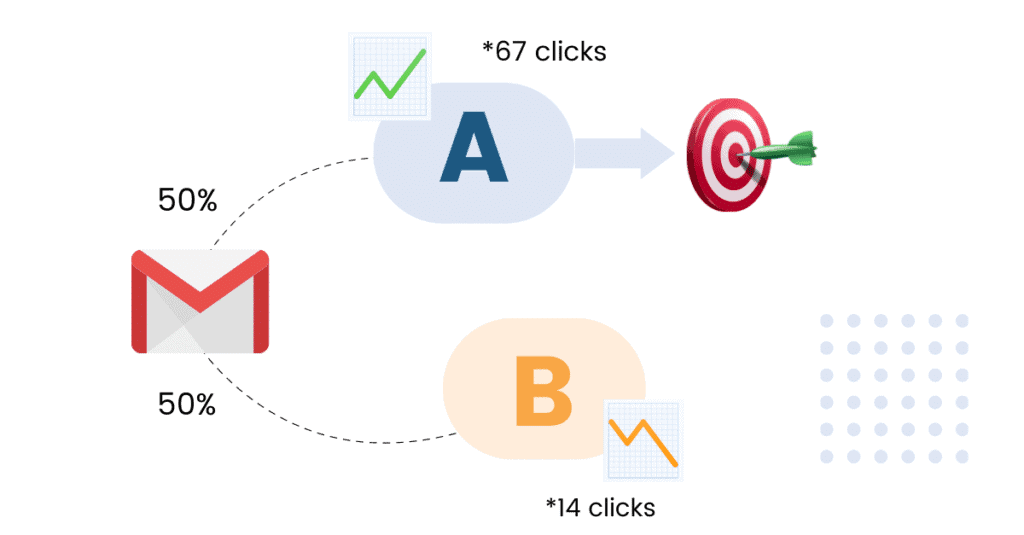
Sometimes the two might seem to be almost the same thing, but in reality they are very different. Conversion optimisation focuses especially on researching a potential customer’s purchase path and therefore improving a site’s conversion rate, with the hope of increasing leads and sales in the long run. By examining each step of the buying path individually, you can make interesting findings or potentially spot problem areas that might be a barrier to a potential buyer. For example, A/B testing is one way to run different tests in conversion optimisation, but it’s important to note that it’s not the only way to optimise your website and improve your conversion rate.
If improving your conversion rate is what you’re looking for, we’ve got you. Here’s a look at how to get started with conversion optimisation.
However, let’s take a look at how to perform A / B tests in four easy steps.
Before you begin A / B testing, it’s important to determine what you want to find out from the tests. Whether it’s testing copy for email marketing, websites, or trying out different campaign pages, you will still need to be able to quantify the results. Measurable goals could be, for example, the number of clicks, leads, or orders received. You will also need to set a reasonable timeline for the test, linked to your goal. Let’s say for example, you wanted to gain data from 10,000 web visitors, and you get 1000 visitors a day, you would need to run the test for 10 days.
If you’re just getting started with A/B testing, a good place to start is to focus on critical points on your website, such as your main conversion points, or using analytics to study your site’s bounce rate. You can then take steps to try to reduce it, and see what works best using A/B testing. The lower the bounce rate on your pages, the more likely you are to increase the conversion rate of your pages when you do get a visitor to your site.
Before you start testing, it is important to make a hypothesis about the desired outcome. As the name implies, a hypothesis is just a “guess” about the outcome, and for that reason you need a test to verify it. Your hypothesis should detail what the variable will be, and this helps you to focus your research and allows you to plan next steps no matter what the outcome of the tests are.
To start A/B testing, you need to create two different versions of the same content, with the only change being the variable as defined in the hypothesis. The two versions will then be shown to two audiences of the same size. For example, you can use the visual website optimiser, Optimizely, or Google Optimize tool to perform this testing.
In order to be able to reliably analyse the results of your test, it is important that the test has been visible to the target groups long enough and that the reach is large enough to provide valid data. You will then be able to compare the results with the set hypothesis and see if the hypothesis you set was correct. When analysing the results, it is especially important to pay attention to the goals you set and the measurable characteristics that support them.
Performing the analysis is a critical part of A/B testing. By looking at two different variations, you can make discoveries about exactly what kind of things or content are more likely to actually make someone who’s engaging with your content convert.
Even if you are very happy with the test results, don’t stop there! You might feel that you’ve achieved what you wanted, but it’s important to continue optimising your content to continue improving your results. A/B testing is a continuous learning process, and performing only one test may not achieve the desired results.
For example, you can always create a new “challenger” for the winner of your first test and see if it would be possible to achieve even better results. Or you could also continue to form entirely new hypotheses and focus on slightly different perspectives or audiences to improve your goals.
A/B testing is a key part of optimising your content for conversion, but it’s not the only way to do it. It can be a really helpful way to gain insight into your audiences and to understand their behaviour and intentions.
Do you actually know what your customer journey looks like for the average person visiting your site? Do you have visibility over who they are, when they visit, and how often, as well as which content and CTAs increase your conversion rate with these customers – or which ones don’t?
Perhaps this isn’t something you’ve ever thought you should, or could, measure. But oversight of these data points are becoming ever more important in a world where customers expect instant response, personalisation, and quick access to information.
If you’re among the many marketers or small business owners who either didn’t know this was a possibility, or possibly didn’t see the value in it, keep reading. We’re going to show you in this article why a solid analytics offering is an important consideration for all businesses to help provide you with a holistic view of your customers’ journey and their activity on your site.
The customer journey isn’t linear. Customers in our world have access to tons of information, as well as access to international markets, meaning that in most scenarios, they have a reasonable amount of choice when they make a decision. The average person is exposed to 5000 adverts and messages a day – messages that can influence their buying behaviour, and another reason why it is really important for you to understand what each customers’ journey looks like.
A typical customer for even a B2C product, something from Amazon for example, usually has several touchpoints and might not purchase on the first visit to the site. They might have had intention, sure – but they might have spent that visit reading reviews, or checking out similar products across the site. And this is where the problem lies.
After all, we are humans, and we don’t ever tend to take the simplest path in life, and our purchasing decisions are varied and subject to change in their nature at short notice. The end point described above – the actual purchase – is what’s known as a hard conversion. A hard conversion is one in which a customer has taken a desired action. You can see your conversion rate for free via Google Analytics, or through many of the paid platforms such as SEMRush.
This is okay, if you’re only interested in the people converting at the end. Perhaps you’re a salesperson and are only interested in the hottest of hot leads. But, those other visitors, hiding in the shadows silently collecting information – they’re potential leads too. Maybe they downloaded a guide, or subscribed to your newsletter. Whatever it might be, those smaller interactions are known as soft conversions. Soft conversions are smaller actions that customers take that give us a good idea of their intent.
This needs a whole section of its own because soft conversions are so important. They map out your customers’ intentions and let you build a picture of what they’re looking for based on the interactions they’ve had with your site. Any analytics worth its salt needs to provide information on these because these are what gives you the best picture of your customers’ buying habits and purchasing intentions. Soft conversions provide us with the opportunity to understand, and be able to nurture, our prospects and encourage them towards making that final purchasing decision.
Soft conversions also mean we get a better overview of this zig-zag journey that most customers end up taking. We can see where in the funnel they are based on what they engage and interact with, and we can arm our sales teams with the information accordingly. A salesperson armed with knowledge is a formidable force indeed.
For example, if a salesperson can see that one particular visitor has read a few blogs on conversions, and then downloaded a guide to conversions – they can gather that this person is probably trying to learn about conversions and perhaps has a pain point linked to this. It’s an avenue for a conversation and the beginning of a discussion and nurturing process that can lead that unsure visitor to becoming a confident customer.
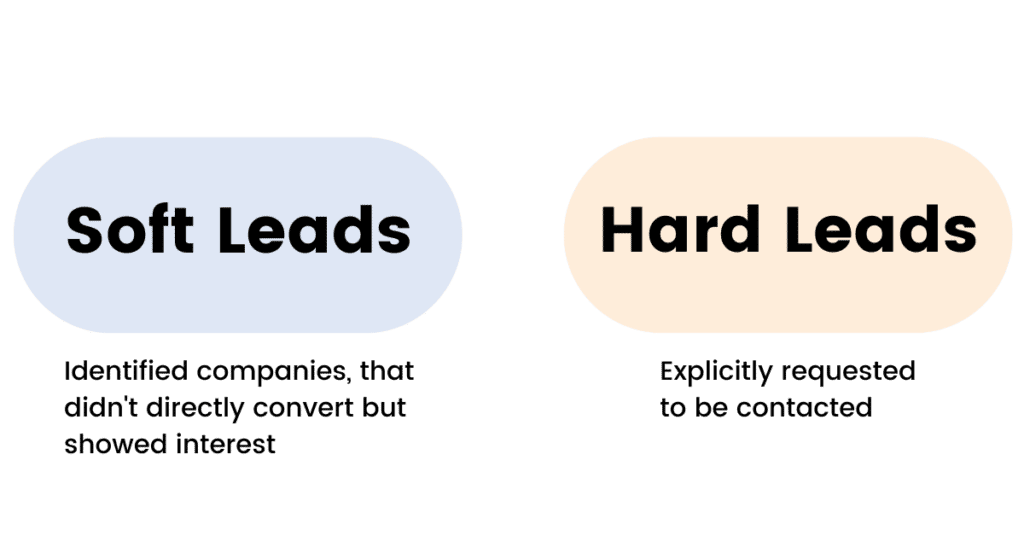
If you add bot solutions to the mix – tailored to the content of each page and the needs of each visitor – then you can qualify each visitor even further, allowing marketers to qualify leads based on intent and position in the funnel, so sales teams can approach at the right time, every time.
You can check out our article on Tools for measuring and increasing conversions for an overview of the features you have at your disposal to ensure this happens.
Also, if you use Google Analytics and are interested in visitor attribution – i.e. where the visitor originated in order to end up on your site – then you’re not going to get the most accurate information by looking at Google Analytics alone. GA only measures the final visit of a customer, the visit on which they converted, when looking at attribution. So, if that customer actually came through Facebook adverts, and then visited the site a few times before their final visit, you won’t see that. You can only see the final time, where they might have gone straight to the URL or visited via a quick Google search.
There are ways around this, if you’re incredibly intimate with the way attribution modelling works and have the time to play around with Google Analytics. We’ll bet most of you don’t, though, and this is where Leadoo’s Conversion Insights (and the expertise of our Conversion Experts) takes centre stage.
Hold my beer 🍺
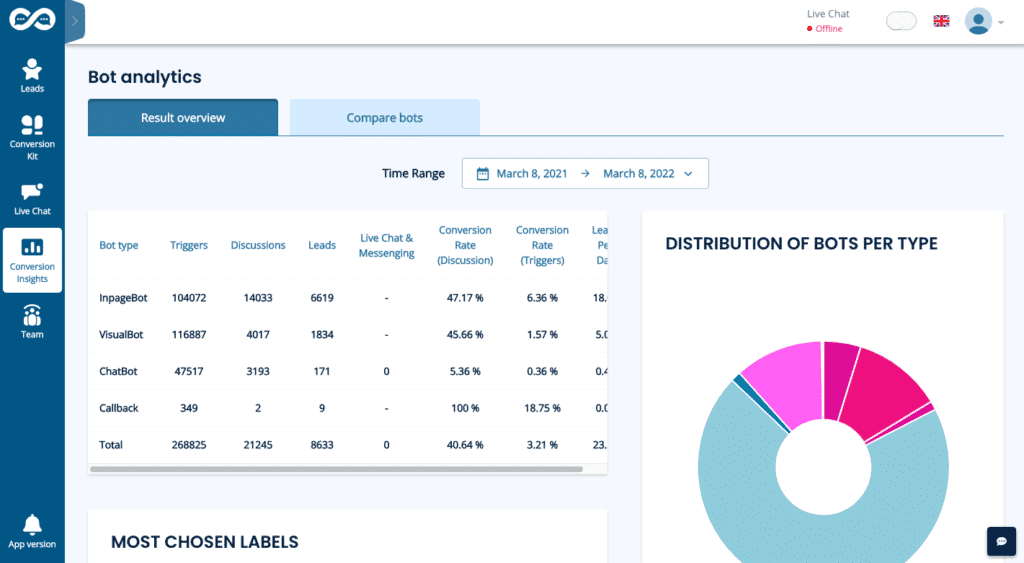
Leadoo’s Conversion Insights is the one-stop dashboard for all things conversion-related. Your personalised dashboard allows you to see:
✅ How your website is performing from the conversion point of view
✅ Best converting pages on your website
✅ Which sources bring the best results. Easily compare different traffic channels to see which channels perform the best.
✅ What the buyer’s journey looks like.
✅ How many days on average does a typical customer journey last – the touch points it consists of, and interactions it requires.
✅ Attribution modelling of your website conversions so you know which traffic channels affect successful conversions throughout the buying journey and not only the last click
✅ Understand which channels are the most efficient in attracting new visitors, which ones are great for getting the visitors back, and which channels empower the final visit that leads to a conversion
✅ Specific types of conversions using filters, and analyse conversion insights and journeys using comprehensive data
With Conversion Insights you get a 360° picture of all your online marketing efforts and how each action is affecting your conversions so you can make proactive decisions in order to optimise your site and increase your conversions.
Conversion Insights solves the issue for marketers who are trying to steer their ship blind in the night in the darkest depths of winter – instead it shines a bright light on a huge range of data points and analysis for you to leverage. Additionally, it helps to organise your leads into an easy-to-use and interpret dashboard, making it easier for everybody within your organisation to understand what is happening with each.
Consider that Leadoo isn’t only for marketing – we help your sales teams hit their targets, and provide customer support functionality inside the platform. It’s an all-in-one solution for conversions, lead generation and lead handling, with an added sprinkle of excellent data and insights.
Who wouldn’t want a taste?
Conversion is the hottest topic on the lips of marketers at the moment – and for good reason. Understanding your customers, their behaviour, their needs and wants, and providing opportunities for them to engage with your site all increases the chances that they will convert. Marketers now can often be found carefully monitoring the hard conversion rate on their site, eager to feed their sales teams with the best quality leads.
Before we start looking at the tools you can use to measure and increase conversions, we should probably cover some of the conversion basics. Nothing like everyone being on the same page before something is explained!
A conversion is any desired action a visitor takes on your website. What this looks like is largely dependent on your business and its objectives, but typically this can be split into hard and soft conversions.
Hard conversions are the final click of the button when a customer requests a demo, or checks out their basket in a B2C situation. These are super important to businesses as these are the actions that directly contribute to the bottom line via revenue.
But soft conversions can be just as important – these are smaller actions customers take on your site, such as downloading content or subscribing to a newsletter. Whilst these actions don’t link immediately to revenue, they do give us an excellent idea on customer intent (and therefore potential revenue in the future). Soft conversions provide us with the opportunity to understand, and be able to nurture, our prospects and encourage them towards making that final purchasing decision.
All the above can be measured using a simple calculation known as your conversion rate. Your conversion rate tells you what percentage of visitors are converting into leads on your website. It’s calculated using the following formula:

If maths and percentages aren’t your strong point, you can use our free Conversion Rate Calculator to work your conversion rate out.
Conversion rate optimisation means taking action to improve your conversion rate on your site.
There are many things you can do to optimise for conversion – adding engaging conversational elements (such as bots) instead of contact forms is a simple one that provides quick results and one which our teams will often look at as a first port of call when working with a new client.
Leadoo’s Conversion Experts have the knowledge and experience of working with over 900 clients to achieve their conversion goals, and as part of all our packages we offer bespoke conversion optimisation sessions to our clients to ensure your solutions are always performing the best they can.
For us to even have some level of awareness of what conversions are, we must have got that metric from somewhere to begin with. To actually obtain the number, you can either calculate it yourself using the above calculation, plug it into our calculator above, or check your Google Analytics – Analytics provides you with the overall conversion rate of your website based on the information it has.
Of course, there are a host of competitor platforms that you can have a look at when thinking about conversions and optimising your site. We’re not the only conversion platform available, and it’s only fair to give an honourable mention to those we share the space with. So we created some handy downloadable guides to help you choose. Check out our Conversion Tools comparison (where we compare Leadoo against Outgrow and ConvertFlow), or our Leadoo v Hubspot comparison for an overview of how these platforms hold up against one another.
A caveat, or perhaps a TL;DR, the other conversion platforms have limited analytics capabilities and don’t provide the depth of analytics that Leadoo does. We’ll go right ahead and explain what we mean by that…
Leadoo Conversion Insights provides an in-depth dashboard with different sections to allow you to understand how visitors behave on your site, to identify who they are, and to see how your current conversion solutions are performing so that you can continuously optimise.
Only 2% of your visitors convert, on average. That’s taking into account only hard conversions. There are plenty of prospects who visit your site who aren’t necessarily ready to purchase – but it’s likely they will be at some point in the near future. Armed with the right information, you can nurture them along the path to hard conversion, and it’s helpful to start with knowing who each visitor is so you can see their individual behaviour when they’re on your site. Leadoo identifies both companies and individuals, and provides information such as company headcount, revenue, industry, and more.
It’s also handy to be able to see when competitors are on your site – what they’re looking at and how often they check.
Not only does the Leadoo platform show you exactly who is visiting, but it shows you what they’re doing whilst they’re on your site. You can see which pages they visit, for how long, and which elements of your site they interacted with. If they interact with Leadoo’s bot solutions, this conversation is also available in each visitor’s profile, so you can get a comprehensive overview of their needs and see how they have qualified so far. Your sales team can then be proactive in approaching prospects based on the information gained about their behaviour, along with any interactions with bots on the site.
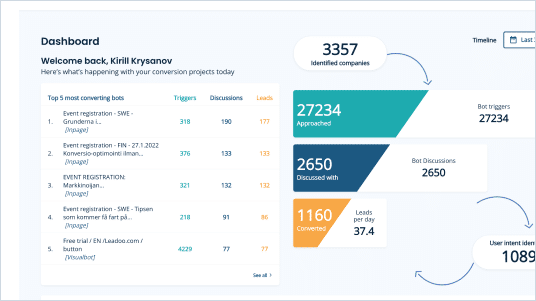
All the most important metrics related to conversions on your website in one handy, user-friendly dashboard. You can see your bot headline statistics, including the number of triggers, discussions and conversions, and Live Chat statistics, along with your visitor identification and tracking dashboards.
A stand-out feature within the conversion space, conversation-level analytics allow you to analyse the performance of each bot and its discussion pathways down to each response. Use our heat-mapping tool to see, at a glance, where prospects drop off or exit each conversation, and see which responses gather the most clicks, so you can make changes to the whole pathway to suit the needs of your customers. Of course, our Conversion Experts are always on hand to advise and help out, and within your optimisation sessions they will advise on the things you (and they) can do to improve your results going forward.
You can make do with monitoring conversions from already-available sources such as Google Analytics, but these only give you the metric and no further insight. You don’t get related metrics either, nor the ability to see conversation-level analytics on the buyer’s journey. Without these things, it’s really difficult to optimise a site for conversion.
There are also other platforms available that provide some of the ability to measure and impact conversions, but again, without the full spectrum of tools at your disposal, your ability to focus on increasing conversions is limited.
We’re not short on surveys to choose from which state that people don’t like chatbots or that they actively try to avoid them if possible, and prefer humans. Yet we acknowledge that chatbots and automation will become more and more popular because of their clear benefits – chatbots are infinitely quicker at finding a resolution than a human, they can be available 24/7 and don’t require rest breaks or holidays, and the ability to automate the lesser tasks which take up the lion’s share of the time. You can focus your human resources on tasks which require humans, meaning your workforce becomes more efficient at helping customers and dealing with issues.
We conducted an analysis on data from our platform – Leadoo Conversion platform – taking into account 162 bots, totalling 444,015 conversations. These bots were selected as they offer both live chat and a chatbot next to each other, with the customer able to make a selection, in a system known as a hybrid chat.
A hybrid chat is a chat where livechat and a chatbot are offered side by side at the beginning of the conversation. This allows the customer to select the option most suitable for their needs, and also helps to qualify what the customer needs. It determines how the next part, whether with a bot or human, continues on.
An excellent example of how hybrid chats can be used would be to take a look at one of our own clients. Tops Day Nurseries is a large early years education company with nurseries all over the South of England. Tops wanted to be able to provide prospective parents a way to contact them quickly and directly, if required, through live chat. But they also wanted to provide a way for customers to self-manage using the chat bot if they were simply looking for information, for example, and therefore perhaps not ready to discuss with a representative from the nursery just yet.
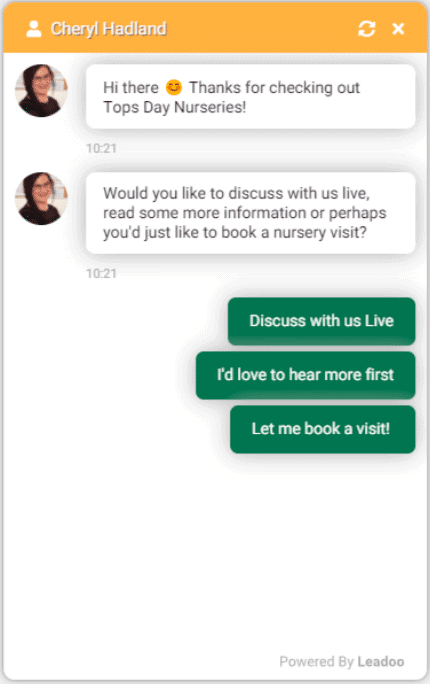
This is where their bot steps in – the chatbot can provide a range of information, such as pricing and company information, whilst still continuing to offer the option for the prospect to speak with a representative should they have all the information they need to begin the sales process.
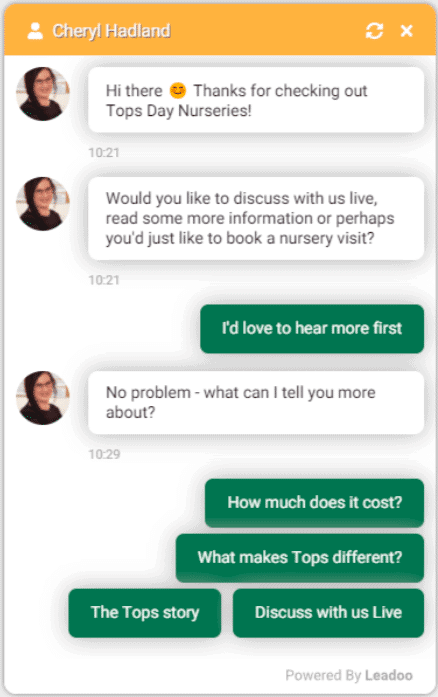
Our analysis shows that when live chat and a chatbot are offered side by side, 33% chose live chat – but a whopping 67% chose the chatbot.
“We were really surprised by the results as public sentiment is quite negative towards chatbots and automation as a whole. This once again shows that asking for opinions with surveys isn’t the whole truth; you also need to get behavioural data to see how people really act,” co-founder and CMO Santtu Kottila explains.
According to the company, there was also no statistical difference when they analysed the same numbers – whether the companies were in product or service businesses, B2C or B2B businesses, or in different industries:
“It’s really quite interesting that the numbers are so similar, even when comparing across industries and business types. The data set has companies from really traditional industries such as manufacturing and on the other side, companies from new and emerging businesses like SaaS and tech, and yet there’s still no difference,” Kottila continues.
Chatbots and automation tools are supposed to make life easier for people. Chats and chatbots are no exception. People value speed, as we tend to spend only a couple of minutes on any given website.
“This data underlines the importance of speed. People work at a faster pace now, and are not afraid of using chatbots to get things done when given the opportunity to choose.”
Hybrid chats and chatbots will remove manual tasks from humans but it will not make people redundant. Not, at least, according to Kottila:
“I would say that it’s actually quite the opposite. Automation takes a lot of repetitive tasks away from humans who get easily bored of dealing with the same tasks day in and day out. That frees our time to focus on the more complex issues that bots can’t handle.”
The main things we found from our research were:
👉 When live chat and a chatbot are offered side by side 33% choose live chat and 67% choose a chatbot
👉 The analysis doesn’t show any statistical differences when considering the results between product vs. services businesses, B2C vs. B2B businesses or when comparing industries
Customers value efficiency over everything. They don’t want to spend hours interacting with your site attempting to find what they need, no matter how pretty your graphics are or how mobile-friendly it is.
The General Data Protection Regulation (GDPR) has been around for more than two years now, and it would not be an overstatement to say that it has shaken up the whole marketing industry. In this post, we will address the use of various tracking technologies in a GDPR-compliant manner – to offer interest-based advertising and stay accountable at the same time.
Although cookies are the most known technologies, websites also use other means to support functionality and track users, such as HTML5 local storage, Local Shared Objects, fingerprinting techniques, etc. However, we will use cookies as an umbrella term in this discussion, keeping in mind that it also covers other technologies.
It is also worth noting that we discuss here compliance with the EU privacy rules on cookies, which will not necessarily apply in the same way to the California Consumer Privacy Act (CCPA) and the Lei Geral de Proteção de Dados (LGPD). Using web analytics in the US, for example, is more relaxed and does not require prior consent. You should understand well which laws govern your activities.
Before moving to a question of lawfulness, it is crucial to differentiate cookies by categories based on the purposes they serve.
Leadoo and any other web analytics service provider uses cookies to recognize users’ behavior and deliver their services. However, each website owner’s responsibility as a data controller is to ask and collect visitors’ consent before starting tracking. It is essential to ask for permission, and whether all cookies require approval, we will discuss below.
It may come by surprise, but the GDPR is not the only and, more importantly, not the first law to consider before using cookies. The GDPR sets forth the fundamentals of personal data protection: principles of processing, data subject’s rights, controller and processor’s duties, etc. In contrast, the ePrivacy Directive (aka a Cookie Law) guarantees respect for private life and protects personal data in electronic communications in particular.
In practice, it means that the ePrivacy Directive prevails over the GDPR in situations where electronic communications are involved. However, unlike the GDPR, the ePrivacy Directive does not have a direct effect, i.e., each EU country has its national law implementing the Directive’s provisions. While it might lead to some deviations between different jurisdictions, the core rules will remain the same.
Under the ePrivacy Directive, there is a general requirement to ask for user’s consent before using any cookies. Importantly, it does not matter whether any personal information is processed or not for it to apply. It is because placing cookies on a user’s device is considered as interference with that user’s private space and thus requires prior permission.
Notably, it is the GDPR that defines consent. Accordingly, it must be any freely given, specific, informed and unambiguous indication of wishes by which a data subject, by a statement or by clear affirmative action, signifies agreement to the processing of personal data. This wording contains quite a lot of meaning to grasp, and it could be a subject for a separate blog post to explain what a GDPR-compliant consent entails.
Leadoo has prepared a detailed, up-to-date guideline on asking for cookie consent to help its customers comply. As a preview, consider that a widespread practice of assuming or implying user’s permission from a mere act of browsing a website is no longer legal in Europe.
From the categories mentioned above, only essential cookies fall under the ePrivacy Directive consent exception. The document refers to them as strictly necessary to provide an information society service explicitly requested by the subscriber or user. Noticeably, it is a very narrow exception. Most of the cookies that facilitate the use of a website, but are not strictly necessary and not explicitly requested, still need user consent. There is no mercy for analytical cookies, either.
The current situation is about to change soon as a new ePrivacy Regulation is coming to replace the Directive. Similarly to the GDPR, it will be directly and uniformly applicable in all EU countries. Among the offered novelties are two additional cookie consent exceptions of our interest:
Consequently, it is mandatory to ask for the visitors’ consent to use any cookies other than strictly necessary. If you would like to receive detailed guidelines on how to do it correctly, contact your customer success person at Leadoo or download our comprehensive guide below! ⤵️
Whenever you visit a website, what happens under the hood is that your web browser calls the website’s server and asks for the page. Much like caller ID on a phone, the website then knows where you’re calling from. On the internet, we don’t call with a phone number but instead with an IP address. The website (or server to be more exact) can look up the owner of the IP address either by using public registers or private IP address databases.
It’s quite a simple yet clever way of knowing where in the world your visitors come from. In addition, in the case of B2B sales, it means that you can see which business owns the IP address of the user, so you’ll be able to find out what companies have visited your site.
Because many have seen this as a lucrative opportunity there are more than enough different IP lookup services online, ranging from free ones to private professional databases, such as Clearbit, Albacross, Lead Forensics or Leadfeeder. The challenge however with these is that too often knowing that somebody from Coca Cola or BMW has visited your site isn’t as valuable as you’d first anticipated.
Leadoo changes the game. The Leadoo platform combines data from Clearbit’s huge register of IP to company names, industries, turnovers together with behavioral data on the website across sessions as well as demographic data gathered from bot discussions.
With Leadoo you’ll know that 14 people from Coca Cola have visited you in the past week, five of whom have viewed your pricing page, three have talked to your bot about using your product in manufacturing and one who has left their name and email address. This is hugely more valuable than just knowing the company’s firmographics (think Leadfeeder), just behavioral data (think Hubspot) or just knowing the person’s email address (think Drift bots).
Your B2B sales team will get prospects that they can filter and prioritize based on company industry, size and areas of interest, as well as immediately having the contact information for the right people.
Setting it up is really straight forward. You’ll set up the Leadoo tracking codes on your website, integrate them with your GDPR popup for compliance (just like for Google Analytics) and add bots to strategic places for helping understand customers’ needs. The really great thing is that we’ll do most of the heavy lifting for you. We want you to succeed so we help make that happen.
Then just wait for leads to pop up inside the Leadoo platform or directly into your CRM or marketing automation system – whichever way you like it. On average you’ll get 30-70% more identified leads with Leadoo but on top of that, you’ll know exactly which companies they’re coming from.
And finally, if that wasn’t enough to get you excited, you’ll be able to send your retargeting ads to groups of people in the industries and interests e.g. in Google Analytics automatically.
Sound good? Want to know more?
Sign up for a private demo from the bot below ;

