Conversational marketing is the process of brands communicating relevant, personalized and real-time messages to audiences. Or simply put, having actual conversations with their users.
Crucially though, companies no longer have to be in the same physical space as a customer to do conversational marketing. Thanks to modern tech like chatbots and personalised website experiences, every brand can now have 1-2-1 conversations with users at scale.
Conversational Marketing on Websites
It’s often said that websites are our digital storefronts.
Now, imagine a physical store that is beautifully laid out. Has all the products on display, has striking visual elements to lure you in, and has promotional offers splattered across the walls. But, when you enter this beautiful store, there is no one to help you or show you around.
No one to answer your questions. No one to help you pick the right product or service. No one to talk you through what happens after you buy. And no one to even help you complete your purchase. Would you buy anything?
This is the trap many modern websites fall into. Visually striking, lots of sales messages, but no relevant help or support for users. Support that might ultimately be the difference between the user continuing their buying journey on that website or not. In short; no personalization, no interactivity, no conversation.
Benefits of Conversational Marketing
In today’s digital world, where information is instantaneous, users expect quick answers and tailored solutions. This is true across all industries, from B2C to B2B. Gone are the days when customers were willing to sift through dense websites or wait for an email response.
Users want instant, contextual interactions – and they want them now. This trend is only likely to accelerate, since as a society we are becoming more used to relying on AI and pilot tools.
A website without conversational elements risks alienating potential customers, leading to poorer user experiences (UX), lost sales, and missed opportunities.
Let’s break down why conversational marketing matters:
Improved Conversion Rates: A guided experience helps users find the information or products they need, streamlining their journey toward making a purchase or taking the desired action. If users cannot find what they are looking for on websites quickly, many simply give up and bounce. Read how Conversational Marketing helped a glass supplier increase revenue per visitor by 62%.
Conversational marketing might sound complicated to do, particularly at scale, but it is surprisingly simple with the right technology.
To revisit our storefront analogy from earlier, think of what you would want from a customer assistant in a physical store. You would want them to greet potential customers, ask them if they need help finding anything, answer FAQs about your products, and help them through the buying process by providing trust signals.
There is no reason a website can’t do all of those things through conversational marketing. Here’s some examples of tools that can be employed to do so:
Chatbots: To act as a constant ‘customer assistant’ should the user decide they have a specific question to ask.
Inpage Tools: To spark conversations organically with users as they browse specific content.
Visual Interactive Experiences: To ‘gamify’ the process of browsing your site, and to create interactive memorable connections.
Smart Forms & Calendars: To allow users to have conversations with you at their own time and convenience.
Live Chat: To give your users the extra trust signal of talking to a real person associated with your business.
Conversational AI Marketing
Naturally, AI has supercharged the potential of conversational marketing. Since brands can now use generative and conversational AI to speak to users in real-time.
With tools like Leadoo AI, users can now ask any questions they want, and brands can shape how an LLM will respond to them instantly, and what onsite pathways it will direct them to.
Even better, because of the power of LLMs, tools like Leadoo AI can:
Conversational AI creates incredible possibilities for marketers, but also some potential pitfalls. After all, it is by definition ‘artificial’ intelligence, and marketers can never know exactly how AI will respond to each individual user.
That’s why if marketers are employing conversational AI, they must be clear on its guardrails and prompting. With Leadoo AI, this takes the form of Knowledge Bases, where customers control the exact content AI models are trained on, and respond with.
A knowledge base can be a single URL, an entire domain, or a catalog of files you upload. Our model is then trained on this content, and uses it to answer questions, with customers able to specify exactly what it can or cannot comment on. The length and tone of responses it should give. Or even if it should prioritize certain topics or links in its responses.
With these kind of guardrails in place, marketers are in a position they never have been before. Where AI can power real-time conversational marketing in ways we could only have dreamt of a few years ago.
If they get it right, this can lead to enhanced UX; improved Conversion Rates; true real-time Personalization; and efficiency in both Sales & Customer Support.
When it comes to converting traffic into leads, there’s not a lot our Customer Success team doesn’t know. So, I grabbed two of our finest players for a chat about all things conversion. Say hello 👋🏽 to Helen Azoia, Onboarding Manager and bot builder extraordinaire, and Abbie Baisden, Customer Success Manager and in-house conversion pro.
My question for them was simple; what are your 5 top tips to help clients improve their conversion rate? They told me that it’s simpler than it sounds, and that the best thing to do is go back to basics – these things, they tell me, are super important and easy to do, but are commonly forgotten or missed.
Call To Actions
Helen – The first tip I’d give is that you need to check your Call To Actions (or CTAs). It seems obvious but we see it surprisingly commonly amongst clients that sometimes when we start looking through their pages to see what we can optimise, they don’t have any CTAs at all! This seems to be true especially on sub-pages and blogs, which means that you’re missing an opportunity at every point of contact that the potential customer has with your site.
Bots can be a really handy tool to use here. Lots of buttons on one page can sometimes be overkill, so we make use of our bots to reduce the number of buttons. We like subtle, subtle is good.
Abbie – To add to that, I definitely think trying out different CTAs is important, even if they’re on the same page, to attract different levels of interest. Not all of the people that visit your page are ready to buy, but they may chat to a bot to get more information on your product or download some resources from you. All of them count as leads, and you can follow up with appropriate contact to these potential customers based on the information you now know about them – who they are and what they’re interested in, all based on the interactions they have made with your page.
And here’s where our SmartProfiles swoop in to save the day. Our SmartProfiles allow our clients to see who has visited their site, what pages they have visited and how many occasions (including times and dates). You can also see which companies people are visiting from to allow you to gauge interest across different industries and markets, as well as the size of the company to allow you to ensure your traffic is coming from the right types of client (and therefore that your outbound marketing is doing its job).
Armed with this information, you can helpfully slide into their DMs with alllll the benefits of your product and how it could meet their needs exactly. Smooth.
There’s an example of our SmartProfiles right there 👇🏼 It’s our Marketing Operations Manager’s SmartProfile, no marketers or GDPR rules were harmed when filming this video.
Check your traffic
Abbie – Another thing it’s super important to do is to look at where your traffic is coming from, and ensuring it’s the right traffic in the first place. Knowing where your visitors are coming from can give you helpful insights into the effectiveness of any campaigns you’re running. Knowing who those visitors are, and whether they’re the right kind of visitors for your business will mean you can see whether those campaigns are being targeted to the right people. It could also indicate that your messaging is off, and so is attracting the wrong type of client to your page.
Helen – I’d definitely agree. And the thing is, this isn’t always really obvious by looking at the traffic volume alone. Some of our clients get a decent amount of traffic but when we plug in our platform and check where it’s coming from, we realise quickly that they are from the wrong country, market or sector. It’s much more difficult to convert people who aren’t the target for your product than it is to ensure that your visitors are from the right target market. You can also use a whole host of free tools to check your Search Engine Optimisation (SEO) to make sure you’re at the top of the results in the searches relevant to your product or service. Also, any traffic you pay for through an agency, speak to them about who they are targeting and what key words they are using so you know you’re on the right track.
So, quantity is important, obviously, but the quality of those visitors is just as important. Those visitors are your potential leads, and we only like quality leads here.
Make it easy
Helen – One thing that I think is important is that you don’t make customers jump through hoops to get in touch with you. We have definitely seen it on some sites where it’s just plain hard work for the customer to actually get in touch with the business. Some websites just leave an email and hope people take the initiative to actually leave the site, open a browser, open their email, paste the address, and compose an email. Some have lengthy forms to fill out, which even the brawniest of us struggle to wade through, and this just puts people off. They won’t bother contacting you, especially if your competitor makes it easier than you do.
So, make it easy for your customers to contact you. Again, this is something we use our super handy bots for. We created some awesome fine-tuned bots for SpeedScreed Ltd., which allows potential customers to get in touch, and then the platform helpfully collates the data to make it quick and easy for you to get back to these customers who you now know are interested. We’ve got an example of the bot below… Pretty cool huh? 😎
Check out a video of SpeedScreed’s extra-helpful bot 👇🏼 This is what we mean when we say “just make it easy for your customers”.
Pay attention to the people who don’t stay
Abbie – Another tip for improving your conversion rate is actually to look at where people are bouncing (leaving your site). Bounce rate tells you they’re leaving but you need to know why they’re not converting. For example, it could be that again, you’re not targeting the right customers. Let’s say you aim for businesses which make between £1-5m a year in revenue, but all you’re getting in the door is small businesses with revenue that’s less than £500k, then it would hardly be a surprise when the bounce rate on your pricing page is over 95%.
We often see high bounce rates on pages where, for example, the header is pricing, but the page doesn’t contain any pricing information, only a form to capture information to provide a quote. Obviously, it’s kinda irritating when you’re looking for information and get led down the garden path only to meet a dead end. Customers click away because it immediately irritates them and they might associate that distaste with your brand… potentially forever.
Easy to navigate
Helen – Make your site easy to navigate. We have all been there – searching an unfamiliar page and you’re trying to navigate but everything is overlapping because it’s in mobile and the whole thing is just a hot mess? 99.9% of the time when that happens, we close the page and look elsewhere. This does overlap a bit with what I said before but I don’t think I can say it enough: make it easy for customers to find what you want them to find. A common one I’ve seen is where you have a Hamburger menu but no top tabs at all, and whilst it might look pretty, it does make it harder to find things.
Abbie – UX and functionality is as important as the design of the site too. I won’t name names but there are some pretty big ecommerce companies out there whose websites are horrendous to use. I’m sure you can think of a few. One particular very large global online retailer’s website on desktop is so ugly and difficult to read and has too many tabs. I’ll bet most of their users probably don’t even use most of the functionalities on there because they’re too hard to find.
The way your site looks can make a huge difference to the amount and level of interaction your customers have with your site and this in turn affects the number of conversions you’re getting. Try different things out to see what works. And no, football pitch green is probably not a shout for the block colour on your main page.
Key takeaway
I think the message from our experts is pretty clear; keep it simple, make it easy for customers to find things and be as proactive as you can with the information you have about the people visiting your site. You can read more handy tips in our Complete Guide to Conversion, where we explain all the numbers and what it means for you. It’s a doozy, so sit down with a cuppa and get ready to become an expert. You got this.
In the digital space, information is often given. That’s it. You look for information, it is given to you and if you have more questions you need to either conduct another search, spend time finding the answer, and just maybe you get what you were looking for.
It’s one-sided and conversions feel forced.
If you want to leave a question, there’s often a form which is asking your basic details and then there’s a glory hole of possibilities for misinterpretation. I mean the open field.
The thing is, at this point you’ve already spent quite some time finding what you’re looking for, and now you have to go to one more one-sided communication channel. Would it be easier for you if there was some kind of way to spark a conversation as soon as you land on a page?
Why do conversations work?
First of all, conversations are engaging and they feel personal. Conversations help to set the tone for the rest of the experience. Conversations are also a way to build trust between a company and a prospective customer. Let’s put it this way: would a discussion make you feel more trusting towards a company than filling a faceless form and hoping for an answer?
That’s what I thought.
Second: with a static form, there is always a high risk of form abandonment. With interactive solutions such as chatbots and other conversion tools, this can be dropped drastically when your website visitor doesn’t need to do all the work themselves. Chatbots help the customer and provide value all the time,
Third: conversations give you information that would otherwise go unnoticed or at least would be very hard to capture. By basic website analytics tools you’ll see where people come from and where do they drop off. These don’t tell you yet what they were frustrated with and why they didn’t convert. You get nothing but anonymous numbers.
Conversations and conversational analytics provide way more insight to your audience and with this, you can provide them with even better conversations and service.
Will a chatbot help me to start converting from conversations?
Yes… and no. Chatbots are one means to the end, but not a silver bullet. They can be as bad of a showstopper as any other poorly designed element on your website if indeed, designed poorly. The conversation needs to be top-notch and actually made to help the client. Service and conversation come first, conversions second.
Too often chatbots are either purely made from a template (and it shows) or they exist solely for the purpose of “having one” (and that shows, too). These chatbots usually don’t answer your questions, they just try to get your information to be added to the endless stream of so-called MQLs. Someone might call you and try to sell to you, even though you are not that far yet on your buyer journey.
It’s not a great customer experience if you don’t feel like you’re getting what you were looking for and thus it won’t bring great business results.
How to make your chatbots to stand out and yield results?
Here’s three top tips to keep in mind when using chatbots to take those conversations to conversions.
Make it contextual 🎯If there’s a chatbot on your front page, it meets a lot of people in different phases of their buyer’s journey. This needs to be accounted for in the way the bot offers its help. Make sure you address different needs and provide concrete steps to go forward.If there’s a bot on a product or service-related page, your website visitors will have a different set of questions there. One size does not fit all, nor can a very general bot actually serve your potential customers so well that you could convert them into business.
Here’s an example of a Integration bot that provides information and is not forcing the person to give out information first 👇🏼
2. Provide a variety of conversion points 📍
You can’t convert all the website visitors into paying customers instantly, so please, try to see what other conversion types could be valuable for your business. For example, short consultation call, signing up for an event or a newsletter or sending them an ebook are all really good conversion points.
None of those will turn into revenue within the first 24 hours but hang in there. You are attracting the people who were not ready to buy, but were interested enough to trust you with their contact information! And we all know, nowadays even valid contact information is a scarce commodity.
Below there’s an example of a bot that makes sure the conversation stays friendly and on brand while still providing information and opportunities for the person discussing with it.
3. Align with your brand 🎨
This should go without saying, but I’ll say it anyway. All the elements on your website should reflect your brand, your values, your promise to your customers. This means tonality, visual design, and service level – and all other brand aspects. And the bots, too.
Align the bots to match the rest of the experience. It makes a difference if the look and feel are polished, compared to the ones that look like “plug and play” -versions that look only like the chatbot provider, but not your brand. Always go with the solution providers who have the option to change the bot to look like your brand.
How to get your conversations to turn into conversions?
I will just toot our horn here (🎺). Leadoo’s conversion tools include everything you need to make sure your conversations keep turning to conversions.
You’ll get conversation analytics to show what kind of discussions your visitors are having with your bots. You’ll get different bot types to ensure the best type of engagement for your potential customers. You’ll get information on identified companies that visit your site, even when they don’t leave their contact details. This allows you to spark conversations with them proactively and show your service level.
And then there’s the Leadoo service you get. Our conversion specialists are always at your disposal and you’ll be assigned a Customer Success Manager of your own whose sole job is to make sure your Leadoo solutions keep converting at all times. You can check out for example our post about our onboarding process.
The important thing is to keep in mind that conversations lead to conversions. Let us help you maximize on those results! 💙
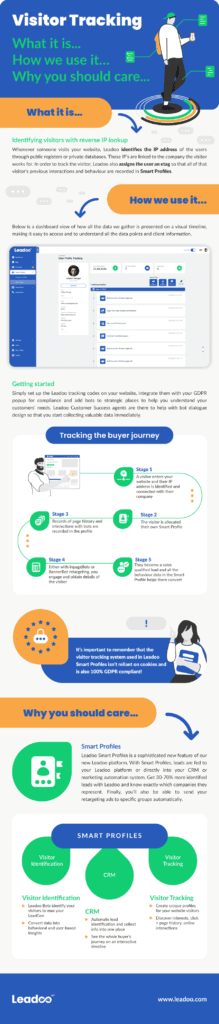
Leadoo AI Visitor Tracking Explained
Identifying Visitors With IP Address Tracking
Whenever someone visits your website, Leadoo AI identifies the IP address of the user through public registers or private databases.
Those IP’s are linked to the company the visitor works for. In order to track the visitor, Leadoo AI also assigns the user an etag so that all of that visitor’s previous interactions and behaviour are recorded in Smart Profiles.
How We Use It
Below is a dashboard view of how all the data we gather is presented on a visual timeline, making it easy to access and to understand all the data points and client information.
Tracking the Buyer Journey
Stage 1 – A visitor enters your website and their IP address is identified and connected with their company
Stage 2 – The visitor is allocated their own Smart Profile
Stage 3 – Records of page history and interactions with bots are recorded in the profile
Stage 4 – Either with InpageBots or BannerBot retargeting, you engage and obtain details of the visitor
Stage 5 – They become a sales qualified lead and all the behaviour data in the Smart Profile helps them convert
Leadoo Smart Profiles is a sophisticated feature of the Leadoo AI platform.
With Smart Profiles, leads are fed to your Leadoo platform or directly into your CRM or marketing automation system. Get 41% more identified leads on average with Leadoo AI, and know exactly which companies they represent. Finally, you’ll also be able to send your retargeting ads to specific groups automatically.
Or contact [email protected] for help with your Visitor Tracking insights. Our Customer Success agents are there to help with bot dialogue design, so that you start collecting valuable data immediately.
Whenever you visit a website, what happens under the hood is that your web browser calls the website’s server and asks for the page. Much like caller ID on a phone, the website then knows where you’re calling from. On the internet, we don’t call with a phone number but instead with an IP address. The website (or server to be more exact) can look up the owner of the IP address either by using public registers or private IP address databases.
It’s quite a simple yet clever way of knowing where in the world your visitors come from. In addition, in the case of B2B sales, it means that you can see which business owns the IP address of the user, so you’ll be able to find out what companies have visited your site.
Because many have seen this as a lucrative opportunity there are more than enough different IP lookup services online, ranging from free ones to private professional databases, such as Clearbit, Albacross, Lead Forensics or Leadfeeder. The challenge however with these is that too often knowing that somebody from Coca Cola or BMW has visited your site isn’t as valuable as you’d first anticipated.
How Leadoo gets the most from IP information
Leadoo changes the game. The Leadoo platform combines data from Clearbit’s huge register of IP to company names, industries, turnovers together with behavioral data on the website across sessions as well as demographic data gathered from bot discussions.
With Leadoo you’ll know that 14 people from Coca Cola have visited you in the past week, five of whom have viewed your pricing page, three have talked to your bot about using your product in manufacturing and one who has left their name and email address. This is hugely more valuable than just knowing the company’s firmographics (think Leadfeeder), just behavioral data (think Hubspot) or just knowing the person’s email address (think Drift bots).
Your B2B sales team will get prospects that they can filter and prioritize based on company industry, size and areas of interest, as well as immediately having the contact information for the right people.
How does this work?
Setting it up is really straight forward. You’ll set up the Leadoo tracking codes on your website, integrate them with your GDPR popup for compliance (just like for Google Analytics) and add bots to strategic places for helping understand customers’ needs. The really great thing is that we’ll do most of the heavy lifting for you. We want you to succeed so we help make that happen.
Then just wait for leads to pop up inside the Leadoo platform or directly into your CRM or marketing automation system – whichever way you like it. On average you’ll get 30-70% more identified leads with Leadoo but on top of that, you’ll know exactly which companies they’re coming from.
And finally, if that wasn’t enough to get you excited, you’ll be able to send your retargeting ads to groups of people in the industries and interests e.g. in Google Analytics automatically.
Sound good? Want to know more?
Sign up for a private demo from the bot below ;