Personalisation matters more than ever for B2C brands.
When visitors can quickly find products that match exactly what they’re looking for – within their budget, preferences, and intent – conversions become much easier.
That’s why we’re excited to introduce:
Leadoo AI Product Recommendations
A new add-on feature that connects your eCommerce store or product list directly to Leadoo’s conversational tools, helping you visually recommend products in real time.
Turn Conversations Into Personalised Shopping Experiences
Product Recommender allows your Leadoo bots to surface relevant products during conversations, exactly when buyer intent is highest.
Instead of sending users away to search manually, your conversational experiences can now recommend products instantly based on what the visitor is actually looking for.
Whether someone is:
Comparing product options
Searching within a budget
Looking for specific features
Checking availability and specs
Your bots can now visually guide them to the right products in that moment.
Connect Your Store to Leadoo AI
Once your eCommerce store is synced with Leadoo, Product Recommender can dynamically pull product information directly into conversations.
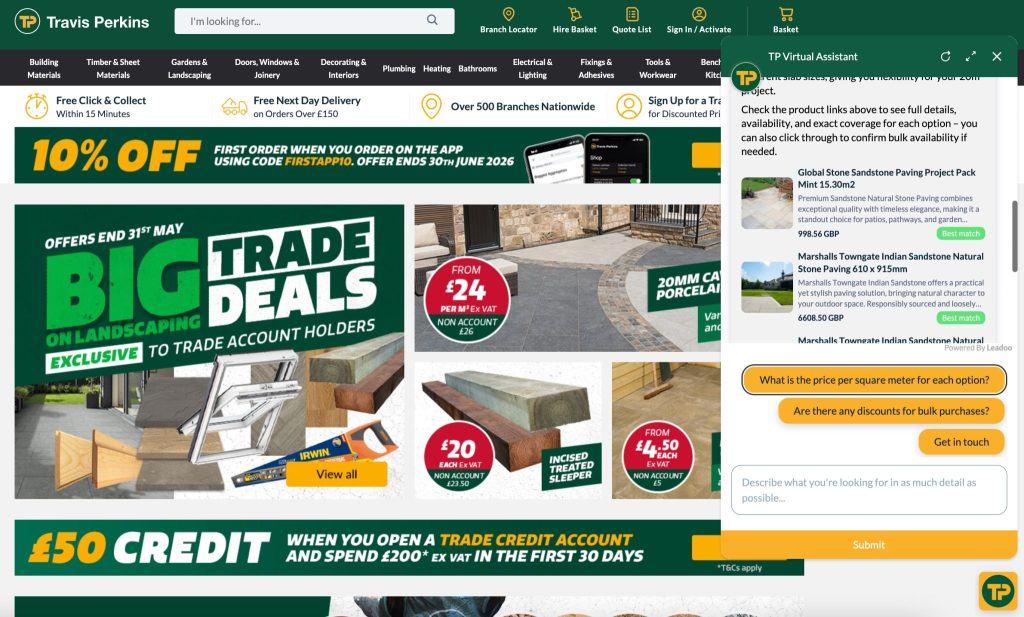
This allows your bots to visually display key information such as:
Product descriptions and URLs
Latest prices
Stock availability
Specifications and features
The result is a more interactive, useful, and conversion-focused buying journey. You can see it here it is in action on a major UK construction retailer’s website:
Why This Matters
🛍 More Relevant Customer Experiences
Help visitors discover products tailored to their specific needs instead of forcing them through generic browsing journeys.
⚡ Faster Paths to Purchase
Reduce friction by surfacing relevant products instantly inside the conversation. When you already have telling you their needs.
💬 Conversational Commerce That Actually Converts
Move beyond static chat experiences and create interactions that actively support buying decisions and link directly to conversion points.
📈 Better Use of Intent Data
Leverage the information users share during conversations to provide smarter recommendations in real time.
Built for High Intent Moments
The best recommendations happen when intent is strongest.
Product Recommender is designed to work inside Leadoo AI’s conversational experiences, where users are already engaging, asking questions, and exploring solutions.
That means recommendations feel timely, relevant, helpful and personalised. Not intrusive.
Flexible Pricing Based on Your Product Catalogue
Product Recommender is available as an add-on Leadoo feature.
Pricing is based on the number of products that can be looked up from your store, making it scalable for different eCommerce sizes and needs.
Get in touch to find out more about how to start using Product Recommender in your Leadoo account today.
In today’s competitive digital landscape, businesses need more than just a website to generate quality leads. They need engaging, interactive, and personalized experiences.
So if you’re looking to improve your lead generation strategy, you’re in the right place. Here we explore best practices for digital lead generation, as well as how you can boost lead generation specifically using Leadoo AI’s unique solutions.
Understanding Lead Generation: What It Means for Your Business
Lead generation is the process of attracting interest from, or providing value to, people. To the point where they are willing to give you their information.
Once you have their contact information, you have a lead! This process is crucial because it is the first step in turning a website visitor into a potential customer. If you can’t capture their information (first party data), you can’t register their interest, and can’t put them into your sales process.
Inbound vs Outbound Lead Generation
There are several methods for generating leads. These generally fall into two categories: Inbound or Outbound.
Inbound leads literally come in to you. This could for example be someone calling you up or walking into a store to ask questions. But most commonly in the digital age, it means leaving their information via your digital channels. Examples can include:
Signing up for a Webinar
Downloading a Whitepaper
Filling out a Contact Form
To drive these kind of actions on a website, marketers use inbound strategies like Content marketing, PPC advertising, and Social Media marketing to generate interest and drive visitors to their website. Hoping they take these desired Conversion actions. And then convert into Inbound leads.
Businesses also use Outbound strategies to generate leads though. Cold email or call outreach, direct mail, or physically approaching people (say at Events) all constitute Outbound lead generation strategies. Wherever a lead comes from, it should ideally be logged in a CRM system so that you can keep track of it, but also evaluate over time how quickly different types of leads develop – and what needs to go into that.
Whether you are generating Inbound or Outbound leads though, the challenge lies in generating quality leads — those who are more likely to ultimate convert into customers.
The Importance of Quality Leads
Not all leads are created equal. While traffic and quantity are important, focusing on quality leads – those who show genuine interest in your offering and are in a position to act on that – is what drives real business growth.
Leadoo’s approach is to enhance the user experience on your website through conversational marketing tools. This achieves two things. Firstly it raises conversion rates – so that more users convert into leads. But crucially it also allows you that pre-qualify leads more effectively and move them down the funnel faster.
As businesses grow and scale, making sure that sales teams aren’t wasting time on non-viable leads becomes increasingly important. Time is money. And the more money you need to make, the less time you have to spend on leads that don’t have a chance of becoming customers.
Leadoo AI’s Unique Approach to Lead Generation
Leadoo AI offers a suite of conversational tools, including chatbots, quizzes, and lead magnets that help businesses capture, qualify, and convert leads in a highly engaging way. Here’s how Leadoo sets itself apart from traditional lead generation methods:
Modern Lead Generation Methods:
Conversational Tech: Our tools interact with visitors 24/7, answering their questions, and guiding them to the next step, whether that’s downloading an ebook, booking a demo, or signing up for a newsletter. We can even use AI to provide unique and relevant responses to each visitor.
Personalized Engagement: Unlike generic lead capture forms, Leadoo’s tools adapt to the visitor’s attributes, past browsing behaviour, and responses. This ensures a personalized experience that can increase conversion rates.
Lead Qualification Automation: Leadoo’s tools do more than just capture leads. They qualify them based on predefined criteria, ensuring that your sales team focuses only on the most promising and relevant prospects.
Step-by-Step Guide to Using Leadoo for Lead Generation
Here’s a practical guide on how to use Leadoo’s tools to enhance your lead generation strategy:
Proven Benefits of Using Leadoo for Lead Generation
Companies using Leadoo AI’s solutions have reported remarkable improvements in their lead generation efforts. Here are some of the key benefits:
Higher Conversion Rates: Personalized interactions with conversational bots lead to higher engagement and conversion rates. For example, Ubbink drove 233% more leads after implementing Leadoo’s tools, demonstrating how engaging visitors with tailored content boosts conversions.
Improved Lead Quality: Automated lead qualification means your sales team spends more time with leads that are likely to convert. In the case of Exceptional Villas, their Leadoo integrations direct inquiries to the most relevant salespeople based on customer preferences, such as travel details and activities, allowing teams to focus on high-quality leads that are more likely to convert.
Reduced Bounce Rates: The personalized content and proactive engagement encourage users to stay longer on the site, interact with the content, and continue through the conversion funnel. For instance, conversational tech across multiple industries have been shown to increase conversion rates on average by 41%.
Ready to Transform Your Lead Generation Strategy?
If you’re ready to take your lead generation strategy to the next level, Leadoo AI is here to help. Our tools are designed to fit seamlessly into your existing marketing stack, providing a better user experience and delivering qualified leads that drive growth.
What is Account Based Marketing? And how does ABM work with Leadoo AI?
What is Account Based Marketing (ABM)?
Account-Based Marketing (ABM) is a focused business strategy where marketing and sales teams work together to target a specific set of high-value accounts.
This could be because they are geographically important accounts, leaders within their space, or because a company has had success with similar customers in the past. The defining factor of ABM though is specificity – targeting individual businesses based on specific criteria.
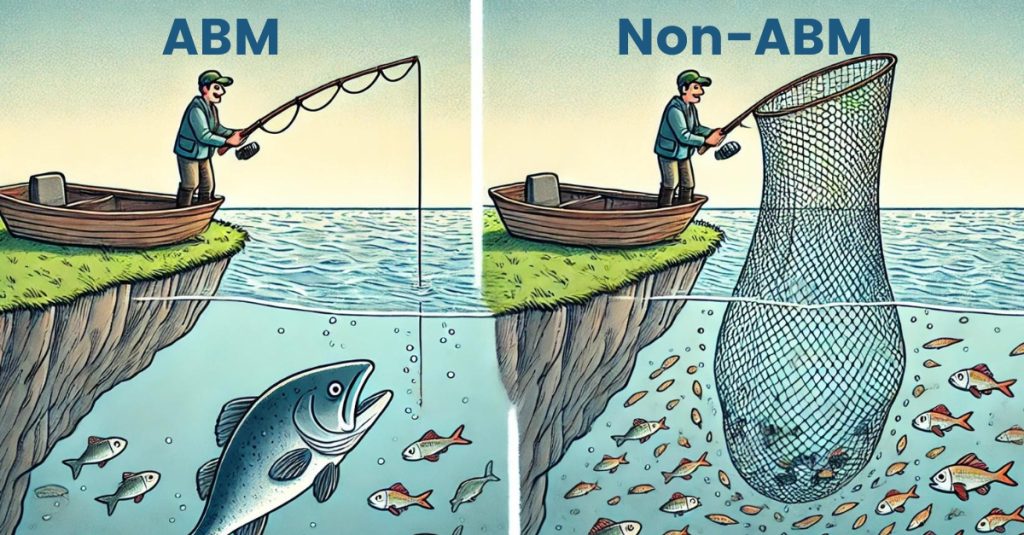
This is unlike traditional marketing, which casts a wide net. To continue that analogy, think of a marketer as a fisherman. Often they are simply casting out the biggest possible net to try and catch as many fish (accounts) as possible. ABM though is a fisherman knowing what waters have bigger fish, and using bait (messaging) specifically designed to reel them in.
Accordingly, ABM requires a more targeted approach, with personalised touchpoints.
What are the Key Benefits of ABM?
Desirable Customers: Whether it’s because of their size, geography, prestige or use case for your solution – you have ideal customers. In a world where personlisation is increasingly expected, ABM is the most efficient way to ensure you have a chance of bringing them on board. And more like them in future.
Increased ROI: By focusing resources on high-value accounts, companies can often achieve better returns than traditional marketing. For example, in a PPC context, it is undoubtedly cheaper and more effective to run re-marketing adverts to visitors who viewed a webpage about Software Recruitment, than it is to run adverts to an audience interested in either Software & Recruitment.
Alignment of Sales and Marketing: ABM fosters better communication and collaboration between sales and marketing teams. Because they are working towards a common and well-defined goal (list of accounts). It also requires distinct sales and marketing touchpoints to work well.
Streamlined Sales Cycle: ABM allows for highly tailored marketing strategies that resonate more effectively with target audiences. Not only does this reflect well on your brand, and start you on good footing with buyers, but ABM has been proven to shorten sales cycles.
How Does ABM Work?
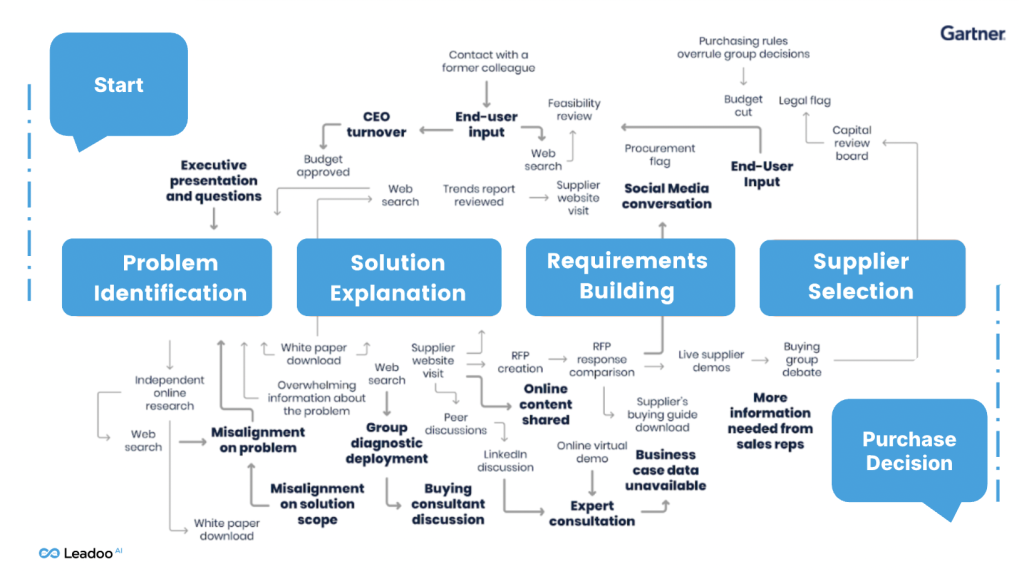
ABM begins by identifying key accounts. Generally this would be done by commercial teams through a CRM system. Then, sales and marketing teams ideally work together to create personalised messaging and content that address the specific needs and pain points of each account.
The ABM Process
Identify Target Accounts: Leverage data to not just identify high-value accounts that align with your business objectives, but understand their pain points and buying journeys.
Create Custom Touchpoints: Develop tailored content and messaging that speaks directly to those pain points and buying journeys. For instance, what a prospect is interested in the first time they visit your website, is very unlikely to be what they want to look at on their fourth visit.
Engage Across Multiple Channels: Use a mix of digital and offline channels to reach and engage decision-makers at these accounts. Your own website is especially important here. If you’ve done your job, they will be checking out your digital storefront repeatedly. It needs to speak to them and reflect your ABM strategy!
Measure and Optimize: Continuously monitor the performance of your ABM campaigns and adjust strategies as needed to maximise results. Behind your target accounts are human buyers, so they will all act and progress differently!
Leadoo AI’s Approach to ABM
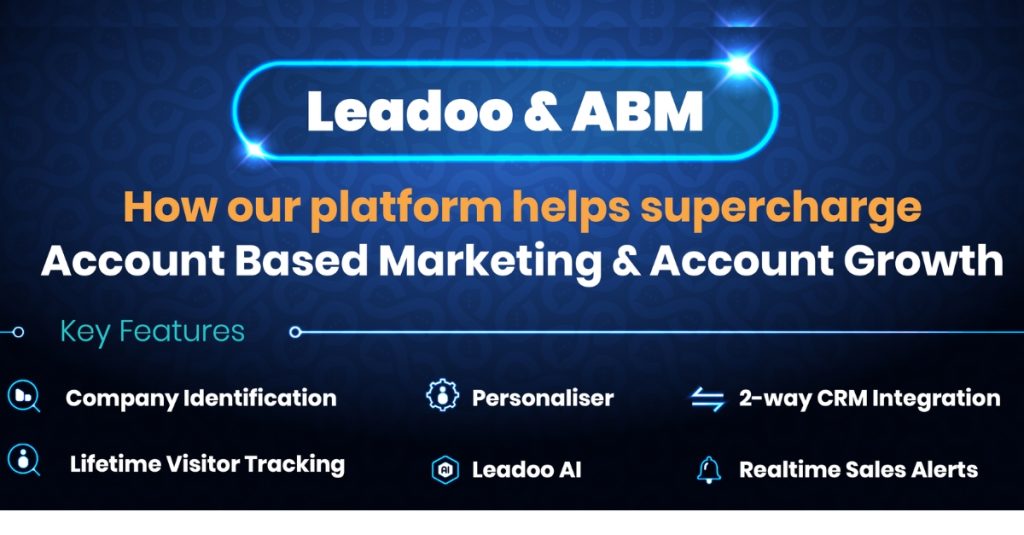
Leadoo AI is uniquely well positioned for ABM strategies, whether it is for New Business teams or Account Growth teams. That’s because the key principles of identifying visitors, activating them with bespoke messaging, and measuring their journeys, can all be done through our platform.
Leadoo ABM for Sales Teams
You have a CRM full of prospects, plus lists of target accounts. Here’s how you can utilise Leadoo to close those must-win logos:
See which of your marketing efforts result in website visits and completed CTAs
Create conversational pathways for specific customers, e.g. those coming from certain emails
Options for conversational bots within platforms and client portals – tailored to their needs
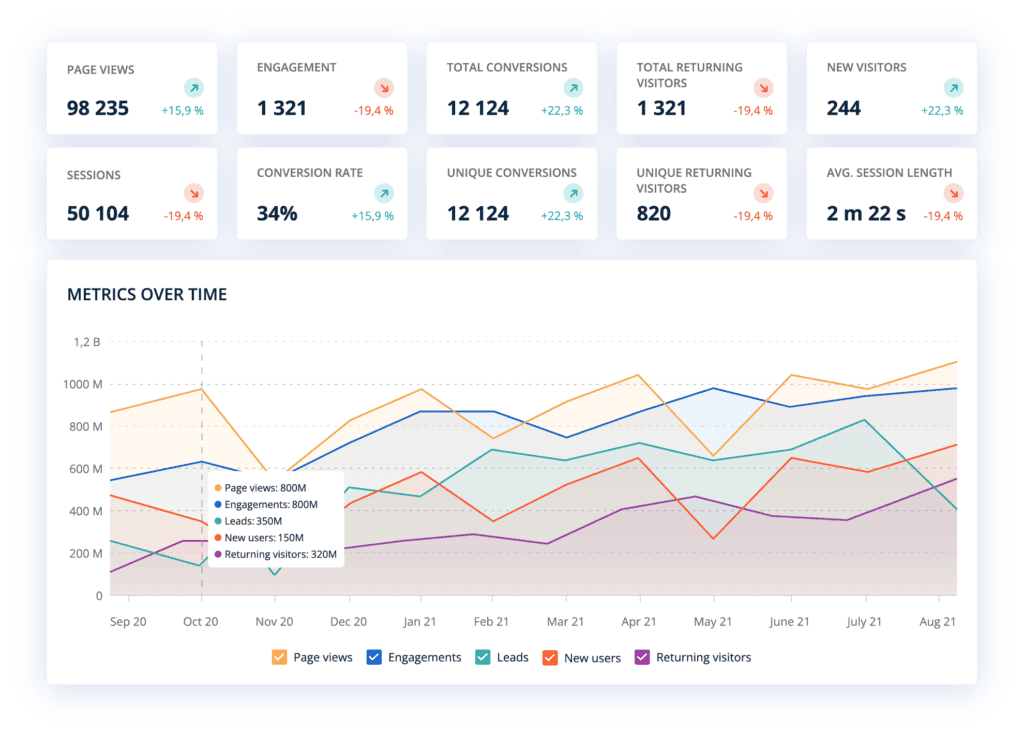
We are proud to release Leadoo Website Analytics as a part of the Leadoo Analytics family! With Website Analytics you will see all the website statistics from visitors, pages, sources, visit durations and more.
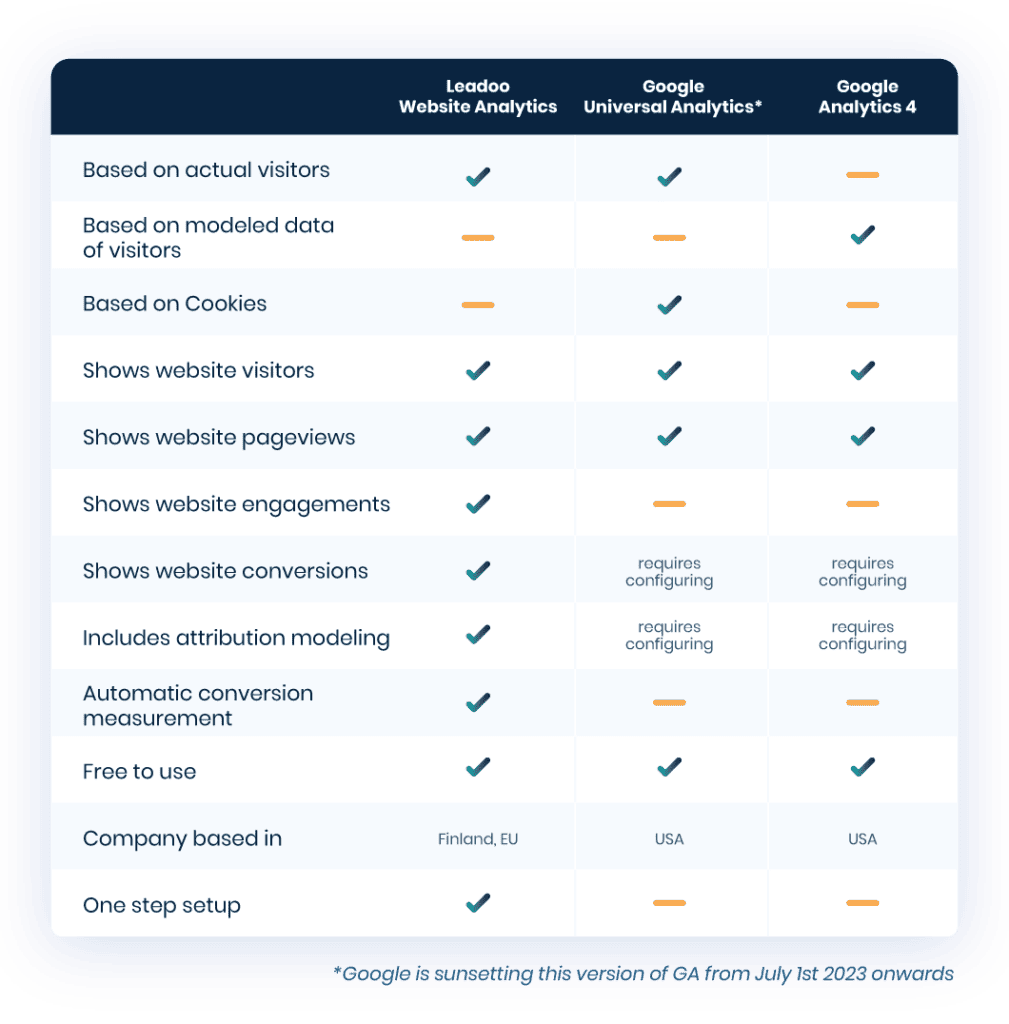
Now that Google’s Universal Analytics is being faded out in June 2023, many of our customers started looking for alternatives to GA4, with data stored in the EU/EEA instead of sending it to the US. And because Leadoo already has very extensive conversion data we decided to develop this new Website Analytics feature and include it for free to all our existing customers.
If you are not a Leadoo user you can sign-up for our waitlist now. You will be the first to know when we release this to a wider audience.
You can read the full feature list here or watch how our founder Mikael da Costa explains the ins and outs of Leadoo Website Analytics.
How to get started?
Leadoo Website Analytics is automatically added to all existing Leadoo subscriptions and it doesn’t cost anything. You can find it from the navigation by clicking “Conversion Insights”.
To view your Leadoo Website Analytics… 1. Log into your Leadoo account (free for all existing customers) 2. Make sure to copy the Leadoo dynamic script to your website header if you haven’t already done so 3. Dive into your website analytics!
…of course you can always contact your dedicated Customer Success person if you have any questions when setting up Leadoo Website Analytics! 🤩
How does Leadoo Website Analytics compare against other known website analytics tools? Check the comparison below.
Leadoo Insights now consist of:
Bot insights – see which bots convert what and where
Source insights – see which sources are responsible for your conversions, did FB perhaps bring in more job application conversions but LI more customers?
Website analytics – see analytics on sources, campaigns and pages and how they perform
“Do you have a price for your product?”
As Auction House Emperor puts it, I dare say that the price of a product or service almost always interests potential buyers. Although the final buying process can be slightly more complex for an individual, price is one of the factors influencing the purchasing decision.
Leadoo’s bots offer various solutions for websites, depending on the customer’s goals or website problem areas. They work for customer service, recruitment, and lead generation – you name it.
When building bots, it’s essential to recognize customer behavior patterns on websites and provide answers to frequently asked questions. Kristiina Suomalainen, a content creator at Leadoo Marketing Technologies, has noticed a trend related to website behavior:
“Questions about pricing have received a significant number of clicks from potential customers in the bots on websites. Often, price information is not readily available on the website, or it is difficult to find. That doesn’t really serve the customer.”
Clear pricing creates concreteness for the customer about what they are getting and at what price. It can even act as a competitive factor and help the customer compare different options more quickly. However, transparent and clear pricing is not always possible if the price is influenced by the sum of various factors. This is where Leadoo’s VisualBots or calculator functionality can provide a solution.
Price Calculator as the Most Enticing Element on Websites
Currently, price calculators have been created for Leadoo MT’s customers, for example, in the construction, renovation, and cleaning industries’ websites. It is clear, though, that a price calculator does not add the same value to all industries. Industries that can provide concrete examples of product or service prices work best with price calculators.
“Sometimes customers might be a bit hesitant to discuss prices, so you have to justify why a price calculator is a very effective element on websites for certain industries,” Kristiina explains.
Although the primary purpose of the price calculator is to offer the customer a price estimate for a product or service, it’s also excellent for lead generation:
“It works really well for lead generation, as the customer easily gets hooked on clicking options and often provides their contact information afterward.”
There are two different methods used to build price calculator bots. In the first method, a price estimate is given after the customer has provided their contact information. This allows for a more personal approach to the customer, either by phone or email, and the conversation can easily continue even after providing the price estimate.
In the second method, the bot offers the customer a price estimate directly after the conversation and then asks for contact information or suggests, for example, booking an appointment. This option allows for a quick price estimate, and the customer can decide immediately whether to continue with the buying process.
Kristiina from Leadoo MT is an experienced creator of price calculators and says that a good and enticing price calculator consists of simple questions, clarity, and the use of images. It’s best to avoid open text fields, as predefined options keep the process quick and easy. A price calculator can be made into a visual element that will undoubtedly not go unnoticed on the website.
Visual Price Calculator Clarifies Options
Price calculators can be created, for example, in the form of a VisualBot or InpageBot. Don’t worry if these terms are unfamiliar to you. The following bot shows what VisualBot-created price calculators have looked like on our customers’ websites.
Quick and Easy Conversation for Immediate Price Estimate
The next price calculator is built in the form of an InpageBot, which visually resembles a more conversational bot. However, InpageBots can also display illustrative images, as shown in the examples above.
In the example below, the calculator function is utilized, which shows the price estimate
Every contact request made through a website almost always requires communication and coordination to find a suitable meeting time for everyone’s calendar.
That’s why we created the calendar integration feature in Leadoo. This way, a lead coming from a website can conveniently book the most suitable time for themselves from a predefined calendar, keeping the sales process fast-paced throughout!
Use cases for Calendar Integration
Where can this feature be used?
Short answer: anywhere.
Since the answer above doesn’t explain much on its own, we’ve listed some excellent use cases for calendar integration below!
Sales Meetings Directly from Your Website
We all love quality inbound leads, but they’re even better when they appear directly in your calendar!
Using calendar integration allows a person requesting a quote or product demo from your website to book the most suitable time with your expert.
The bot can first ask qualifying questions, then offer the option to book a calendar appointment, and all the salesperson needs to do is be present at the scheduled time.
Customer Service
Everyone wants to serve their customers as personally and quickly as possible.
Leadoo’s tools enable your customers to have an interactive, conversational way to get in touch 24/7 and book meeting times according to predefined rules.
This way, customer service representatives can focus exceptionally well on each encounter and provide the best possible customer experience for each customer, as these frustrating “would this work for you” email chains can be completely eliminated.
Recruitment
Scheduling interview times with multiple candidates is laborious and time-consuming.
It might also be nice to offer potential job seekers the opportunity to take a 15-minute virtual coffee break with their future supervisor, but manually scheduling it? No, thank you.
That’s where calendar integration comes to save the day! You can easily connect the recruiting supervisor’s calendar to Leadoo’s bot and manage the entire application process through this bot.
If you want to learn more about how to use Leadoo in recruitment, check out this post!
Landing Page Conversion Point
Landing pages are a great opportunity to convert a visiting user – provided the landing page is well-designed.
Too often, the landing page is cold and only allows one type of conversion, such as sending a demo request. This way, much potential is wasted.
By adding Leadoo’s calendar integration solution to the landing page, you enable not only lead qualification but also convincing and converting visitors at different stages of their purchase journey into comfortable calendar meetings.
Practical Questions on Your Mind
Do I have to be a Leadoo user to use this feature?
Is there a free version to test?
What calendars can be integrated?
4 reasons why calendar integration is essential for you
Save Time
No more back-and-forth emails and numerous updating calendar invitations. Get meetings directly into your calendar without extra hassle.
Boost Sales Process
By giving prospects the opportunity to book a meeting directly from your calendar, you save time at a crucial point and make working with you as easy as possible.
Better Meeting Quality
When a prospect or existing customer can choose the best time for them, they are typically more committed to attending and are genuinely ready for the meeting. In addition, Leadoo’s solutions enable easy qualification and gathering additional information about the lead at the same time as the calendar booking, so you get a well-qualified and committed lead to your meeting.
Improve Customer Experience
Whether it’s a potential or existing customer, you want to provide them with the best possible experience. This starts by making their lives as easy as possible. Give them the opportunity to contact you when it suits them best and book the most suitable meeting time.
If you’re already a Leadoo customer you can create your own Leadoo Sales Assistant or add calendar bookings to your existing bots by following the videos below.
If you are currently using our livechat application and have noticed that the sound notifications are not working properly, we would like to clarify that this is not an issue with our application. Instead, it appears to be a browser-related problem.
To resolve this issue, we recommend following the instructions provided on thetroubleshooting sound issues in Chrome for Chromebook, Mac, Windows, and Ubuntu users. By following the steps outlined in the article, you can attempt to resolve the sound issue on your browser and ensure that you receive sound notifications for our livechat application.
Chrome
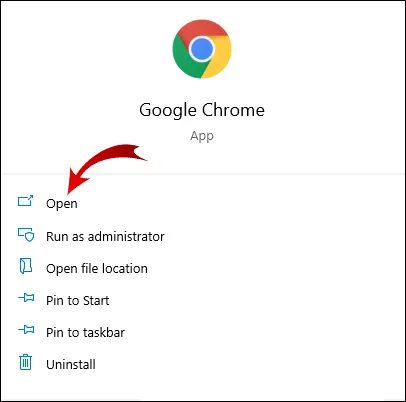
Launch Chrome.
Click on the three dots (or three horizontal lines) in the upper right-hand corner of the browser.
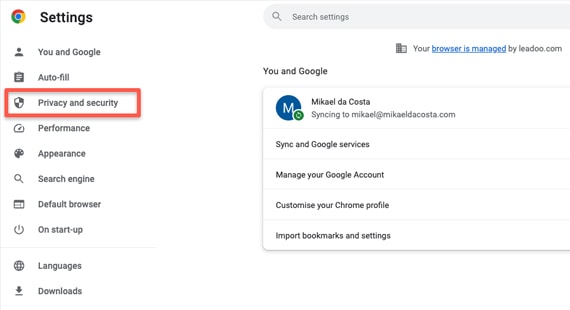
Go to the Settings page.
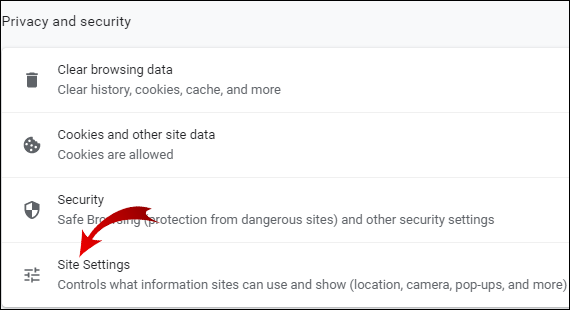
Now, under the Privacy and security tab, click on Site settings.
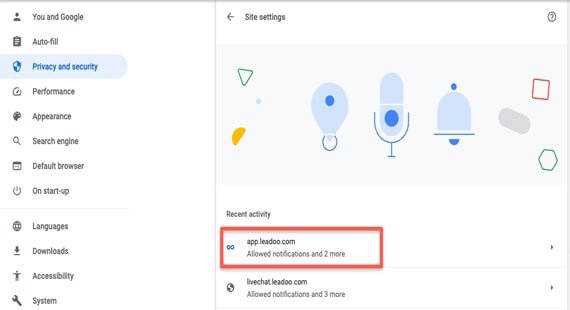
Find app.leadoo.com
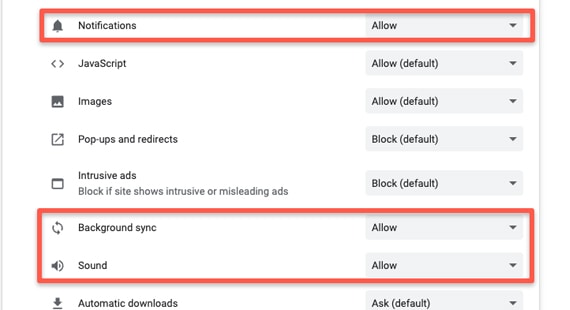
Find “Notifications”, “Sound” and “Background sync”. Then set all of them to “Allow”
Firefox
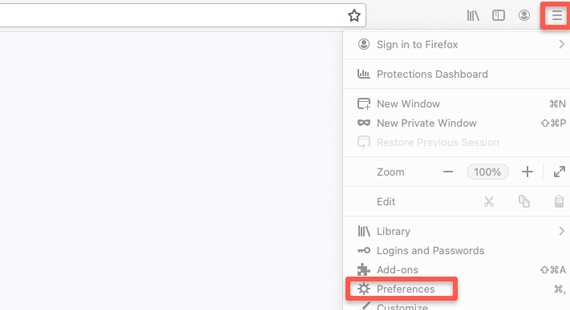
1. Open Firefox
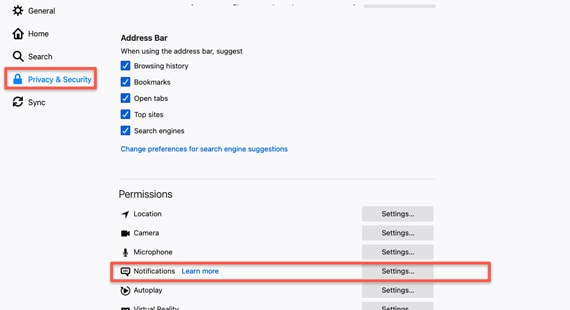
2. Select settings -> Privacy & Security
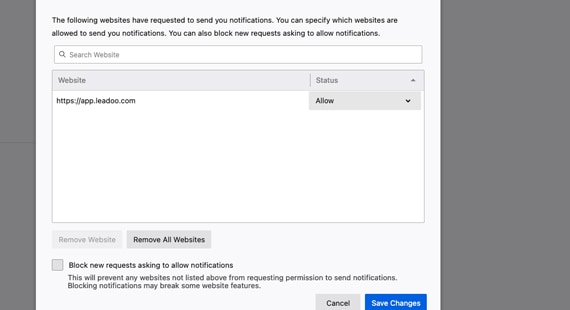
3. Search for App.leadoo.com and allow notifications
I need to update my website.
The famous words upon almost every marketer’s lips, it seems. The idea of updating your website may evoke some unpleasant feelings – it often seems like a laborious project that requires both time and financial resources. However, websites are one of the most important sales channels for almost all companies, if not the most important. Today’s buyer acts more independently (at arms’ length!), and is less bothered about being in contact with the seller before making a purchase decision – therefore websites must serve customers in the way they want, and not try to fit a square peg in a round hole, so to say.
Many companies face at least some kind of website updates semi-regularly. This can come from product updates, changes in the market, changes in brand or positioning and more. And, even if the pages themselves offer a lot of information, many other things affect the user experience, such as loading speed, clarity and other user-friendliness. We want answers from websites, and we want them now.
Website renewal is no mean feat. So why on earth would now be a good time to introduce any new services or tools? Doesn’t that just complicate things? 🤔
Well, we think not – at least not in the case of Leadoo – and we spoke with expert Customer Success Managers to find out four reasons why Leadoo’s tools should be used when updating or renewing your website.
1. Fix all elements of the site at the same time
When we start to work with a client and they’re doing a big website revamp, it’s actually easier for both parties to plan ahead – we can kill two birds with one stone. You already know what your new website will be like, what you’re aiming to do with it, and what kind of conversion tools you might want there. Leadoo can slide seamlessly into this plan.
After the first onboarding meeting, we have a comprehensive understanding of your needs, and we know how to design conversion tools exactly according to the needs of your customer base – our onboarding teams have helped over 1000 companies to improve their conversion rates, and have vast experience in working closely with clients during website renewal to ensure it’s optimised for conversions. Once the new web pages are ready, you will immediately get the perks of efficient, interactive and data-gathering conversion points, rather than having to then do it as a whole extra project afterwards, and retrospectively fit it to your site.
2. Collect data to inform the improvements you make
Ah, wonderful yet horrible data. Sometimes it’s difficult to decide what all the data should be collected and how to properly utilise it, but one thing is certain – you can never have too much information about the stages of the customer’s purchase path and the various touch points they have had on your site. This information is gold for both your marketing and sales teams – and pretty important when considering a redesign of your site. You want it to be as easy as possible for a customer to get the support they need to make a purchase, and this starts with tailoring your site to the needs and wants of your customer base.
It is good to remember that Leadoo’s conversion tools can also be used on slightly unfinished or old pages. Leadoo’s conversion tools collect a lot of information about the stages of website visitors’ purchase paths and what kind of information visitors want to find. Based on this data, planning and implementing new websites can also be a faster process, because it is easier for you to produce content that is of real value to website visitors.
Updating your website (sadly) is not a one-time project, but in fact its optimisation continues over time. The data collected by the conversion tools is crucial for web page conversion optimisation, as the behaviour of the visitors and the conversations they have with the conversion tools give a lot of clues about how the pages can be modified and improved to be even more effective.
3. The benefit of conversion points, identified by experts
With Leadoo’s conversion tools, you can eliminate at least one point from your website redesign – having to create conversion points.
It’s good to have a wide range of different conversion points on websites, so that every customer, regardless of the stage of the purchase path, can find a conversion point that is just right for them. Forget static forms and simple “request a quote” buttons, after which you ask the customer to fill in everything from their horoscope to their shoe size. Ain’t nobody got time for that. They need lighter conversion points – perhaps additional information that can be read independently, or an expert’s guidance on how to proceed.
Either way, you’ll have the support of our expert team to identify the best places on your site for conversion opportunities using our tools, and where you might add in extra conversion points to capture the soft conversions (i.e. those at an earlier stage in the funnel).
4. Versatile and interactive pages
No more flat, boring websites. Leadoo’s tools are about activating and engaging your visitors, and the way we do that is by making it a personalised, conversational experience. This could be through a simple set of questions to find a suitable service or, for example, calculate a price estimate directly using an interactive calculator. Nowadays, personalisation is expected by customers. We’ve even taken this to a whole new level – with Leadoo Personaliser, for example, you can provide personalised conversations based on a previous touchpoint or piece of information, such as the visitor’s industry, number of visits or other filters you want 🤩
So if you’re wondering if it’s worth using Leadoo if a website update is around the corner – the answer is yes, it’s worth it!
We want to help you accumulate conversions on your existing or new websites. From us, you get conversion tools carefully thought out for your needs, designed by an expert, which bring more interactivity to your website and mean help is available 24/7. Find out more about our tools here, for example, or take a look at the success stories of our happy customers here 💙
If you want to hear more about the suitability of Leadoo for you, chat our assistant below 👇🤖
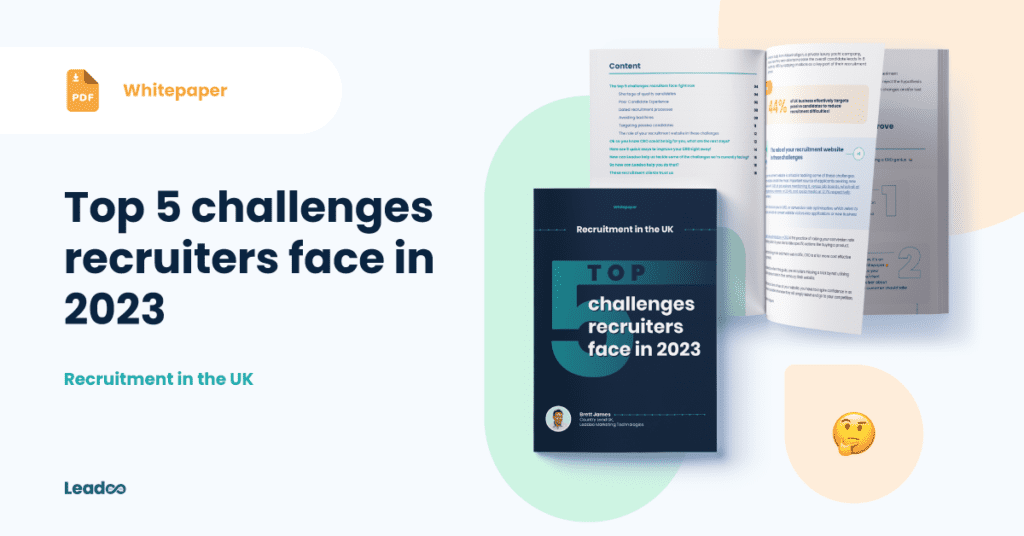
2023 is already shaping up to be quite the year in terms of the challenges recruiters face. Fortunately, we’ve put together some helpful resources to give you the hottest take, so you can stay one step ahead of the game next year.
Our team devised 6 challenges they feel recruitment as an industry will face this year:
Vacancies are around for an extended amount of time, meaning your teams work harder than they should be for longer, risking burnout and poor productivity.
There is a need for increased efforts of recruiters and their clients in attracting candidates that are active and inactive; there has never been more of a need to be ‘strategic’ in these efforts.
Being able to get qualified candidates’ interest as they are afraid to switch jobs (as well as highlighting key trending ‘perks’ of jobs i.e. remote work)
There are things you can do to mitigate these issues:
Make it candidate friendly
As most qualified candidates are not looking for new challenges this puts enormous pressure on the application process, it needs to be really candidate friendly. Do you still make candidates do all the heavy lifting by making them write cover letters and sending them over with CVs? That’s not candidate friendly.
Still make that awkward LinkedIn approach. It works.
Sending those DMs to your prospecting candidates isn’t a trait unique to you – your competitors are too. Don’t stop, but rather think about how to do it differently than others. Looking at the previous DMs you’ve sent you’ve probably messaged people by saying you are interested in their profile and would like to have a quick chat. Well, that’s exactly what other companies send as well. So, be different.
Build trust.
In these current circumstances people are reluctant to switch jobs as they need to face a probation period. Is there a way for you to be more thorough in the process so you wouldn’t need a probationary period? Perhaps you could differentiate yourself by being one of the few companies that is transparent about salaries (or at the very least, providing a salary band). This also helps to build trust between yourself and the candidate, increasing the chance they will use your services going forward.
Challenge #2: Providing candidates with a positive experience on your site
Our next tip is around providing your candidates with a better experience throughout the process; that starts from the moment they arrive on your website. 60% of job seekers abandon the application process if it takes too long or is too complex. Go to your audience where they’re at, make it easy for them, and provide them with an overall better experience to attract a wider, and higher calibre, pool of candidates.
If you don’t get this right, there are some implications:
Loss of bottom-line revenue, hampering company growth
Unhappy candidates who don’t return
Quality candidates drop out from the process before you even know they were interested
Damage to the brand and candidate trust in your business
Ultimate reduction in number of candidates in your talent pool due to high barriers to application and poor experience
In order to mitigate this issue, you should:
Focus on proactive communication throughout the process
Lower the barrier to apply by introducing things like chatbots or online tests that make applying easy, provide candidates with information about the work and how they would suit the role.
Challenge #3: Targeting passive candidates
There are a huge number of things that could block a candidate or business client from leaving their details with you – perhaps it’s too difficult for them to get in touch due to a lengthy contact form, or just an email address or phone number on the Contact Us page. Maybe it’s because they’re just not ready to find a new job yet – but they’re thinking about it. 70% of the global workforce is passive talent. Either way, they’re still someone who has some level of intent and so it makes sense to make the most of these opportunities as they come about.
To mitigate these issues:
1. Resource projects that target passive candidates with more time and tools
You will need to be more creative in the sourcing process when attracting passive candidates
2. Make it easier for people to apply
Lower the barrier to apply by introducing things like chatbots or online tests that make applying easy, provide candidates with information about the work and how they would suit the role.
A recent study from Wilsonhalligan, a private luxury yacht company, shows how they were able to Increase the overall candidate leads in 6 months by 418% by applying chatbots as a key part of their recruitment process
Challenge #4: Dated recruitment processes
Dated recruitment processes is a challenge that, whilst not unique to 2023, is something that far too many recruitment businesses circumvent when trying to improve their offering. The general mood amongst candidates is shifting – they have more choice when it comes to the roles available, and so they’re expecting more from the businesses they’re applying to work for.
After all, the application process is a two way street – you are assessing them, but they are also sizing you and the company up against their own personal values to see if they feel it would be a good fit. So, once again, make it easy for them to apply and be transparent about the process and the way it works. Nobody wants to fill out a five page contact form style application that takes 3 hours of their life to fill in. It’s 2022.
Optimising each step of the process through technology can also help ease the burden and workload on consultants and prove to make a big difference to the bottom line. Those that are starting to embrace new technology to streamline processes are already ahead of the game.
It’s important to prioritise which parts of the process are slowing the time-to-hire, in particular, and start to explore what could optimise the process.
This can mean:
Poor candidate experience
Time wasted on things that could be automated which has cost implications in terms of your existing colleagues’ time
Lost opportunities as candidates abandon the process in favour of a competitor with an easier and smoother candidate experience
How to fix this:
Update your knowhow on the most recent trends in recruitment by joining online and offline recruitment communities, following top industry influencers and joining industry training sessions
Make yourself familiar with rising recruitment technology opportunities and how you can leverage them within your business to reduce time-to-hire and streamline your recruitment process
Challenge #5: Avoiding bad hires
It’s a problem as old as recruitment itself. The cost of a bad hire is about 30% of the employee’s first-year earnings according to the U.S. Department of Labour. Considering the current economic climate, this would be difficult to swallow with one poor hiring choice. Multiply that across a larger business, and the costs start to become a big problem.
So, it’s obvious then that you need to have proper processes in place to avoid bad hires. There are three things that explain most bad hires:
Mismatch in the skills of the person and the role
Poor culture fit
The company not knowing what/why they actually needed to hire
Traditional recruitment processes tend to focus on skills fit, ignoring the cultural fit of each candidate with your existing team. If you have any expectation of your new hire working alongside existing team members, then you should probably take cultural fit into account.
Performance and behavioural questions are therefore key to focus on as you search for the best candidates to fit your client’s organisation.
What should you do?
Be thorough when defining the required skills for the position. Unfortunately many recruiting supervisors and organisations aren’t aware of the skill sets needed for their vacancies so spare time for your recruiters in order to execute proper evaluation
Challenge the recruiting supervisor about the role and its importance to make sure the role is something the company really needs
Focus on the culture fit by making sure the candidates get exposed to the company culture. There are several ways you can do it in different phases of the recruitment process. It should be noted that this shouldn’t come at the cost of all else, though – as that still makes for a poor hire!
BONUS: Challenge #6: The role of your website in all of this
This challenge introduces you to CRO, or conversion rate optimisation, which refers to how well you are able to convert website visitors into applications or new business leads – a key thing to consider for all recruitment businesses.
Conversion rate optimisation or CRO is the practice of raising your conversion rate by compelling visitors to your site to take specific actions like buying a product. Compared to driving more and more web traffic, CRO is a far more cost effective way to get results. As we discussed in earlier emails, recruiters are missing a trick by not utilising perhaps the greatest tool in their armoury; their website.
If a candidate or client arrives at your website, you have to inspire confidence in as many ways as possible otherwise they will simply leave and go to your competition. Don’t let this happen!
Key Takeaway
Recruitment is set to face some serious challenges in 2023. You can download our guide using the bot below, or contact us to get all the best tips on how to mitigate these challenges in your recruitment business!
What if we told you that you can use the power of interactive content to boost your conversions and drive user engagement at the same time? Sounds like a win-win situation, right? Interactive content is fast becoming one of the hottest trends in digital marketing because it offers brands many benefits – the first of many being that it enables users to take action immediately instead of just reading or watching content.
What is interactive content?
By definition, it is quite simply exactly what it sounds like: content that gives people the choice to interact with it in some way. It doesn’t matter if the interaction comes from clicking on an image, swiping through an article, chatting to a bot, or any other method really – as long as there is some kind of interaction involved. This type of dynamic content creates a much more personal experience for users and engages them in something a bit more interesting than the usual flat, static content.
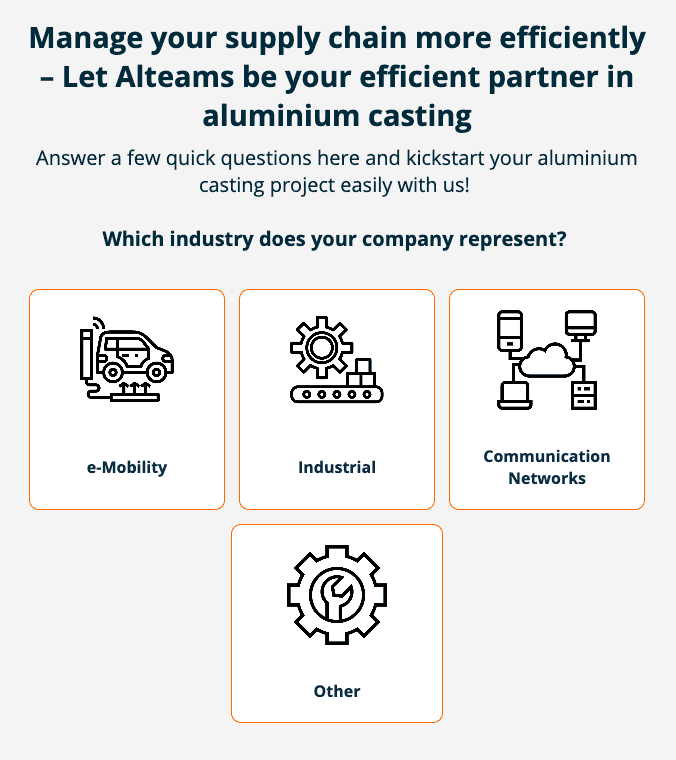
Bots, such as the one pictured above, make excellent activation and engagement tools to help increase conversions.
The VisualBot pictured above is taken from Leadoo client AlTeams, who use the bot to help engage visitors to help provide insight to their intent.
Why interactive content is so effective for conversion
Interactive content is a hotbed for conversions. Let us explain:
👉 Interactive Content helps build trust
Firstly, an interactive experience creates a stronger connection between visitors and your brand by making the interaction more memorable and personal – meaning that from the outset, users have a positive view of your company and its product. Today’s visitors expect personalisation as standard, and to integrate this with some level of interactivity only helps to build trust in your brand and its products.
👉 Interactive Content activates and engages your visitors
By engaging and activating your visitors with a variety of interactive content, you garner their attention, pique their interest and get them thinking about your product. When a user is given the option to decide how they interact with your content, they’re more likely to form a positive connection with you and your company, making you more memorable and giving that visitor a better experience. People also tend to more easily remember interactive experiences than they do passive ones, especially if that experience is something extraordinary or something they’ve not seen before.
Interactive content can also be an excellent lead generation strategy. This is especially true if you create a level of challenge for your visitors – by offering a quiz, or the opportunity to test themselves or compete against others, you not only engage the reader and improve your rapport with them, but you also – when done right – helpfully get their first party data too. After all, if they really want that branded bandana for their dog, they’ll give you the details to make it possible for you to deliver on your promise.
Activation and engagement of your visitors is proven to help with increasing conversions, and so by providing interactive content you increase the likelihood of this happening with each visitor, driving them to take action. That could mean signing up for a newsletter, making a purchase, or taking any other step towards the conversion goals you set out when creating your site and content. This helps you to feed your sales team’s pipeline with potential leads, as well as a notion of their level of intent based on the type of conversion they complete.
👉 Interactive Content helps you gain an understanding of your visitors – and collect their data
This brings us to possibly the most important reason why interactive content is so effective – assessing customer intent and collecting their data – so you know where they’re at in the buying funnel and make strategic decisions to nurture or prospect them based on the information available to you. You could even create super specific retargeting campaigns that speak to your customers about their problem and how your solution can help. In addition, you can use this information to make your content even more engaging, if you have the tools that allow you to see what works, and what doesn’t.
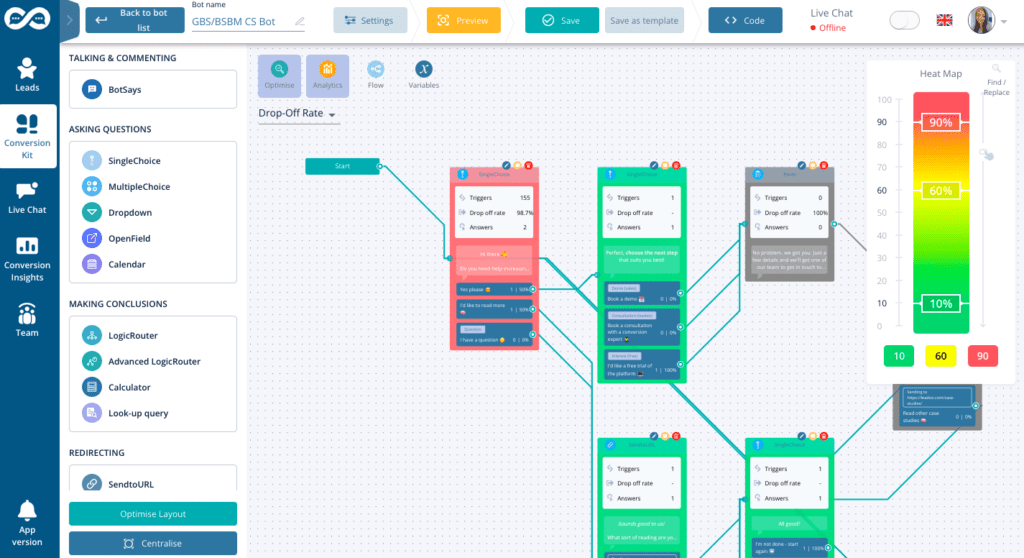
Using Leadoo’s conversational analytics, conversations can be optimised specifically for conversion
How can interactive content be used to increase conversions?
The best way to use interactive content to increase conversions is to make conversions the focus of your marketing efforts. This will ensure anything you create is done so with the intention of qualifying and converting the customer, and interactive content should form a key part of this process.
You can utilise interactive content to increase conversion by:
Increasing the phrasing, and interactivity, of your calls to action
Inviting visitors to take part in polls or quizzes
through making your content more visual. This can be achieved using a VisualBot as shown above, or an Inpagebot, like the one at the bottom of the page.
Key Takeaway
As you can see, interactive content is a powerful tool that can be used to build trust and rapport with your communities and visitors, improve your understanding of your customers, and increase the number of visitors you convert through your website.
To find out how you can introduce interactive elements and use them to increase conversions, get in touch, or chat to the bot below 👇