Leadoo has officially become Leadoo AI. You’ve probably noticed our name and visual changes across both our website and platform. But what do those signify? And why are we now Leadoo AI?
We Have Modernised Our Platform
As the new name suggests, as a platform we have become truly AI-led.
If you have logged in recently, you will have noticed more and more agentic AI features aimed at helping you and speeding up your work.
By introducing AI-generated Bot Content, we sped up the Drafting, Rewriting and Translating of bot content to minutes rather than potentially hours.
AI Insights: Conversational Flow delivers busy marketers relevant snapshot insights into conversion journeys, bot performance, and website analytics.
While the recently introduced AI Bot Builder changes the game in terms of building our conversational tools. Let our AI create entire conversational pathways in minutes. So you can spend your time refining and optimising, rather than building from scratch.
These features are all designed to harness the power of AI to allow marketers to do more, test more, and think more. In our platform, AI is raising the floor, while marketers and our Conversion Experts are raising the ceiling.
On the frontend of websites, since introducing our AI-powered bots in 2024, we have also seen a marked shift towards users seeking out these AI conversational experiences.
And with the recent rollout of AI-powered Product Recommendations, our chatbots can now better serve B2C audiences by instantly visualising relevant products to users from eCommerce stores.
That all explains why we’ve added AI to our name and are becoming a true AI-led Conversion & Customer Experience platform.
But what’s with the new black backgrounds and lighter blue logo?
Well, we’ve aligned our visual brand identity into the Manago AI family.
Manago AI, our parent company, recently launched a full rebrand of their platform and product. You can read more about that here – manago.ai/brand-story
Alongside Thulium AI, the three of us now make up the Manago AI family. As you can see, our visual brand identities are now aligned to make that clear.
These three Customer Lifecycle companies are now seamlessly integrated, and provide you all the Customer Data, Marketing Automation, Conversion and Support capabilities you need to turn visitors to leads to customers to advocates.
Our visual identity and platform capabilities are now truly AI-led
They reflect the need for modern marketers to move quicker, do more, and integrate faster.
Leadoo AI cements this future identity and purpose. AI has raised the floor.
Together with you, we will raise the ceiling on Conversions and Customer Experience.
PPC and Leadoo AI: How We Help Marketers Get More From Their Paid Ads
Paid advertising is one of the fastest ways to drive traffic to your website. But it’s also one of the easiest ways to waste budget.
If you’ve ever looked at your PPC reports and thought “We’re paying for the clicks… but where are the conversions?”, you’re not alone. Many marketers pour significant spend into paid search and paid social, only to see visitors bounce, hesitate, or disappear without taking action.
This is exactly where Leadoo AI helps marketers bridge the gap between clicks and conversions.
We combine PPC with personalised onsite conversations to dramatically increase the value of paid traffic. Let’s break down what that means, and how you can apply it.
The PPC Problem: Paying for non-converting Traffic
Pay-per-click (PPC) generally works. It generally gets relevant people to your site at relevant moments.
The issue? What happens after the click?
Many paid visitors bounce for two main reasons:
They don’t have time or interest to read through an entire landing page
They’re not ready to buy yet, but might be later
Either way, the cost is the same. You’ve already paid for that click.
This is one of the biggest leaks in paid ad performance. If your landing pages rely only on static content and forms, you’re asking visitors to do all the work themselves. And they will make decision to either buy, or not buy, they choose the latter 98% of the time on average.
Why Landing Pages Alone Aren’t Enough
Even the best-designed landing pages can struggle to:
Address every visitor’s intent
Adapt to different keywords or ad messages
Engage users who are still researching
Provide answers to their specific questions or concerns
PPC traffic isn’t one-size-fits-all. Someone searching “enterprise chatbot software” has very different needs from someone searching “website lead generation tools”, even if they land on the same page.
Without personalisation, both visitors see the same experience. And that’s where conversions (and budget!) are lost.
The uncomfortable truth is: if you’re paying to get eyeballs onto your landing pages but aren’t engaging them onsite, you’re leaving money on the table.
How Leadoo Unlocks More PPC Value
Leadoo adds conversational tools to your paid landing pages. Turning passive landing pages into interactive experiences.
Personalised bots for specific keywords and ads
Instead of hoping your landing page copy covers paid visitors’ needs, Leadoo allows you to:
Match bots to specific landing pages
Tailor conversations to keywords, ad copy, and search intent
Ask directly what the visitor is looking for, and start nurturing from there
So if someone clicks an ad tied to a specific feature or problem, the bot immediately continues that conversation. Without making them hunt for answers. This keeps users engaged in the moment, when their intent is highest. And when you’ve just paid money to acquire them!
Not every PPC visitor is sales-ready. That’s not a problem. In reality, the majority won’t be at any given moment.
Leadoo helps you:
Qualify visitors conversationally instead of forcing a form
Offer helpful next steps (content, demos, downloads, consultations, etc)
Capture intent and data without pressure
Instead of losing those visitors forever, you keep them engaged and moving forward. Turning paid clicks into future opportunities.
Why Conversational Engagement Boosts ROI
When you combine PPC with Leadoo, you’re no longer just paying for attention, you’re paying for interaction.
This means:
Lower bounce rates on paid landing pages
Higher engagement from high-intent visitors
More qualified leads from the same ad budget
If you are paying to bring someone to your digital storefront, the only way to truly maximise ROI on that spend is to engage them properly. Just like a store assistant would do in a physical store.
PPC and Leadoo AI: Scale Your Paid Ads
Paid Ads are often a key growth channel. But scaling PPC sustainably means getting more value from every click, not just buying more traffic.
By combining targeted ads with personalised onsite conversations, Leadoo helps marketers:
Reduce wasted ad spend
Improve conversion rates without redesigning pages
Turn more paid traffic into meaningful conversations
If you’re serious about maximising your paid ad performance, the next step isn’t more budget. It’s better engagement.
👉 Want to see how Leadoo can help you get more out of your PPC spend?
You’ve spent hour after hour on website creation and content, but you just can’t get visitors to stick around – and your bounce rate keeps increasing. Sound familiar? It’s not surprising; the average time people spend on a website is only 54 seconds, and 50% of visitors leave after browsing just one page.
So the competition for people’s attention, not to mention conversions, is fierce. What if I told you that we at Leadoo had come up with a solution to this problem? With our help, you can create a conversion tool tailored to your needs , which is equipped with the Exit Intent feature. Now, you can include an entire bot conversation as part of the Exit Intent pop-up, and take the last opportunity to activate your site visitors before they go.
The user experience with pop up features is often poor – pointless and non-personalised at best, and annoying and intrusive at worst. Why would you want to subscribe to the newsletter if you are leaving the site anyway? But now, you can turn the user experience into a valuable and useful one with our new Exit Intent feature.
In addition to simply subscribing to a typical newsletter, you can bring whatever options and features you want to the Exit Intent conversion tool, and you can modify the appearance to suit your brand. With Leadoo, you can also adjust the appearance of the Exit Intent to be time-dependent instead of based on mouse action. Convenient, right? Let’s also keep in mind that with a good Exit Intent pop-up you can increase conversions by up to 46%! 🚀
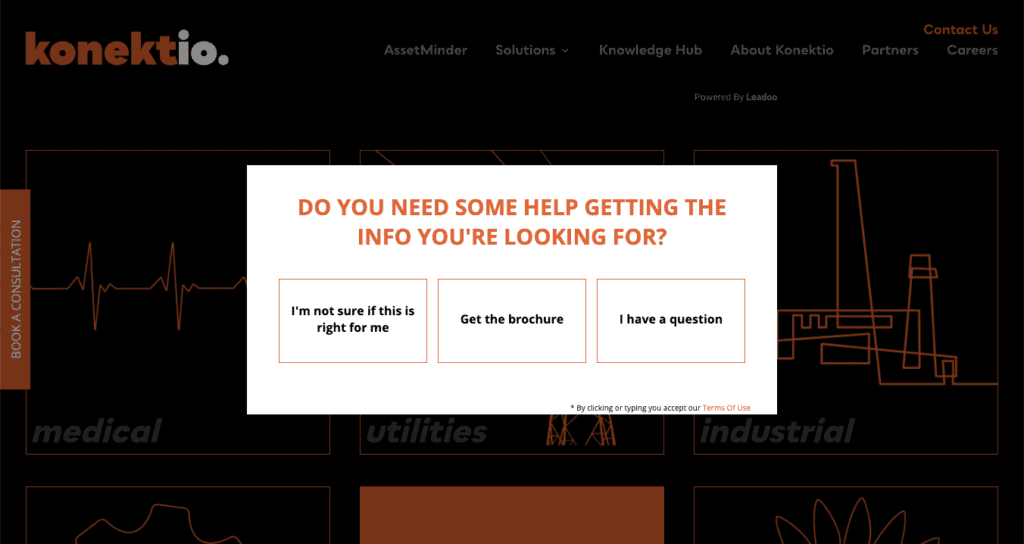
Konetiko uses exit intent to capture visitors at the point they might leave by checking in with the visitor’s needs, offering a brochure and the chance to ask a question.
Why does exit intent work?
With Exit Intent, you can get the attention of the website visitor at that prized moment, just before they go. Since we can place the pop-up on a specific page, we already know what the visitor is interested in. That means we’re able to bring useful direction to other content or tips into the pop-up, alongside the regular newsletter subscription or 10% discount for example.
You know your customers, and we know the best ways to convert them – these, combined with the Exit Intent feature, guarantee a nice boost in conversions.
One of the undeniable benefits of the Exit Intent feature is that the visitor is not given options in a certain way – you either close it entirely or choose from the options you have. Even if the visitor ends up closing the pop-up window, the content could still be interesting enough that the visitor remembers it when the conversion is relevant – and returns to your page to check it out at a later date.
The Exit Intent pop-up is usually a familiar sight, for example, on a product page or in an online store, but it can actually be used anywhere you want to activate website visitors. Naturally, the feature is useful for boosting sales, but it can also activate the visitor, for example, on contact pages or with open jobs.
So in a nutshell – Exit Intent works because we can bring personalised conversion opportunities to the website visitor, options to solve pain points, or whatever you want to bring there – just at the right moment!
What can you do with exit intent?
Exit Intent especially helps to increase conversions. Whether they are sales leads, requests for offers or, for example, subscriptions to the newsletter. The Exit Intent feature gives you a second chance to convert a visitor – if the website didn’t convince the visitor, maybe you can embed an irresistible offer in the conversion tool with Exit Intent that turns the visitor into a lead.
The Exit Intent feature can also help with web page navigation. If you know that your website might be a bit confusing because you have, for example, a lot of different product options, then the Exit Intent conversion tool can help the visitor navigate to the right information or page.
Since we at Leadoo believe in continuous optimisation based on data, it is good to remember that you can also practise AB testing with Exit Intent. You can try out different options to convert visitors, and make decisions about what will be used in the future based on the data.
The list of possibilities for using the Exit Intent feature is actually endless, because you can use it in exactly the way you want. And remember that our conversion experts are always there to help you if you need support or guidance with creating the perfect tool.
What makes for good exit intent content?
In short: something that provides a targeted precision strike! You shouldn’t add too much text, instead explaining things simply and briefly. This way, it is easy for website visitors to activate – without having to read something the length of War and Peace to get to the point.
As already mentioned earlier, knowing your target group is important in order to know how to offer them the right tips and CTA buttons. Personalisation makes the website visitor feel noticed, and this in turn increases the likelihood of conversion.
Websites are often visited on a phone, so optimising for mobile devices is also really important. No one likes a huge window on the screen that can’t be closed easily. We at Leadoo have naturally taken this into account when developing the feature, so you can be sure that the user experience will not suffer.
Gotta catch ’em all…
…as the wise Pokémon Master once said.
Exit Intent, as well as many of our other great features are ready and waiting to help you make the most of every visitor. Our Conversion Experts are always there to lend a hand – from making the first drafts of your solutions, all the way to analysing data and results and optimising your tools for conversion. We can promise that when using Leadoo, you won’t be alone, but that we will support you throughout your journey with us.
If you want to know more about the Exit Intent feature and how this can help improve your conversions, get in touch via this page, or chat to the bot below 👇
You’ve given blood, sweat and tears to that blog post, guide, or video. It’s almost given you sleepless nights, and the impression of a thousand open tabs from all your research is now permanently impressed on the inside of your eyelids. Yet that content you lovingly crafted isn’t converting people, or even pushing them further down the funnel, and you can’t help but wonder why. We know this is something many people struggle with – knowing how to create content that converts well – so we thought some handy tips on improving conversions throughout your content would be appreciated by our marketing friends.
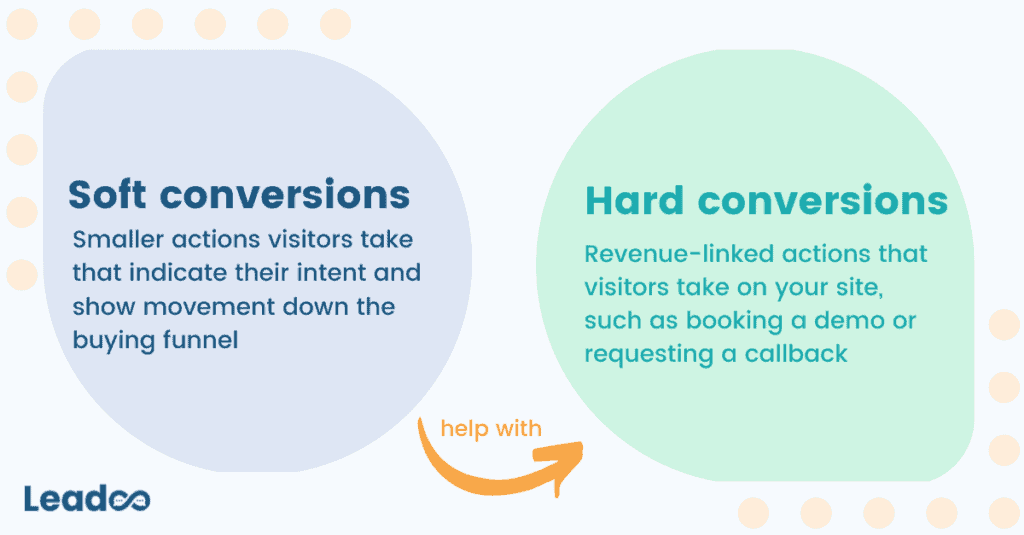
When we talk about content, this can take many forms – from blog posts to videos, graphics, web pages and images. Whatever form it takes, it needs to be helpful and educational for your audience, as well as doing its job of signposting visitors to your website or a CTA where they can learn more about you and your products. Most importantly, it needs to be tailored to the buyer’s position in the buying funnel and whether or not they are ready to buy; providing opportunities for soft conversions.
We’re going to look at the main things you should focus on when you’re looking to create ultra-converting content for your site.
Why is creating quality content so important?
Firstly, a common misconception within content marketing is that volume is the most important factor. And whilst this does help somewhat in terms of SEO, it doesn’t actually help you convert the people who are on the page reading the content. Quality content attracts visitors and makes them stay. It’s that simple.
It should also be noted that quality can look different depending, again, on the needs of your customer base – some of your prospects may feel overwhelmed with too much text when they’re looking for facts, for example, and this may cause them to leave your page without reading much of your content at all. For these customers, shorter form content, infographics and visuals are the key to maintaining their attention and encouraging them to want to learn more.
Quality is therefore mostly about recognising the needs of your customers and ensuring you’re providing for how they want to consume your content. For example, if your target audience tends to be younger, then it’s likely much of their content consumption is via audiobooks and podcasts, rather than traditional media such as newspaper articles or even blog posts, and you should tailor your content offering to meet this need. Content not in the form that your customer is looking for will cause them to seek it out in their desired format elsewhere – meaning you lose that customer into the ether potentially forever.
1. Know your audience
At the heart of all content marketing strategies should be a deep understanding of your customer – without this, you have nothing. You should firstly decide who it is that makes up your target audience. There are a million ways to categorise these (ok, perhaps not quite a million), but you can of course start by segmenting people using the old favourites; demographics, psychographics, behavioural and geographic segmentation should give you a good starting point to identify common characteristics in your typical customer. It may be the case that you end up with several personas, each representing a different type of prospect, and that’s perfectly fine – very few businesses solely sell to one very small segment or niche market, and even niche markets tend to have one or two overlapping customer personas.
Once you know who your audience is and what they look like, you can start to identify the common problems amongst this group and how your product is able to help. You can start by asking some basic questions about your identified personas; What do they care about? What do they struggle with? What are their motivations and fears? What are their goals?
Figuring all of this out is the first step, and then you can then create content which they actually find interesting and relevant so are therefore more likely to consume it. This is where you can make use of all that market research you probably spent hours conducting when creating your brand and product strategy – by making yourself intimately familiar with your target audience’s pains and frustrations, you can identify the ways in which you can help. Communicating the value of your product or service is the key, and each persona or target group identified will have differing uses for your solution. This makes it really important to alter the messaging and value proposition offered to each group and persona so that it’s always relevant for them. More on this later in the article.
2. Set goals for your content
Once you know who you’re targeting with your content, you should look to set some simple goals for the content you produce. Three simple things to start you off thinking here:
1. What stage of the funnel is my reader going to be at?
Not every customer is ready to make a purchase the second they land on your site for the first time. You need to know where they’re at, and then ensure that there is content available that is relevant to their stage of the funnel. For example, if they are only visiting for the first time, you can look at which pages they looked at and how long they looked at it to assess the intent of your visitor (and even leverage this in retargeting campaigns).
2. What do I want them to do as a result of engaging with my content?
This is important because it determines the calls to action you should set within your content – if you want them to read more information, then you need to provide a signpost of some description to get them there. This could be a CTA, a linked bit of text, or a chatbot that directs them to the next step. This would also count as a soft conversion (and remember, they’re really handy for helping us understand our customers better).
3. How can I make number 2 happen?
Just because you have the ability for your visitors to take the next desired step, it doesn’t mean they will. Your job is to provide all the information they need to make a decision about whether or not to take that step. Then, if they decide to do what you wanted them to, then you need to make it as frictionless and easy as possible for them to take that step. Don’t overwhelm your visitor with a 50-field contact form. Ain’t nobody got time for that, and they won’t fill it out.
This is of course not an exhaustive set up, but it does provide a good starting point for you to start creating content that is relevant to every audience you’re trying to reach. Before you start the creation process, you should be able to clearly identify what problem your content solves and how it does so, so that you can ensure you’re communicating the value of your product for these issues. You can of course then set more official objectives for your content, to help you focus the contents of each piece on the target audience specifically. The objectives could be as simple as getting a better understanding of what sort of content works for your audience, or a harder KPI like improving the conversion rate of content on your blog.
3. Decide on the type and medium for the content you need
Now that you’ve given consideration to the purpose of the content, and its intended audience, you need to think about what medium your target audience most often consumes other content through. For example, if you’re targeting a younger audience, then it makes sense (considering 90% of Gen Z have at least one social media profile) to create content designed to be shared via social media channels such as Instagram and TikTok. Alternatively, if your target demographic is sales and marketing professionals, LinkedIn is your friend. No other social platform offers access to a business network like LinkedIn, and the targeting capabilities on LinkedIn are decent. LinkedIn is used by professionals to share business insights, job opportunities and industry news, and so content created for LinkedIn should be created with this in mind.
It may be the case that the message you need to convey is a more complex one, better suited to a video or a podcast, perhaps due to the sheer volume of information. Some consumers prefer to digest information that is presented visually, such as through infographics, while others prefer to read long-form text. Get to know your audience (point number 1!) and make sure that you’re delivering the content to them in the medium they prefer.
3. Find tools to help you convert your existing visitors
Making your ‘book a demo’ button bigger and brighter, or your contact form longer, is not the catch-all solution you probably think it is.
In our extensive experience of working with clients across a huge number of industries all across Europe, we know that this just doesn’t work. If you want to convert your audience, then you need to give them plenty of opportunity to do so, and make it really easy for them. Presenting your prospects with an arduous contact form (or just an email address to email), isn’t going to fly with today’s customer. They expect an easy experience, personalisation and immediacy – none of which a contact form bigger than your dreams will solve.
And, whilst the standard analytics tools like Google Analytics and Hubspot can help you track things like where your audience comes from, how long they stay on your site, and what they do while they’re there, they don’t necessarily give you the most holistic view. If you want to focus on converting your visitors across your site, then a Conversion Platform, such as Leadoo, is what you need. Leadoo provides you with a comprehensive platform that gives you oversight and control of the conversions happening on your site. With Leadoo, you can see who is visiting, how long they stay on each page, where they’ve come from (using more than the last touchpoint, making your attribution much more accurate), which companies people are visiting from, as well as key contact data on company decision-makers and individual visitors.
Leadoo also provides interactive, personalised conversations for your web pages to allow visitors to interact and ask questions about your products, get help from an agent, or be referred to the relevant sales team.
At the end of the day, creating content is a lot of work, but it’s also fun. You get to stretch your creative muscles, work with your team, and build something that will ultimately help your business and your customers. Follow the tips above, and we have every bit of faith that your content will start converting the way you want it to.
If you want help with creating converting content, or want to discuss anything conversion related with us, we’d love to chat! Get in touch or chat to the bot below 👇
Sometimes marketers might have trouble working out what the right text for a CTA (call to action) button is, or what the right kind of content for a newsletter or campaign might be. Sometimes it comes naturally, but more often than not, it doesn’t, and this is where A/B testing can come in handy to help you increase the number of conversions you get from your efforts.
What is A/B testing?
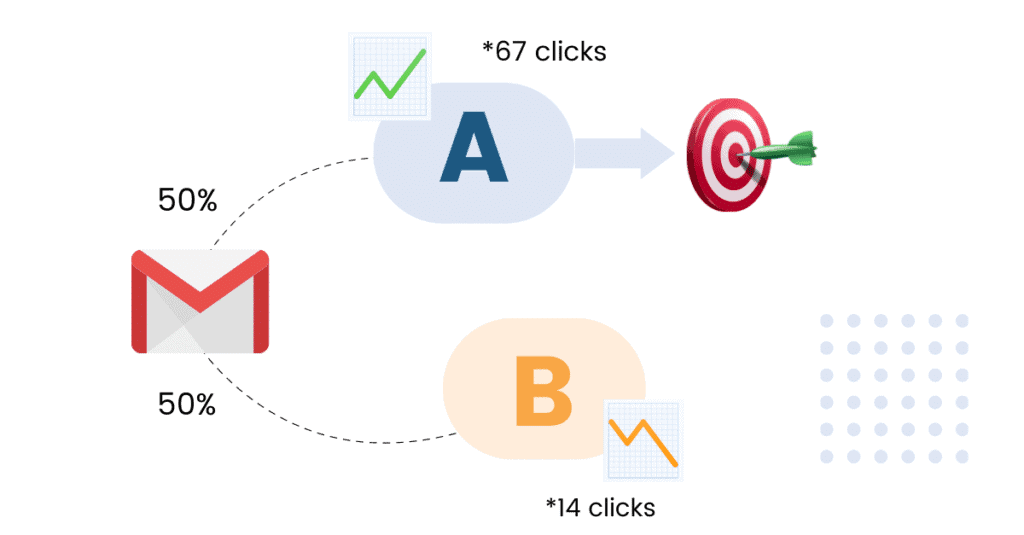
A/B testing simply means testing different options; one target group is shown one set of content, and another is shown something else. You can then analyse the performance of both pieces with the relevant target audience in order to determine which one is the better option. A/B testing can have a significant impact on the performance of your website when you test different options for layouts and optimisation to ensure you’re getting the most from it.
The best thing about A/B testing is that you can test pretty much anything, including different parts of your website. This could be, for example, the placement, wording or colour of the CTA button, the wording, placement and visualisation of pricing, the contents of the body text, the question fields on the contact form, or the number of images on the pages. These examples can be sorted into tests that seek to improve the user experience of the website, for example, or tests related to improving the design and navigation of the pages.
How do conversion optimisation and A/B differ?
Sometimes the two might seem to be almost the same thing, but in reality they are very different. Conversion optimisation focuses especially on researching a potential customer’s purchase path and therefore improving a site’s conversion rate, with the hope of increasing leads and sales in the long run. By examining each step of the buying path individually, you can make interesting findings or potentially spot problem areas that might be a barrier to a potential buyer. For example, A/B testing is one way to run different tests in conversion optimisation, but it’s important to note that it’s not the only way to optimise your website and improve your conversion rate.
However, let’s take a look at how to perform A / B tests in four easy steps.
How to run an A/B test
1. Define timeline, set goals and look at problem areas
Before you begin A / B testing, it’s important to determine what you want to find out from the tests. Whether it’s testing copy for email marketing, websites, or trying out different campaign pages, you will still need to be able to quantify the results. Measurable goals could be, for example, the number of clicks, leads, or orders received. You will also need to set a reasonable timeline for the test, linked to your goal. Let’s say for example, you wanted to gain data from 10,000 web visitors, and you get 1000 visitors a day, you would need to run the test for 10 days.
If you’re just getting started with A/B testing, a good place to start is to focus on critical points on your website, such as your main conversion points, or using analytics to study your site’s bounce rate. You can then take steps to try to reduce it, and see what works best using A/B testing. The lower the bounce rate on your pages, the more likely you are to increase the conversion rate of your pages when you do get a visitor to your site.
2. Form a hypothesis
Before you start testing, it is important to make a hypothesis about the desired outcome. As the name implies, a hypothesis is just a “guess” about the outcome, and for that reason you need a test to verify it. Your hypothesis should detail what the variable will be, and this helps you to focus your research and allows you to plan next steps no matter what the outcome of the tests are.
3. Run the tests
To start A/B testing, you need to create two different versions of the same content, with the only change being the variable as defined in the hypothesis. The two versions will then be shown to two audiences of the same size. For example, you can use the visual website optimiser, Optimizely, or Google Optimize tool to perform this testing.
4. Monitor and analyse
In order to be able to reliably analyse the results of your test, it is important that the test has been visible to the target groups long enough and that the reach is large enough to provide valid data. You will then be able to compare the results with the set hypothesis and see if the hypothesis you set was correct. When analysing the results, it is especially important to pay attention to the goals you set and the measurable characteristics that support them.
Performing the analysis is a critical part of A/B testing. By looking at two different variations, you can make discoveries about exactly what kind of things or content are more likely to actually make someone who’s engaging with your content convert.
5. Plan the next test
Even if you are very happy with the test results, don’t stop there! You might feel that you’ve achieved what you wanted, but it’s important to continue optimising your content to continue improving your results. A/B testing is a continuous learning process, and performing only one test may not achieve the desired results.
For example, you can always create a new “challenger” for the winner of your first test and see if it would be possible to achieve even better results. Or you could also continue to form entirely new hypotheses and focus on slightly different perspectives or audiences to improve your goals.
Key takeaway: A/B testing and CRO go hand-in-hand
A/B testing is a key part of optimising your content for conversion, but it’s not the only way to do it. It can be a really helpful way to gain insight into your audiences and to understand their behaviour and intentions.
If you want to know more about A/B testing and how it can help improve your conversion rate, get in touch or chat to the bot below 👇
If I asked every reader of this article to name some things I can find in a toolbox, it’s likely that the answers you give will be invariably the same; hammer, screwdriver, drill and so on.
But what about a conversion toolkit? Could you name the handy tools that it contains? Probably not. Could you make use of every single one? Probably. In fact, we’d say almost certainly.
Conversion, conversion optimisation and conversion rates
Have you heard of these? If you have, you’ll know how important they are, and if you don’t – well, as usual, we’ve got you covered.
A conversion is simply a desirable action you would like your customer to take on your site. This can look different depending on the business, and whereabouts in the funnel the customer is (we can measure this through micro-conversions – smaller, but still significant conversions which give us an excellent indication as to what point the customer is at in their buyers’ journey). We use these two terms interchangeably a lot of the time, and that’s because we place value on every qualified conversion opportunity – not just the end result.
In practical terms, a conversion can be anything from a newsletter download, to a conversation with a chatbot, or a qualified prospect completing a demo request. Simplified, it’s just any business-relevant activity which, at the end of the day, will affect a company’s revenue and profit.
Conversion Optimisation is a key part of online marketing that seeks to develop websites and increase their user experience, to provide better information and opportunities for customers to become a conversion. This means making the most of the visitors you have coming onto your site, and ensuring as many of them as possible are qualified and turned into leads, ready for nurturing or contact from your sales team.
Optimising your conversion rate therefore is about constantly testing and improving your website’s layout, design and functionality in order to make it easier for your visitors to convert. This process means you’re able to much better understand what works (and doesn’t) on your website, so you can continue to increase your conversion rate further.
The metric used is the Conversion Rate, and this can be calculated from the website, campaigns, or ads and emails.
Summary of Conversion Rate
In its simplest form, a website conversion rate tells you how much of a site’s visitors convert – that is, what percentage of visitors take the desired action on your site and/or become a customer.
A campaign’s conversion rate is the percentage of people who completed an action (such as a purchase) of those who could possibly have completed the action.
To look at the conversion rate for adverts and emails, divide the conversions by the number of clicks, and multiply by 100. This conversion rate is known as the click-to-conversion rate.
If maths isn’t your bag, fear not – we have our handy Conversion Rate calculator here to help:
Conversion tools make marketing easier
In order to focus on conversions, it would probably be a good idea to take a look and see which tools are available to help you achieve your conversion goals.
Conversion platforms, as the name suggests, are platforms which are fine-tuned for increasing conversions and collecting lead data to allow sales teams to be proactive in their approach and increase the number of deals they close.
They’re designed to make sales and marketing professionals’ lives easier by activating, capturing and nurturing web conversions. Activation is an incredibly important (and probably underestimated) part of conversion – only 2% of visitors on an average website convert. That means a whopping 98% of the people visiting your site don’t convert.
What a waste.
But this is where conversion platforms can step in to save the day – and there are usually things you can do immediately to improve conversion rates across your site. For example, are there enough available conversion points or at least visitor-activating elements which provide the opportunity for customers to move down the funnel? Possibly not.
Many companies are just actively seeking to collect leads, and this isn’t always a bad thing – in fact, 91% of marketers say that generating leads is their number one goal. And that’s fine, so long as the customer experience is as good as it could possibly be. Improving the customer experience is another relatively simple way to increase the likelihood of conversion.
And many marketers are focused on driving huge amounts of traffic to their site, which again in principle doesn’t sound like a bad thing, but who are those visitors? Are they quality visitors who are likely to turn into sales? Or are they just brisk visitors who clicked on your advert by accident?
It’s quite important for your sales teams that you know the answers to these questions. Traffic is, of course, important – but having visitor numbers of 20k a month and only gaining 10 quality leads from these efforts isn’t exactly anything to write home about. The key here is to create meaningful, engaging, entertaining and educational experiences for the customer, build rapport, qualify their needs, and nurture them into a lead with exceptional precision every time.
The other thing we commonly see when working with clients to improve their conversions is poor navigation. It goes without saying that you need to make it as easy as possible for visitors to convert.
Activate, convert, understand
When converting web pages, it is essential to remember the rule of three points: activate, convert and analyse.
1. Activate your visitors
Understand the steps in every customer’s journey, and take every opportunity to activate them using the solutions available in your conversion platform.
2. Convert visitors
Once your visitor has been activated, the next stage is ensuring the conversation or interaction the visitor has with your solutions is highly converting. This is where conversation-level analytics become really important as it allows you to optimise each conversation specifically to your customers’ needs.
3. Understand your visitors
Any conversion platform worth its salt will provide analytics to show you how and why your conversions happened – it’s super important to check these as they will give you excellent insights into what works well for your customers, and what doesn’t, so you can replicate across your site and increase your conversions even more.
A decent conversion platform will help you activate, convert, and understand your visitors. They aim to help make your life easier by automating your sales and marketing processes and providing a variety of tools to help you gather valuable data on your prospects before and after the purchase happens. Above all, the conversion platform you choose should be able to bring in quality leads, not just deliver thousands of cold leads to your inbox.
Conversion tools
Let’s take a closer look at what you can expect to find within a conversion platform – namely the tools available to you.
Conversion tools are any solution which helps you to improve your conversion rate. In general, they refer to marketing automation tools, analytics and visitor identification tools.
Marketing automation tools help you to automate your marketing processes, and streamline anything that may be repetitive. By making the processes much less labour intensive, it allows you to spend your time on more important tasks. For example, you might automate emails to go out to particular existing customers or to nurture prospects, and you can provide automated chat for your customers to self-serve or to qualify and direct them to the right team.
Analytics tools, on the other hand, collect that valuable data about your website visitors, and allow you to analyse what works for your customers, and what doesn’t. You should be able to see what conversations you’ve had with each visitor via any bot solutions implemented and analyse those conversations. These tools tend to focus on a specific type of data, and alternatives to these systems include systems that;
Show website analytics and traffic data to get a better idea of what drives visitors to your website, what works and what doesn’t.
Emphasise marketing attribution data. Attribution helps to outline the customer’s entire conversion path and shows you the touchpoints in their journey. There are often many touchpoints before the customer’s purchasing decision, and the journey is rarely a straightforward one. Attribution modelling, as above, can be used to form a more comprehensive picture of the customer’s conversion path.
Identify companies. There are various identification tools that accurately identify the companies that visit your website and can tell you, for example, which company and what size company the visitors are from.
Often, conversion tools also include Customer Relationship Management (CRM) integration. CRM is one of the most important competitive advantages in sales and marketing. In its simplest form, CRM integration means that all the valuable data you collect is automatically exported to your CRM system, where you can manage the information in the way your company works. If your CRM integration is automated, this saves lots of time and manual work in sending leads across to different team members.
As you can see, there’s plenty of help available in terms of tools to improve your conversion rate.
If you’re particularly interested in conversion platforms, we can tell you a bit more about us and the solutions we offer. At Leadoo Marketing Technologies, we invest in both marketing automation and comprehensive analytics tools. Our platform is made of three parts; Conversion Kit, Conversion Insights, and Conversion Experts, which all form part of our service offer.
Conversion Kit 🛠
Our state-of-the-art conversion tools include a variety of bot solutions to activate your web visitors and spark converting conversations in just the right place, at the right time.
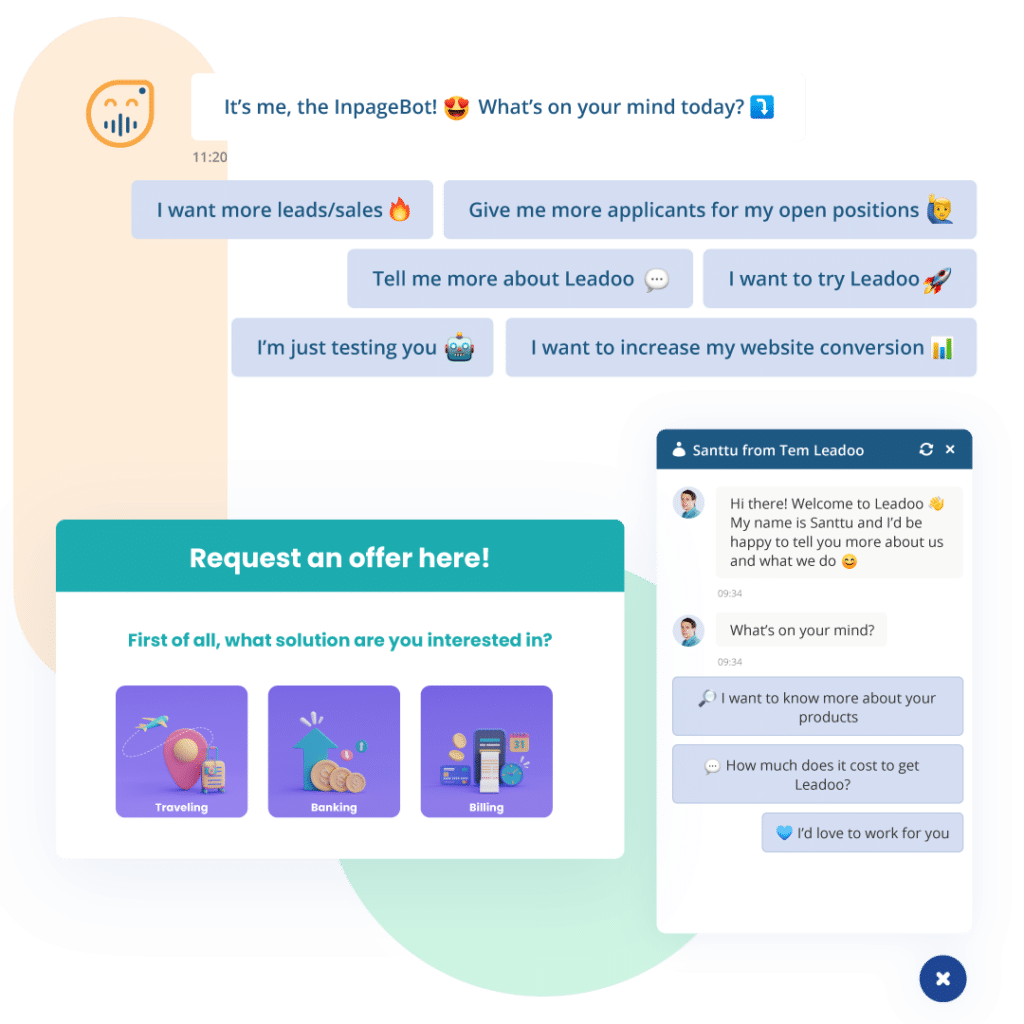
Try InpageBot, or VisualBot, which both seamlessly blend into your website, allowing you to unleash your creativity and take advantage of tests, quizzes and questions to activate and qualify your visitors. ChatBot provides support and guidance on every page, for those customers who just can’t find the page they’re looking for. Or try our CallbackCTA, a lightning fast way for customers to submit contact requests through your site.
A good service provider understands that a bot is essentially an automated and hard working customer service representative working for you on your site. A high quality, engaging bot naturally activates the web visitor and provides real, contextual added value to the visitors experience by providing answers to FAQs or assisting in product selection, for example.
Conversion Insights 📊
We don’t like guesswork – it’s much better to base our Conversion Insights analysis on solid data so that it best serves your needs. Not only do we tell you who is visiting your site, and which parts they visited when, but it also tells you what works best on your page, and what doesn’t, as well as what the visitors are actually doing when browsing your site.
Our company identification tool allows you to view important company data about your website visitors (e.g., industries, company revenue) and explore the decision-making processes and buyer journeys of these companies on your website.
With conversion analytics, you can see when your website visitors are most active, which of your conversion tools are getting the best results, and you can see what interests your website visitors the most.
Conversation-level analytics, in turn, allows you to easily and quickly analyse the performance and dropout rates of your conversion tools, understand in detail how your potential customers want to act, and take swift action based on the information provided.
All of this information is also automatically exported to your CRM system, of course – we’re here to make your life easier 😉
Conversion Experts 🧑💻
You may look at the kit and insights sections and think hold on – how on earth am I going to single handedly monitor and implement all these solutions? As a sales or marketing professional, you’re already extremely busy and so don’t have the time to spend hours pouring over the analytics and insights. We get it.
So, that’s why our Conversion Experts are a key part of our service offer. Our experts are on hand to help you make the most of your solutions. When you sign the contract with Leadoo, you’re allocated an Onboarding Manager, whose job it is to understand and implement your initial solutions based on your brief. Then, once you’re up and running, you’ll be handed over to one of our Customer Success Managers, whose job it is to look after you as one of our customers, as well as optimising your solutions regularly and working with you to improve your site.
Leadoo’s CSM team will review your site’s and solutions’ performance with you on a regular basis, so you can highlight anything you’re particularly happy with (and so perhaps should be replicated elsewhere on the site), and anything you’re not happy with (so our team can look at how to rectify). The bottom line is, our team is here to support you in your conversion rate improvement journey, and are here to answer any questions you have about your solutions or their implementation.
Are you interested in conversion tools?
Conversions matter. The first step is to start testing different solutions to find out what works on the website and what doesn’t. Conversion tools aren’t necessarily required, but they’ll help you a great deal: take advantage of marketing automation tools, certain analytics tools, or all of them in one package in the form of a conversion platform.
Some consideration should be given to your business goals here – where do you need help, and what is the solution? Your alternative is to, for example, take advantage of a service provider that focuses its solutions on marketing automation or analytics specifically.
But, if you’re someone short on time (aren’t we all?) and you think you wouldn’t have time to implement a conversion platform, think again. A conversion platform should provide you with the whole package needed to improve your conversion rate. Ours is the best (okay, maybe we’re a bit biased…) because we provide you with industry experts who are on hand to help you whenever you need support, meaning you can hand the legwork over and our experts will do the rest. You just sit back and take credit for the results. Winning.
All in all, our conversion platform is comprehensive, our tools are high quality and our experts are literally THE experts when it comes to conversion – sounds pretty good, right?
If you’d like to know how we can help you increase your conversions, get in touch today or have a chat with the bot below 👇
Quizzes are fun, aren’t they?
Not the type we all sat through on repeat from March-July 2020 delivered via Google Meet. We’d be happy never seeing one of those again.
But quizzes can actually be a super easy and fun way to engage an audience on a web page. This is often successfully used on ecommerce sites, where product selectors can help customers find the product they are looking for quickly.
This has uses in lead generation and conversion too – by carefully curating those questions, you can qualify visitors to your site and continue to nurture them after their visit.
How are quizzes an effective tool for conversion and lead generation?
With the rise of inbound marketing and the increasingly important focus on website conversions, quizzes provide an opportunity to activate visitors, engage them with your content, move them through your funnel, qualify them and their needs, and finally to collect their information as a lead.
1. Increased brand awareness and traffic
Quizzes are surprisingly good at generating traffic – our research online, and with our own clients, indicates that they generate traffic well, or moderately well, around 70% of the time. This, when compared with 36% for static content, makes an excellent case for having a quiz somewhere on your site. We’ll give you some ideas of how this could look a bit later in the article.
2. Better customer experience
An interactive quiz makes a users’ experience on your site much more personal – they’ve interacted with your site and your brand and now most likely have some understanding of your product and what you can offer them. This is a perfect time to point them in the right direction based on their position in the funnel – it could be encouraging them to sign up to a newsletter; or to book a demo with a salesperson.
Leadoo’s Conversion Platform not only allows you to create dynamic quizzes with complex logic and calculation functionality, but it also allows you to direct prospects to book a meeting directly onto a sales person’s calendar via our calendar integration function.
3. Adaptability in many situations
One of the best things about quizzes is that they are adaptable to many situations, in any industry or niche. It’s easy to use an Inpage, content-specific bot, or a VisualBot, to create a lead generating quiz, and our experts are always on hand to discuss and help with your industry-specific questions and ideas.
4. Qualification, segmentation and retargeting
By using one of the solutions suggested in point 3, you can create converting conversations that qualify, segment and allow you to retarget and nurture your prospects, to ensure you never miss a lead again. Using Google Tag Manager integration in Leadoo allows you to create super-targeted micro segments for even more specific targeting of campaigns.
5. Real-time, informative analytics
Visitor responses give you an excellent insight into their intent and position in the funnel, and allow you to make better marketing decisions to nurture them better.
Using Leadoo’s Conversion Insights, you get a clean, user-friendly dashboard with all the relevant analytics you need to monitor customer journeys and use this knowledge to increase your conversions. You can even optimise for conversions at the conversational level by using Conversation Analytics, and each bot is created to be fully customisable and bespoke for your business’, and customers’, needs.
Different types of quiz
With Leadoo, you can create a quiz for any purpose, and our Conversion Experts are always on hand to help create your vision, but we thought it might be useful to provide some inspiration and examples of ways quiz bots can be used.
Product Recommendation Quiz
When you provide a product recommendation quiz, not only are you identifying the needs of the customer immediately; you’re also gathering information that can help you to continue to nurture that customer if they aren’t in a position to purchase on that occasion.
If they are ready to purchase, you’re leading them straight to the product they need, by asking qualifying questions and creating unique conversation pathways that are context-specific to each product.
CareCo, the UK’s leading mobility specialists, provide the option for website users to get recommendations from the bot based on carefully selected qualifying questions. This option is provided in the right hand corner pop-up chatbot, which also provides users the option to speak to a live chat representative to get product advice, too.
If the customer wants to use the automated product selector, they can select this option, and the bot will take them through a set of questions to identify their needs and guide them to view products that they might find suitable.
The bot also offers opportunities to educate along the way – not all customers know what exactly they need and so sometimes it’s your job to help them know. For example, on the CareCo bot, when a customer is presented with the option of a power chair or wheelchair, they also have an option to select which will provide them with an explanation between the two. Super handy.
Once you reach the end of the conversation, and the product is selected, it gives you the option to leave contact details so an advisor can call you and continue the buying process from there. This means sales advisors are already armed with the information on what each prospect is looking for prior to speaking to them.
Calculator/scored quiz
Cooling Castle Barn is a wedding venue in Kent, U.K., offering luxury weddings in beautiful surroundings. As with all wedding venues, their prices differ based on day of the week, number of guests, and season, and so to provide pricing to a customer they would need this information.
Asking questions is the perfect opportunity to provide relevant and helpful information to the user – for example, if I were looking for a wedding venue and needed a price quotation, I could check out Cooling Castle Barn’s price calculator to see how much it would cost to get married there.
The customer provides details, and, using logic routing and calculations based on user inputs, it calculates the cost of the price based on pre-set parameters and provides this to the customer. It also allows them to book a tour, book a meeting and ask a question – to provide the opportunity to continue to nurture the customer towards booking their wedding day.
It also means Cooling Castle Barn’s sales team have an idea of the customers’ price range and information about their ideal wedding prior to contacting them, so that they can prepare accordingly and only provide the customer with wedding packages and extras within their budget and needs.
Another basic example of this would be our handy Conversion Rate Calculator – by inputting visitor and conversion numbers in, it provides you with the conversion rate for your site. Check it out 👇
Personality quiz
For something a bit more fun, but still great for engagement, you could try offering a personality quiz. It will depend on the industry and sector you’re in – not many people need to know which sort of roof tile their personality is most like – but something relevant to the customers that visit your site won’t go amiss. As humans, we love to talk about ourselves, and what better way to do that than fill out a personality quiz.
Some of our favourite examples of these come from BuzzFeed, which gained the majority of its reputation and awareness amongst its target audience through providing personality quizzes on a huge range of topics. They’re famed for their not-so-serious quizzes, from ‘Which Harry Potter character are you?” to ‘Can you see all these shades of blue?’.
Obviously BuzzFeed’s examples are much less serious, but there are ways to do these on-brand, whilst gaining some seriously useful information. Pair this with visitor identification, and you have a whole load more data that you can use to make smarter marketing decisions.
In Art Attack style, here’s one we made earlier as a different sort of example:
Key Takeaway
Quizzes can be a super-powerful tool for improving your users’ experience on your site, engaging customers with your brand, and qualifying and collecting lead data. When used with a conversion platform such as Leadoo, you gain excellent Conversion Insights to allow you to optimise your solutions and bots to increase conversions and generate leads on every page of your site.
Get in touch with us or chat to the bot below to find out how we can use quizzes and other solutions to help you up your engagement and conversions 📈
You’ve heard it all before – the persistent InMail, the OTT keen beans chasing you down at the expos – they’re all here to sell you more magic that doesn’t actually work (or is so complicated that you need 7 PHDs and 150 years experience to figure it out).
But hear me out. Leadoo’s conversion platform is not one of those things. We’re not a magic enigma for increasing conversions that nobody really understands. We’re a legit, easy-to-use solution for anyone who is struggling to up their conversions and turn their traffic into leads.
So, without further ado, here are my 5 reasons why every Marketing Manager needs Leadoo in their tech stack. If you’re short on time, and need the key bits, just skip to the good bit 👇
1. 30-70% increase in conversions
Okay, this one’s a fairly easy one. There’s a lot of debate over the hottest metrics in marketing right now, but we’re here to tell you that conversions are it. Visitor numbers are one thing, but if those visitors are just bouncing right off the page, then that number means nothing.
You need to make the most of every single visitor you receive. That means working out why they’ve ended up on your page, what their issues are, and how your solution can solve them. Some of that comes from the actual copy on the page – helping the prospects understand what you are offering.
But, most of it comes from activating your visitors along the way and ensuring that they – even if they’re not ready to buy – are leaving breadcrumbs that allow you to pick them up and nurture them going forward. We achieve this using something called an InpageBot, amongst other tools, which sits seamlessly within your content, is always context-specific, and is designed especially to engage visitors and get them to give you some clues as to what they need.
2. In-depth analytics of buying funnel
I said earlier that it’s important to grab your visitors no matter what stage of the buying funnel they’re currently in – and that’s where Leadoo’s Conversion Insights steps in to save the day. Insights helps you to understand your visitors and their behaviour, and make decisions that will help you nurture each prospect, such as offering discounts, special offers, or free consultations, to encourage them to convert.
With Leadoo, you get excellent conversation and conversion analytics in an easy-to-digest format, meaning you can make changes proactively – alongside our Conversion Experts – to ensure your results are always improving. Who knew a conversion platform could be so much fun?
3. Easy AB testing for CRO improvement
Not sure whether the CTA works better on the left or the right? Or if you should offer contact right away? Test it all out using the Leadoo platform. You could try different bots on different pages and see what works best in each case. You can also tailor each conversation to be completely context-specific, increasing the likelihood that your visitors will engage and convert, and test different conversations to see what really makes your customers tick..
Our Conversion Experts will be on hand to help out with all of that, and can also advise on the placement and testing out of different bot placements, as they have vast experience working with our pool of over 900 clients to bring them the best conversion results they can.
Need to know who’s knockin’ on the door? Would be nice, wouldn’t it?
With Leadoo, you can see all kinds of helpful information about your visitors, like who they are, what companies they work for, information on the company itself and much more. We also make use of Google Tag Manager, so you can create custom audiences and target your ads based on who’s already been snooping (and therefore further down the funnel than a first-time visitor).
Identification isn’t the only part of our platform – we’re no one trick pony 😉 – but it is a part that we know our customers truly appreciate and make excellent use of.
5. No coding skills required
All of the above in one neat little package, and no coding skills beyond a copy and paste’ required. Winning. All you have to do is paste the code for each bot into your site (just like embedding a video) and the bots will crack on and get to work immediately.
As with everything, your very own Conversion Expert will always be on hand to provide any support you might need. We got you.
Let’s skip to the good bit…
If the above is TLDR, here’s a brief summary of the benefits Leadoo’s Conversion Platform can bring to you, mischievous marketing manager:
Complete set of conversion tools from in-content widgets to calculators, tests and chatbots.
Super light tools that are quick to load and thus offer awesome UX and no hit on your website SEO
A unique combination of tools, insights and Leadoo specialists to help you out
0% cookies and 100% GDPR compliant whilst providing in-depth analytics and insights on your website visitors
Connect Leadoo with Google Tag Manager to create custom audiences based on visitors’ behaviour
Help and training to get better at online marketing and sales
Let’s see how we can help you improve your marketing results – chat to us below ⤵️
The General Data Protection Regulation (GDPR) has been around for more than two years now, and it would not be an overstatement to say that it has shaken up the whole marketing industry. In this post, we will address the use of various tracking technologies in a GDPR-compliant manner – to offer interest-based advertising and stay accountable at the same time.
Cookies and compliance with privacy legislation
Although cookies are the most known technologies, websites also use other means to support functionality and track users, such as HTML5 local storage, Local Shared Objects, fingerprinting techniques, etc. However, we will use cookies as an umbrella term in this discussion, keeping in mind that it also covers other technologies.
It is also worth noting that we discuss here compliance with the EU privacy rules on cookies, which will not necessarily apply in the same way to the California Consumer Privacy Act (CCPA) and the Lei Geral de Proteção de Dados (LGPD). Using web analytics in the US, for example, is more relaxed and does not require prior consent. You should understand well which laws govern your activities.
Before moving to a question of lawfulness, it is crucial to differentiate cookies by categories based on the purposes they serve.
Strictly necessary cookies are essential for a website to work correctly. The most common example is online shopping, where a site remembers items placed in a cart.
Functional cookies help to facilitate the use of a website and enhance the user’s experience. For example, they remember language preferences and enable some extra functionalities.
Analytical cookies collect information about how visitors use sites and about the visitors themselves. We can divide them into two subcategories:
Statistical – analyze the traffic and offer an aggregated overview of users’ interaction with a website, and
Marketing – they track users’ online activity to understand their needs better and provide more relevant advertisements.
Leadoo and any other web analytics service provider uses cookies to recognize users’ behavior and deliver their services. However, each website owner’s responsibility as a data controller is to ask and collect visitors’ consent before starting tracking. It is essential to ask for permission, and whether all cookies require approval, we will discuss below.
GDPR and ePrivacy Directive
It may come by surprise, but the GDPR is not the only and, more importantly, not the first law to consider before using cookies. The GDPR sets forth the fundamentals of personal data protection: principles of processing, data subject’s rights, controller and processor’s duties, etc. In contrast, the ePrivacy Directive (aka a Cookie Law) guarantees respect for private life and protects personal data in electronic communications in particular.
In practice, it means that the ePrivacy Directive prevails over the GDPR in situations where electronic communications are involved. However, unlike the GDPR, the ePrivacy Directive does not have a direct effect, i.e., each EU country has its national law implementing the Directive’s provisions. While it might lead to some deviations between different jurisdictions, the core rules will remain the same.
Cookie consent foundations
Under the ePrivacy Directive, there is a general requirement to ask for user’s consent before using any cookies. Importantly, it does not matter whether any personal information is processed or not for it to apply. It is because placing cookies on a user’s device is considered as interference with that user’s private space and thus requires prior permission.
Notably, it is the GDPR that defines consent. Accordingly, it must be any freely given, specific, informed and unambiguous indication of wishes by which a data subject, by a statement or by clear affirmative action, signifies agreement to the processing of personal data. This wording contains quite a lot of meaning to grasp, and it could be a subject for a separate blog post to explain what a GDPR-compliant consent entails.
From the categories mentioned above, only essential cookies fall under the ePrivacy Directive consent exception. The document refers to them as strictly necessary to provide an information society service explicitly requested by the subscriber or user. Noticeably, it is a very narrow exception. Most of the cookies that facilitate the use of a website, but are not strictly necessary and not explicitly requested, still need user consent. There is no mercy for analytical cookies, either.
Hope for the future
The current situation is about to change soon as a new ePrivacy Regulation is coming to replace the Directive. Similarly to the GDPR, it will be directly and uniformly applicable in all EU countries. Among the offered novelties are two additional cookie consent exceptions of our interest:
when it is necessary for audience measuring, it will potentially cover analytical cookies for statistical purposes, and
when required for legitimate interests of a service provider, except when users’ privacy rights override such interests. This category may potentially include some functionality and other cookies that do not interfere considerably with the user’s privacy. However, cookies used for profiling are explicitly excluded from this exception, while some other cookies used to deliver advertisements may be allowed without asking for consent.
Consequently, it is mandatory to ask for the visitors’ consent to use any cookies other than strictly necessary. If you would like to receive detailed guidelines on how to do it correctly, contact your customer success person at Leadoo or download our comprehensive guide below! ⤵️
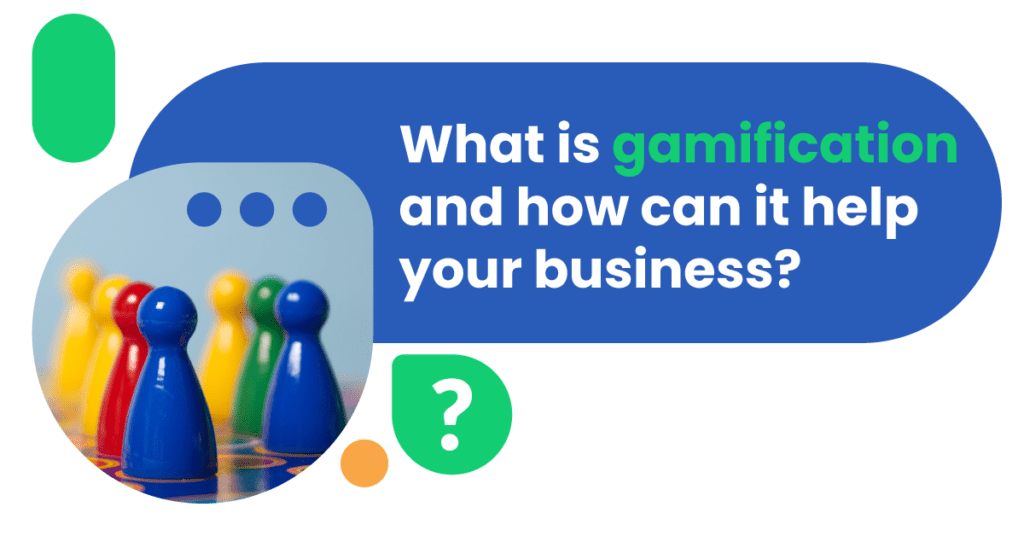
Are you looking for ways to increase engagement with your brand? Do you feel like the content you painstakingly produce just isn’t cutting through? Maybe it’s time you tried incorporating gamified elements into your material.
Gaming is not the same as gamification
For some this may be obvious but gamification is not the same as gaming. Gaming is the production of a separate medium whereas gamification is the application of the principles of gaming to marketing or educational material. What gamification seeks to achieve is increased engagement and understanding of content through our natural attraction to game principles.
The following post will explain how gaming principles leverage our human instincts for competition and game scenarios, what these gaming principles actually are, and finally ways those principles can be introduced to provide value to your business.
What’s the psychology of gaming?
Gamification activates the following elements of human motivation:
1. Competition
– The first is our desire to compete. Whether we are trying to demonstrate our knowledge on a subject by taking a quiz or completing a crossword, or whether we want to establish a position in a community, competition is a deep survival instinct. We either want to demonstrate our strengths or we see what others have done and want to receive the same benefits.
2. Status
– Next is the importance we attach to status. Like all of these motivations they fluctuate depending on the individual, however, most of us take pride in having others recognise our position in a community. Although status through gamification doesn’t hold the prestige of work or education, it can be just as powerful, especially when applied to mundane or routine tasks.
3. Achievement
– This is the most obvious gaming motivation. Dopamine release is triggered in our brains whenever we achieve even the smallest of goals or targets. The design of a challenge can trigger this sense of achievement in itself but recognition of the achievement will also have the same effect.
There are other motivational elements applied in gamification principles, such as self-expression or altruism. However, these are less common and powerful than the three mentioned above, as well as being more difficult to incorporate into a basic gamification strategy.
Good examples of the principles of gamification in practice
Competition
All gamification principles and ideas can be categorised under the umbrella of competition, status and achievement. In the first place, our competitive instincts are what draw us into the idea of a challenge. It’s worth remembering that ‘challenge’ is a flexible term. Think about all those ridiculously easy facebook quizzes that state only ‘3 out 10 people can name all these cities’. You know they’re clickbait and obvious but you just can’t help yourself! We love the idea of proving to ourselves (and others) that we are smart.
A good example is the National Geographic competition run in order to promote interest in the second season of its show Genius. Spread out over a period of five days were clues that fans of the channel had to figure out. In this case, the questions were a real test of knowledge regarding topics such as architecture and history. Even though there was a prize at the end, you can be sure there were many who were hooked on the idea of demonstrating just how clever and capable they are.
Status
If your gamification strategy is being built for the long-term, then it’s important to think about status. Individual progress should be measurable through the accumulation of points. Those points can lead to different levels and be recognised on a leaderboard. The issue of external status is one element but then appreciation of personal progress is another.
One example I know well (because my mother-in-law is hooked on it) is the foreign language learning software Duolingo. They have different leader boards for whatever learning stage you’re at, and in whatever language you’re practicing. If you don’t keep at it everyday then you lose your position. Also, if you lapse and forget, there’s some notification reminders that evoke a sense of disappointment. It’s all designed to help tackle the daunting challenge of learning a foreign language by breaking it up into manageable pieces.
Achievement
Whether or not you can create an effective gamification challenge alone doesn’t necessarily matter if you can supplement it with a system of rewards. Coupons, prizes, giveaways etc. have been used by businesses for a long time. Lavish holidays or expensive cars are now commonplace. However, again you don’t have to break the bank in order to activate the human desire for rewards. Earning badges or certificates are a great example of a budget reward mechanism. Prizes and goods can be initially virtual and then could be exchanged for tangible assets if the programme proves successful.
The company SAP needed to quickly get its huge global team of sales staff to quickly engage in a new portfolio. It did this by tapping into the competitive nature of sales people through its Roadwarrior programme. Sales reps answered questions from simulated interactions with customers, winning badges and earning points in the process. Reps then challenged coworkers and the overall strategy helped train employees.
Statistical tracking and a deeper relationship with your audience
Like with most things, the data behind the process is critical. It’s essential that you keep a track of how much each user interacts with the gamification strategy. This is not just for your benefit but theirs as well. Reflecting on how much and how successfully they engage is the biggest (and cheapest) reward you can provide. The more creative ways you can illustrate and reflect this information the more attention you will capture.
This is also how you foster a much deeper relationship with your audience. Not every company can provide a huge customer support team or respond individually to community members. This is why a gamification strategy can help. Companies can do much more to embrace customers than, say, simple loyalty schemes. For example, using chatbots to engage website visitors in conversations. These bots can also be easily linked to your gamification strategy as a way of inspiring visitors to engage more with your content.
Gamification is a much more interesting way to reach and interact with your audience. That’s what people nowadays expect: to be entertained and engaged.