KNOWLEDGE
Case StudiesBlogsEventsSupport & Starting
Support Articles & HubSupport Videos (Youtube)Try Leadoo Free (Leadoo Lite)Partners & Careers
PartnershipsCareersSecurity & Privacy
Security at Leadoo AIGeneral Terms & ConditionsData & GDPRKNOWLEDGE
Case StudiesBlogsEventsSupport & Starting
Support Articles & HubSupport Videos (Youtube)Try Leadoo Free (Leadoo Lite)Partners & Careers
PartnershipsCareersSecurity & Privacy
Security at Leadoo AIGeneral Terms & ConditionsData & GDPRB2B sales, or business-to-business sales, is simply the process selling products or services from one business to another. Unlike B2C (business-to-consumer) sales, B2B sales typically involve longer sales cycles, larger transactions, and more complex decision-making processes.
In fact, depending on what you sell B2B, your sales cycle might involve dozens – if not hundreds – of touchpoints before a final decision is even made. As the below graphic from Gartner shows, B2B sales can hit obstacles in everything from buyer website interactions, to staff turnover, to compliance checks.
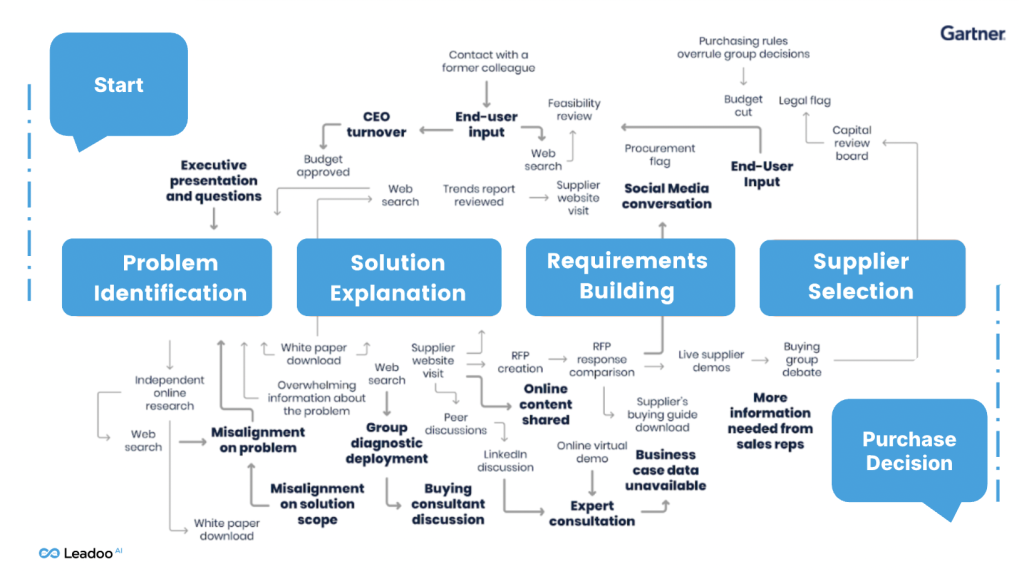
With this many potential touchpoints and stumbling blocks, mastering B2B sales strategies is crucial for driving growth and success. In this guide, we’ll explore the fundamentals of B2B sales, the key differences from B2C sales, and how leveraging advanced tools like Leadoo AI can help your business thrive in a competitive landscape.
B2B sales is about building relationships, solving business problems, and delivering value. Whether you’re selling software, professional services, or industrial products, understanding the dynamics of B2B sales is essential.
While both B2B and B2C sales aim to sell products or services, they differ significantly. In everything from the target audiences, to sales processes and strategies:
The B2B sales funnel includes several stages, each requiring different approaches and tactics to move leads closer to conversion:
Understanding these stages allows sales teams to craft personalized strategies to nurture leads and convert them into customers.
B2B sales strategies are evolving rapidly, driven by digital transformation, shifting buyer behavior, and the growing importance of data. Here are some proven strategies to excel in B2B sales:
Conversational marketing is a game-changer in B2B sales. By using conversational website tools, businesses can engage potential customers in real-time, answer their questions, and guide them through the sales funnel. This personalized approach boosts conversion rates for Leadoo customers by 41% on average.
ABM is a highly targeted approach that aligns sales and marketing efforts to focus on key accounts. By understanding the specific needs and pain points of target accounts, you can create personalized messaging that resonates with decision-makers and accelerates the sales cycle.
Data is the backbone of successful B2B sales strategies. Using tools like Leadoo’s conversion platform, businesses can gather actionable insights about their prospects’ behavior, engagement levels, and interests. This data can be leveraged to craft more effective outreach and follow-up strategies.
Content is crucial in building trust and establishing authority in B2B sales. By providing valuable content – like case studies, whitepapers, and webinars – you can address the specific challenges of your prospects and demonstrate your expertise. Leadoo helps you capture leads directly from your content by offering engaging tools that convert visitors into sales-ready leads. And can even answer their specific questions in realtime through AI.
B2B sales teams can benefit greatly from automation. By automating repetitive tasks like follow-up emails, lead scoring, and nurturing, your sales team can focus on high-value activities, such as closing deals and building relationships. Leadoo AI’s automation and integration features can streamline these processes, ensuring no lead is left behind.
Leadoo AI is a powerful tool for B2B sales teams looking to enhance their sales processes, engage more leads, and convert them into customers. Here’s how Leadoo AI can help:
By integrating Leadoo AI into your B2B sales strategy, you can create a more efficient, personalized, and data-driven sales process that converts more leads into loyal customers.
Ready to find out more?
As marketers, we’re bombarded with advice and proposals for acquiring more website traffic.
A quick skim through a marketer’s LinkedIn feed is likely to include everything from the latest tips for ranking highly in Google, to how to increase PPC click rates, to email open rate advice.
More traffic from any of these sources can be invaluable to marketers. And there are plenty of qualified agencies and consultants who can improve performance in these channels.
But it is interesting that so many marketers are so focused specifically on traffic acquisition. Past research has shown that for every dollar spent on trying to convert traffic, $92 is spent trying to acquire it.
So that begs the question…
Why are we always so focused on traffic??!!
It’s easy to get caught up in the idea that more traffic equals more conversions. Many marketers seem to have this idea that if they keep flooding traffic through the gates, eventually, they will convert into leads or sales.
But since our websites are our digital shop fronts, let’s think about a shop…
Imagine you’ve just opened a brand new retail store. You’ve got your products set out nicely, the atmosphere of your store is very trendy and appealing. You’re also in a prime location that gets a lot of footfall, and people are coming into the store regularly.
The only problem is they aren’t buying as much as you need them to.
You’ve got a hiring choice. Do you…
For most people, the answer is obvious. You’d turn your attention to trying to get the most out of each potential customer who you’d already brought into the store.
Unfortunately when it comes to websites, marketers often fall into the trap of buying digital sign spinners or leafletters. Simply focusing on driving as much digital footfall as possible, hoping the website will convert in roughly the same way it always has.
Unfortunately, expecting your site visitors to do the heavy lifting and figure out the buying journey for themselves often doesn’t cut it. They get bored, or frustrated, or simply enticed by a better experience they’ve had on a competitor site. So it’s no surprise that the average conversion rate for most websites is just 2%.
This means that ultimately, around 98% of your site traffic is leaving your website without doing what you actually need them to do.
This is particularly costly for marketers when we are paying to acquire traffic, say through PPC or referral links. But it can affect any source of traffic you have put a lot of effort into acquiring. One of the most common areas we see this is from Organic Search engine traffic.
There are many URLs that rank highly in Google or LLMS for popular searches, but simply do not generate conversions from all the traffic they bring in.
We recently had a Leadoo AI customer – a luxury holiday provider – experiencing exactly this. They had a blog ranking highly for ‘New York flights to the Caribbean’.
Clearly a highly desirable and competitive search term. But despite bringing in tens of thousands of organic sessions, and having several ‘buy your holiday now’ CTAs on the page, they had not captured a single sale from all that organic traffic.
That’s because most of the traffic was still in the research – or ‘holiday inspo’ – phase. Showing them hard CTAs wasn’t going to make them buy an expensive holiday.
So we embedded one of our Visual Bots on the page, which put the emphasis back on the user to ‘build’ their perfect holiday.
This gamified experience led to a major increase in on-page interaction, and crucially, many more users reaching potential conversion points. They had planned their perfect holiday, and could see trust signals that the company could provide this, all while never having left the blog they landed on from Google.
The end result? Tens of thousands of pounds of booked revenue within weeks of our conversion tool going live. From a blog that had not previously converted, despite high traffic.
We consistently see this at Leadoo AI. Marketers put lots of time and resources – often successfully – into traffic acquisition. But they aren’t able to convert all that new traffic into leads or sales.
And that’s worrying because the ultimate goal of marketing should never be how much traffic you can drive. Whilst traffic can be a means to an end, marketing’s role is to understand customers and help drive positive commercial outcomes from them.
And that’s why, we’re seeing a big shift towards marketers focusing on conversions rather than traffic. Not just to measure performance, but to justify activity internally.
79% of marketers openly admit that their main priority is to generate qualified leads. But that’s difficult to square with the average website conversion rate being just 2%.
With 98% of traffic walking away on average, surely there’s more potential in decreasing that massive number by investing in conversion optimization?
Rather than constantly focusing on the unpredictable and often expensive challenge that is traffic acquisition?
Maybe it’s time to start making the most from the traffic we’ve already got!
Even if Your Offering Is Complex
The Complexity Fallacy
Among specialist or technical B2B companies, you often hear a common sentiment when it comes to websites. Our products or services are so complex that it’s impossible to explain them simply online.
It is true that many products or services are complex. It is difficult to distill Aerospace components, or Actuarial software, or AI-driven anything down into simple straplines or bullet points.
But it’s important not to conflate complex information with a complex buying journey.
Believe it or not, your website can very simply and succinctly guide users to conversion points – no matter what you sell. And still provide buyers with all the information they need to know about specifications, invoicing, case studies, manuals, procurement details or anything else complex.
Read on to find out how. Or watch this 5 minute video from our Head of Marketing, who looks at how Universal Robots create simple yet compelling buying journeys. Despite selling something very technical and expensive – robots that automate production processes.
If they can create simple online journeys selling those, so can anyone!
And it’s essential that even niche B2B providers do. Research shows that more than 4 out of 5 B2B buyers want to make buying decisions online. Even for things as complex as solar panels or statistical analysis. Simplifying digital buying journeys has become essential, whatever you sell.
As established, B2B buyers want to research and go through their buying decisions online. So it’s only natural that they would expect websites to be interactive, able to answer their questions, and make enquiries easy.
If you’re sending visitors to a website which does the following things – you aren’t meeting their demands:
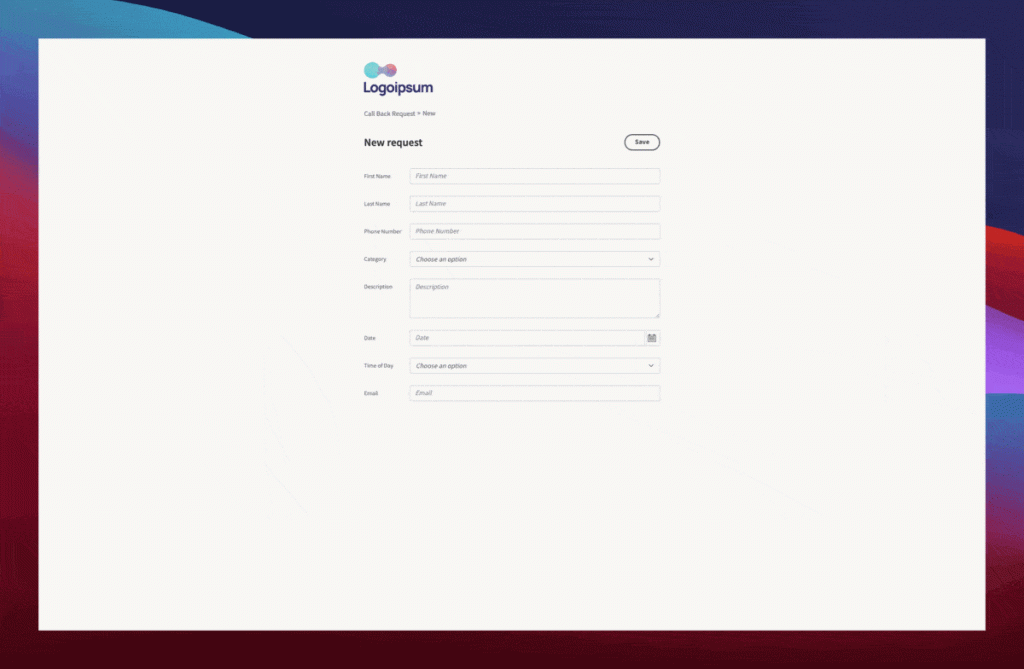
These are all too common in many specialist websites. But the reason they don’t work and result in low conversion rates is because they place the burden on the potential buyer. Learn more about Traffic vs Conversions.
Buyers often have to parse through multiple sections or pathways of a website to find a product relevant to them. Or content that shows it off in action. Or to ask a simple question to a sales rep – that they have no idea when it will get answered.
And with 80%+ of buying decisions happening online, you better believe they’ll be looking at competitor websites too. If they get an instant and interactive experience that allows them to find these things more efficiently on another site – you’re forever playing catchup.
In the Universal Robots example from the video above, as soon as potential buyers come onto the site they are greeted by the on-brand ArthUR – who asks them what he can help them with. Anything from submitting a sales enquiry to discovering the right robot for you, can be taken care of by ArthUR.
Buyers want to research and find out info for themselves. But they also want to find that easily. Signposting and personalised prompts based on their behaviour are essential to this.
In that Universal Robots example, if you click through to the full showroom of products, you can filter by product types, applications, etc. Or you can simply click back into ArthUR. But instead of showing you the same options as before, he knows he sent you to the showroom.
So now he just asks – did you find the product you were looking for? And if you didn’t, or you have a question, you can type it directly into the bot that the customer service team will get back to you on.
No sending you to a contact form page. No forced telephone or live chat options that requires a team on call. We landed on the homepage, got advice on choosing a relevant robot, saw all our available solutions, and were able to submit a question – all in a handful of clicks. And without ever having to even scroll down pages.
Hopefully the above has given you ideas for how to make the initial browsing of your specialist B2B website more interactive, relevant and instantaneous.
If you can implement a similarly efficient pathway, either through web design or conversational tech like chatbots, you’ll have a lot more people reaching relevant product and services pages.
But then you need to get those potential conversions over the line. Universal Robots do a fantastic job of this. Firstly, their product pages contain very digestible graphics, specifications, and traditional CTAs above the fold.
You can also scroll down and see tabs of images, more in-depth specs, and even product manuals in clearly marked tabs in the page. So whether it’s a product expert or a procurement department visiting the page – the user has all important info available to them.
But, remember we’re trying to make the buying journeys as simple and interactive as possible! Some users might not even want to have to scroll through these pages.
So that’s where ArthUR comes back into play. This time he pops up as an Inpage bot, as you scroll through the product page organically.
And again, without being directed to another URL, you can do anything from asking a question specifically about the UR3 robot, to seeing case studies of it in action, to downloading technical support manuals.
A product as complex as an industrial robot, summarised in an inpage bot with 5 interactive prompts. That allows the user to answer any questions they have it about – and even start the buying process.
It’s these final conversion touchpoints that have allowed Universal Robots to achieve notable commercial successes through their website recently.
Ready to find out more?
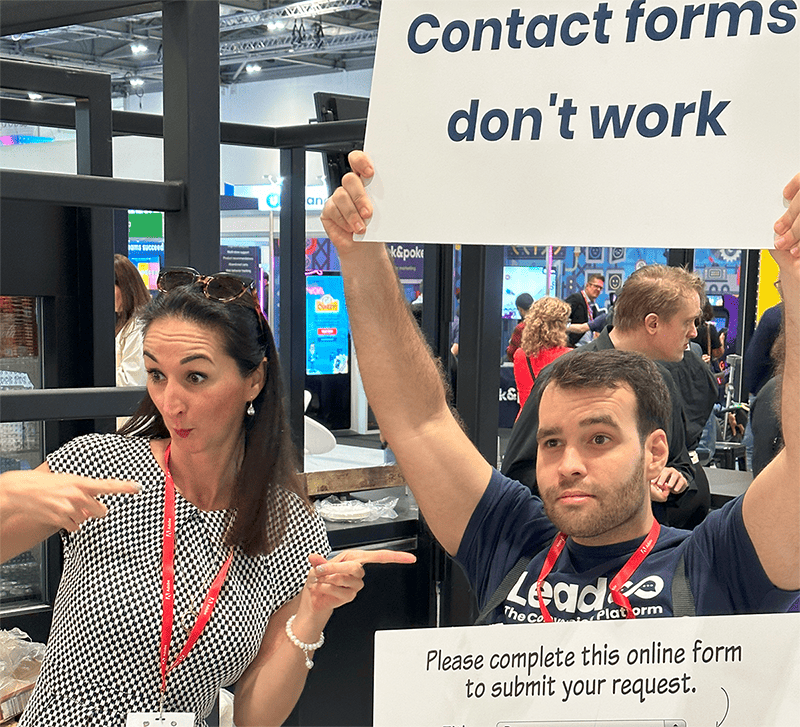
Ah, yes. The good old contact form. They’ve been around for decades, coming in all different shapes & sizes.
Unfortunately, for many websites, the journey set out for site traffic to convert to a tangible lead is often long and ugly. And contact forms are at the centre of that.
Hubspot’s blog says a good contact form should convert around 2-5%. Most of us aren’t satisfied with such a low conversion rate, so we (as savvy marketers) turn to other methods to help us be more proactive, improve end-user experience, and maximise conversions.
So without further ado, here’s 8 good reasons why you should say bon voyage to your old contact forms.
Many contact forms are U-G-L-Y.
If you’ve been on the developing end, you know how hard it is to doll up a contact form. Ask any marketer that’s worth their weight in gold and they’ll tell you that aesthetics are key when it comes to keeping site traffic engaged.
The reality is most contact forms look like they were dropped onto the page with no real care, visually overwhelming those that care to give it a second look.
They also often do not look like the rest of the site in any way, sticking out like a sore thumb, and creating brand inconsistency. Learn more about How to Increase Conversion Rates Using Visual Bots

In today’s digital landscape, people value two things above all else. Significance and convenience.
When it comes to contact forms, it can be pretty tough to try and get what you need from your site visitors without your form looking like War & Peace.
Unnecessarily long contact forms can be a massive turn off to site visitors who have made it that far, so it’s vital that you keep it short & sweet.
Research from 2022 found that contact forms with 3 fields (uncommonly short) had a conversion rate of around 25%. With 5 fields this decreased to 15%. And each subsequent field in the form significantly decreased conversion rate from there.
If you have long contact forms, you are tying one arm behind your back when it comes to conversion rate.
Contact forms feel like a significant commitment because the act of filling them out is pretty transactional.
Your site visitor hands over their personal data in exchange for a piece of information (this could be a guide, eBook or even a demo request.)
The problem is that most people are aware that the only reason they’re handing over data is so the door is opened for future communication between a business and a prospective buyer. Some may opt out of this idea entirely.
(If you haven’t got a checkbox on your contact form allowing users to opt out of marketing communications, we highly encourage you to do so!). Learn more about How to Collect GDPR-Compliant Data
Remember, it’s 2023. Data breaches are rife. Most users will not want to hand over their personal information without first establishing a foundation of trust or relevance.
This is why it’s so important for modern brands to sharpen their buyer’s journey before their traffic reaches a stage of commitment. You can do this by…

You’ve probably already experienced this yourself.
Contact forms are famous for receiving spam or even low quality lead submissions because of the fact that anybody can fill one out.
We hate to plug our product halfway through a blog, but Leadoo can actually help with this.
Your buyer’s can be routed down a variety of different options in place of a contact form, sequentially disqualifying leads that don’t meet your pre-set criteria. It’s also much harder for a bot to complete a dynamically loaded in-page bot, compared to say a contact form specifically housed on its own URL.
Below is a demonstration of one of our Visual Bots.
Give it a go for yourself and see Leadoo’s lead qualifying magic first hand. ✨
Another big issue with contact forms is the lack of any level of urgency or pressure to finish converting. Once a visitor begins engaging with your form, the decision to convert is left completely in their hands.
A traditional contact form offers no level of interactivity or urgency to convert there and then. Meaning your site traffic can abandon the conversion process pretty early on.
If this sounds pretty similar to what you’re experiencing, a contact form might not be the best option available for you.
Fortunately, Leadoo’s conversion kit offers all the tools you need to engage & activate your web traffic.
You can serve as many dynamic prompts within a Leadoo bot conversation as you like. And the nature of conversational tech itself creates much more of a sense of urgency and responsiveness, compared to a traditional contact form URL.
Another area that contact forms miss the mark is failing to tailor the user experience based on where your visitor is at in the buying journey.
A popular conversion myth is that any two conversion journeys are the same. We know that this isn’t the truth, so why treat them like they are?
Visitors who return to your site post discovery might be further along in their decision making process and might find your contact form too generic and not fit for purpose.
In contrast, offering a more personalised approach such as offering content or recommendations based on how much your visitor knows, or what content they have engaged with onsite, can help you maximise conversions.
There’s a lot of research proving that modern buyers now EXPECT and even demand personalisation. Give it to them with tools like Leadoo Personaliser.

The lack of critical data or insights is one of the biggest drawbacks when it comes to contact forms.
For example, if a thousand visitors hit your website today but only a few convert, contact forms won’t help you figure out why the rest didn’t (or how close they came to actually converting.)
Plus, if for any reason your visitors bounced due to any number of the problems listed above, you’re left with no actual valuable insights, making it guess work to try and fine tune or optimise your website experience.
This brings us to our final point…
You’re probably wondering what contact form alternatives are out there. Fortunately, there’s plenty of great products to choose from that can help you improve your chances of landing conversions from your website.
Let’s talk about Leadoo.
We help businesses convert more of their web traffic by transforming your website’s user experience using interactive content in place of legacy methods (contact forms, we’re looking at you…👀)
But what does this have to do with contact forms?
Our Conversion Kit offers a range of on-page tools that you can use to replace your contact form, offering unique experiences to every site visitor based on factors such as:
Not only do they look a lot better (example of our InPage bot below…)

They also give you all the relevant data & insights needed to provide better conversion journeys.
We’ve helped ICE InsureTech triple their quarterly website leads; vCreate increase weekly leads by 75%; and D-Tech increase their conversions by 546%.
If you’re not using Leadoo, you’re missing out 😉
A conversion rate calculator is typically used to determine the effectiveness of a website, landing page or campaign by telling you the rate at which users are completing conversion actions.
An ROI calculator weighs up campaign or marketing spend against generated revenue, and tells you whether you’ve made a profit or loss based on the value of the leads or conversions generated. So conversion rates can impact ROI calculations heavily. Learn more about Traffic vs Conversion Rate.
Our Conversion Rate & ROI Calculator will estimate the increase in web leads with Leadoo in place, using real aggregated data of how Leadoo has increased customer conversion rates across different industries.
When combined with your existing website stats, we can calculate potential increases in your conversion and lead levels. So you can make an informed decision on whether Leadoo AI is the right choice for you.
Simple. Give us your approximate number of monthly site visitors & leads and we’ll calculate the number of leads you could be getting, using historical data that we’ve recorded working with clients in the same industry, as you can see in The Conversion Crunch: 800.
If you can tell us roughly what your average order value is too, we’ll then estimate potential revenue increases and compare that against how much Leadoo costs. Which will quantify the potential return from investing in a conversion platform.
If you’d like to see real examples of Leadoo delivering ROI for customers, check out our many success stories.
Leadoo enhances conversion rates using a variety of engaging onsite bots and tools, powerful in-journey personalisation, company identification tools, sales alerts, analytics & revealing insights.
And to help you get up and running, our team will help you identify areas of quick improvement across your site where Leadoo will fit in quite nicely.
Crucially, Leadoo helps you increase conversion rates. Which helps deliver lead increases even if your website traffic stays the same – or drops.
Don’t believe us? Read here about how D-Tech increased conversions over 500% with Leadoo – despite receiving less overall traffic.
Leadoo AI has a range of different packages, accommodating businesses of all shapes & sizes.
However, the increase in conversion rates that Leadoo brings often more than offsets the cost, meaning that our conversion platform could pay for itself and then some!
As marketers, we often find ourselves researching best practices when trying to achieve an end goal. And when it comes to conversions – our ultimate goal for traffic on our websites – it is tempting to look for ‘best practice’ advice from anywhere and everywhere.
The only problem is that there’s a lot of misinformation and split opinions out there that can leave you stuck on who to believe.
And just because a strategy, technique or method worked for someone else….
Doesn’t mean it’s going to work for you too.
Here, we’ll debunk 5 common Conversion and CRO myths.
Obviously, a conversion can mean a sale, but let’s not limit ourselves here.
As a modern marketer, you’re probably already aware that most customers won’t convert after a single touchpoint. So restricting conversions to mean sales & sales only is a serious injustice to your customer journeys.
It also creates a very narrow view of your attribution, meaning you might over-value the channel that brought in the final sale, but under-value channels that contributed to it earlier in the journey.
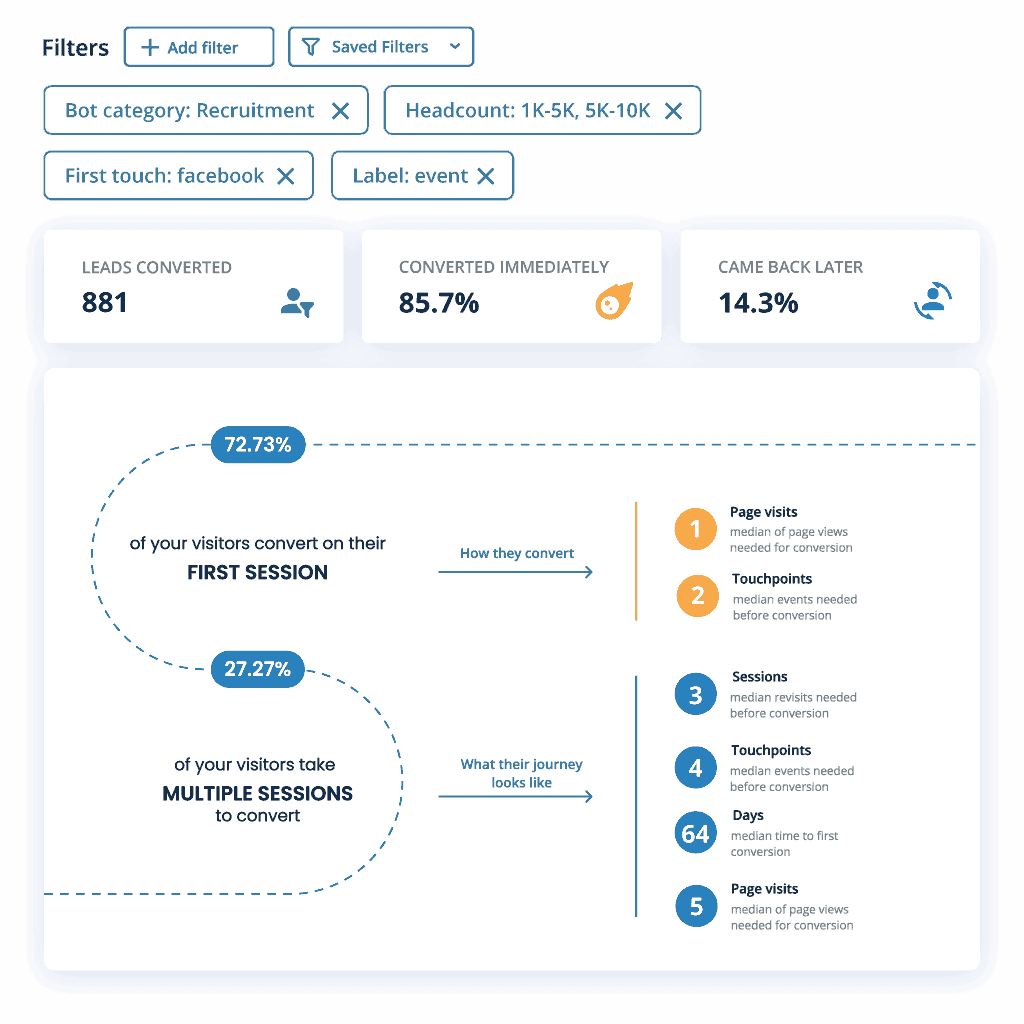
Most (eventual) customers will move through a series of different website touchpoints before they even consider buying.
At Leadoo, we have some customers with sales cycles can last a year or more. Meaning they could involve 20-30 site touchpoints and 5-10 different conversion types. Read about how we tripled ICE InsureTech’s leads here – despite their particularly long sales cycles.
Unfortunately, some marketers will focus too heavily on desired outcomes and miss out on tonnes of vital data points in between.
So, instead of hard pressing for sales as the end goal, why not open yourself up to the idea of a conversion being…

More traffic does give you more conversion opportunities on paper, however, it doesn’t guarantee an increase in conversions.
Also, if you’re paying to acquire traffic from external sources like Google or Social Ads but don’t have the right conversion strategy in place, you’ll find yourself wasting money on sessions that don’t ultimately convert.
As a matter of fact, we’ve seen a large portion of customers end up with more conversions from a similar – or on some occasions even lower – traffic levels after implementing Leadoo.
This is due to them having the right conversion strategy in place and a good understanding of their customer journeys.
They were able to become more targeted and purposeful in acquiring users, helped those users get to where they needed to go quicker onsite, and had the right tools in place to ultimately convert them.
Read about how we helped D-Tech increase conversions by more than 500% despite year-on-year traffic dropping slightly. After all, quality traffic = quality conversions.
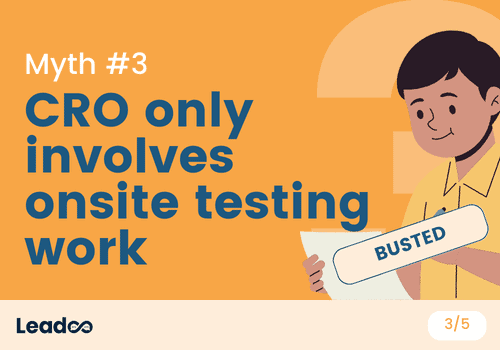
Conversion Rate Optimization is often thought about as getting many website visitors as possible to take conversion actions.
So ‘CRO tactics’ commonly involve making aesthetic changes to websites, testing different calls-to-action, visuals, or page types against each other to see which leads to the most conversions.
But true CRO isn’t just onsite tweaks & tests. It involves truly understanding customers and getting down to the nitty gritty.
The best way to optimise a customer journey is to ask yourself the following questions:
Hopefully, once answered, those questions will give you insight on what changes you need to make to maximise impact.
(Unfortunately, making your CTA buttons bigger and brighter isn’t enough 😉)
Marketers might be tempted to simply pass website leads into a CRM platform or directly to sales and then forget about them.
But just because someone completed a conversion action doesn’t mean…
Understanding true lead engagement takes time. Ultimately your best chance of being able to grasp buyer lifecycles is if you’re tracking users every step of the way, pre and post conversion actions.
If you’re interested in turning your website into a well oiled lead machine, you should probably look into Leadoo.
It’s tempting to study competitors and even more tempting to copy their approach to conversion optimization.
While there are best practices when it comes to CRO, there is no one size fits all approach for converting leads to paying customers.
All websites have different traffic sources, target audiences, technical specs, and marketing budgets behind them.
You aren’t your competitors, so why try and convert your own customers like they do?
 “Do you have a price for your product?”
As Auction House Emperor puts it, I dare say that the price of a product or service almost always interests potential buyers. Although the final buying process can be slightly more complex for an individual, price is one of the factors influencing the purchasing decision.
Leadoo’s bots offer various solutions for websites, depending on the customer’s goals or website problem areas. They work for customer service, recruitment, and lead generation – you name it.
When building bots, it’s essential to recognize customer behavior patterns on websites and provide answers to frequently asked questions. Kristiina Suomalainen, a content creator at Leadoo Marketing Technologies, has noticed a trend related to website behavior:
“Questions about pricing have received a significant number of clicks from potential customers in the bots on websites. Often, price information is not readily available on the website, or it is difficult to find. That doesn’t really serve the customer.”
Clear pricing creates concreteness for the customer about what they are getting and at what price. It can even act as a competitive factor and help the customer compare different options more quickly. However, transparent and clear pricing is not always possible if the price is influenced by the sum of various factors. This is where Leadoo’s VisualBots or calculator functionality can provide a solution.
Price Calculator as the Most Enticing Element on Websites
Currently, price calculators have been created for Leadoo MT’s customers, for example, in the construction, renovation, and cleaning industries’ websites. It is clear, though, that a price calculator does not add the same value to all industries. Industries that can provide concrete examples of product or service prices work best with price calculators.
“Sometimes customers might be a bit hesitant to discuss prices, so you have to justify why a price calculator is a very effective element on websites for certain industries,” Kristiina explains.
Although the primary purpose of the price calculator is to offer the customer a price estimate for a product or service, it’s also excellent for lead generation:
“It works really well for lead generation, as the customer easily gets hooked on clicking options and often provides their contact information afterward.”
There are two different methods used to build price calculator bots. In the first method, a price estimate is given after the customer has provided their contact information. This allows for a more personal approach to the customer, either by phone or email, and the conversation can easily continue even after providing the price estimate.
In the second method, the bot offers the customer a price estimate directly after the conversation and then asks for contact information or suggests, for example, booking an appointment. This option allows for a quick price estimate, and the customer can decide immediately whether to continue with the buying process.
Kristiina from Leadoo MT is an experienced creator of price calculators and says that a good and enticing price calculator consists of simple questions, clarity, and the use of images. It’s best to avoid open text fields, as predefined options keep the process quick and easy. A price calculator can be made into a visual element that will undoubtedly not go unnoticed on the website.
Visual Price Calculator Clarifies Options
Price calculators can be created, for example, in the form of a VisualBot or InpageBot. Don’t worry if these terms are unfamiliar to you. The following bot shows what VisualBot-created price calculators have looked like on our customers’ websites.
Quick and Easy Conversation for Immediate Price Estimate
The next price calculator is built in the form of an InpageBot, which visually resembles a more conversational bot. However, InpageBots can also display illustrative images, as shown in the examples above.
In the example below, the calculator function is utilized, which shows the price estimate
Content was always the king, clickbait is the new queen, and content that actually converts is the newly appointed, well-trusted advisor that keeps the royal family in check. If you take nothing else away from this article, know this – ultra-converting content is what makes your audience trust you and want to do business with you again.
It’s not about the quantity of content provided but the quality and value that content brings. Your prospects don’t care how much content you can produce or how many blog posts you have on your site – they care about whether they can trust you and whether your content (and your product) solves a problem they have. This means that creating content that converts isn’t just a nice-to-have but an essential part of any digital marketing strategy.
Let’s take a look at some of the best practices for creating content that converts:
Your first task when considering what content you should create is to understand your audience. You can do this a few ways:
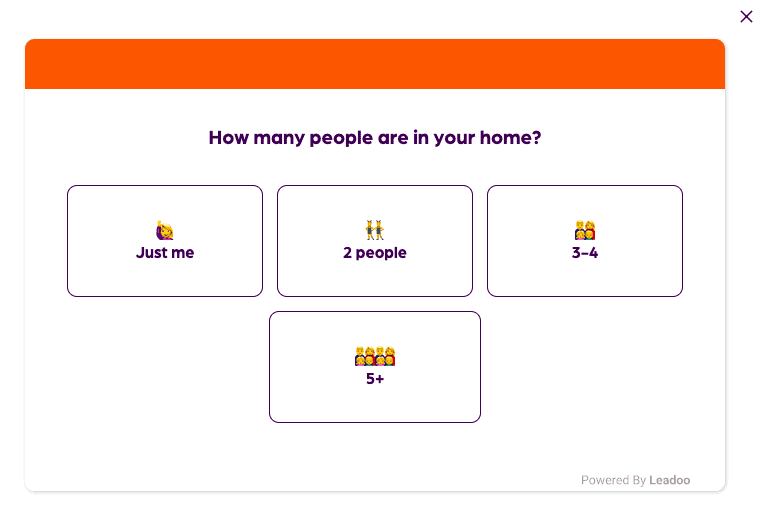
✅ Consider using surveys and polls to get direct feedback from people who visit your site. The more you know about each visitor and their interaction with each piece of content and their individual levels of intent, the better content you can create to meet their needs. This can be easily achieved using Leadoo’s VisualBot in quiz format, as shown below:
✅ Keep track of which content gets the most views and shares. You can do this by using Google Analytics to look at your each page, the number of views, average time spent on page, and your bounce rate. This provides insight into your customers interests, and means you can create more of the content they have shown interest in, making them more likely to convert in the future.
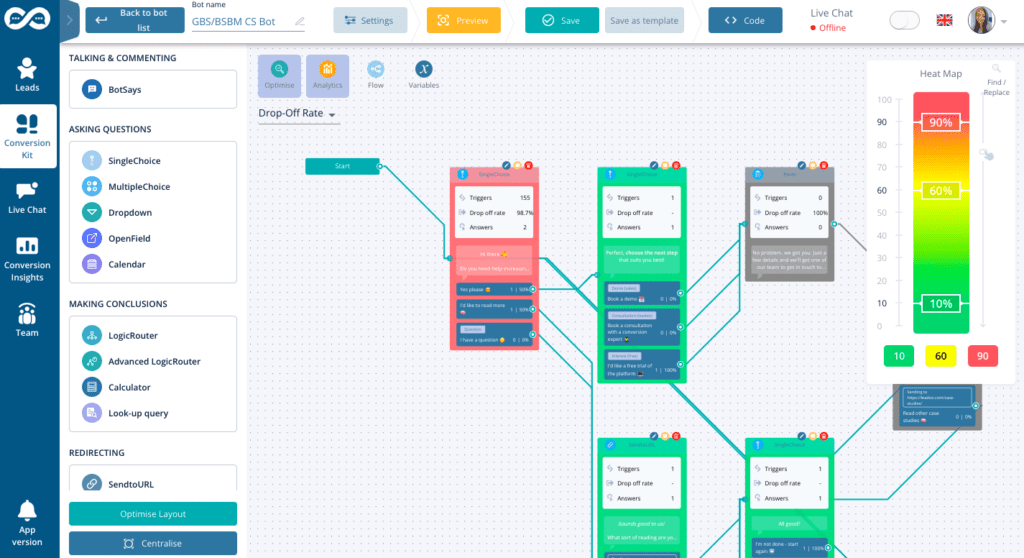
✅ Use data from your analytics software to see which content gets the most engagement. You can again use Google Analytics for this, but it will only give you the interactivity with the page overall and not any interactive elements that are on it. Using a more specialist software, like Leadoo Conversion Platform, allows you to see the interactions with interactive elements on a deeper level, such as through the use of heat mapping to show which specific conversation pathways convert visitors, and which need editing to improve their bounce rate.
Visual content is proven to be almost 40% more likely to be shared than plain text, and most of us spend enough time on TikTok and Instagram these days to know that there’s something about visual imagery that seems to speak to our soul. We find it much easier to digest and accept information that’s presented in an easy-to-read and visually stimulating way, than one that’s presented in a flat, static format.
You can of course use images carefully to break up your content and make it easy to read, creating a flow that keeps your readers’ attention. You could also embed video content, tailored to specific customer preferences. Bear in mind that the format of your video could impact its performance. For instance, a tool like VEED’s video converter can help you manoeuvre different video formats like AVI, MKV, and WAV with ease, allowing for optimal video performance.
It’s not anecdotal either; according to a study by Hubspot, the average person will spend 88% more time on a website that has video content. What’s more, 94% of marketers say that including video in their marketing efforts has improved their overall ROI. Social media channels are increasingly focusing on video content, with LinkedIn being the latest algorithm to prioritise video content over text. Your visuals don’t have to be bells-and-whistles or massively complicated either – you can create some simple visuals using a tool like Canva. You can also use things like GIFs or memes to make your point. Just make sure that the message is clear and easy to understand.
Your calls to action should be clear and concise, and littered in places that make sense for the visitor’s journey as they navigate your site. If they are reading a blog, then you might offer them the option to read more (and hopefully start to move down the buying funnel); if they’re spending long periods on your product pages, but haven’t filled out your 30 page contact form, then they probably need something a bit simpler in order to convert. Nobody wants to fill out a 30 page contact form, no matter how much they want your product.
How many CTAs you use, and their phrasing, will be somewhat determined by the type of content that your visitor is engaging with, and where in the funnel that visitor is – a visitor who signs up to your informative marketing newsletter is probably not as far down the funnel as someone who’s looking to book a demo, and your CTAs need to be reflective of this.
For example; if your content is a blog post, include a CTA in the article; if your content is a video, make sure you include a CTA in the description; if your content is a podcast, make sure you include a CTA at the beginning and end of the episode. Think carefully about where in the funnel the consumers of your content are, and provide them a CTA that is relevant to them.
Interactive elements are a great way to not only keep your readers engaged, but they’re also a good way to show off your expertise. They can take the form of quizzes, polls, calculators, or a simple contextual conversation about whatever the visitor is reading or looking for.
Leadoo Conversion Platform has the perfect toolkit for you to provide all the interactive elements your site needs to make it extra converting – and the analytics to enable you to monitor, and optimise for, conversions. The Conversion Kit contains an array of bots. But they’re not just any old chatbots – there’s different solutions for a whole host of use cases: InpageBot is designed to slide seamlessly into your content, so sneaky that nobody even notices it’s a chatbot, but always in the right place at the right time nonetheless; Chatbot, in the traditional format you know and love but with much improved capabilities; VisualBot, for when you want to include visuals as part of your bot and really engage the visitor; as well as SmartForms, LiveChat capabilities, Callback CTA, and the newest addition to the kit – the Leadoo Sales Assistant.
We must add a caveat when recommending interactive elements as a way to improve conversion – it’s really important that you consider the ‘heaviness’ of interactive elements and the impact this could have on your rankings on Google. If you implement interactive elements which slow down your page load speed, Google will lower your page’s ranking. Leadoo’s solutions are all designed to be lightweight and have little to no impact on page speed. You can find out more on our Leadoo and Page Speed/SEO blog article.
Ultra-converting content isn’t something you can create overnight. It requires well written, relevant content, interactive elements, and solid calls to action to increase the number of conversions you get across your website. Get it right though, and your sales team will love you forever.
What if we told you that you can use the power of interactive content to boost your conversions and drive user engagement at the same time? Sounds like a win-win situation, right? Interactive content is fast becoming one of the hottest trends in digital marketing because it offers brands many benefits – the first of many being that it enables users to take action immediately instead of just reading or watching content.
By definition, it is quite simply exactly what it sounds like: content that gives people the choice to interact with it in some way. It doesn’t matter if the interaction comes from clicking on an image, swiping through an article, chatting to a bot, or any other method really – as long as there is some kind of interaction involved. This type of dynamic content creates a much more personal experience for users and engages them in something a bit more interesting than the usual flat, static content.
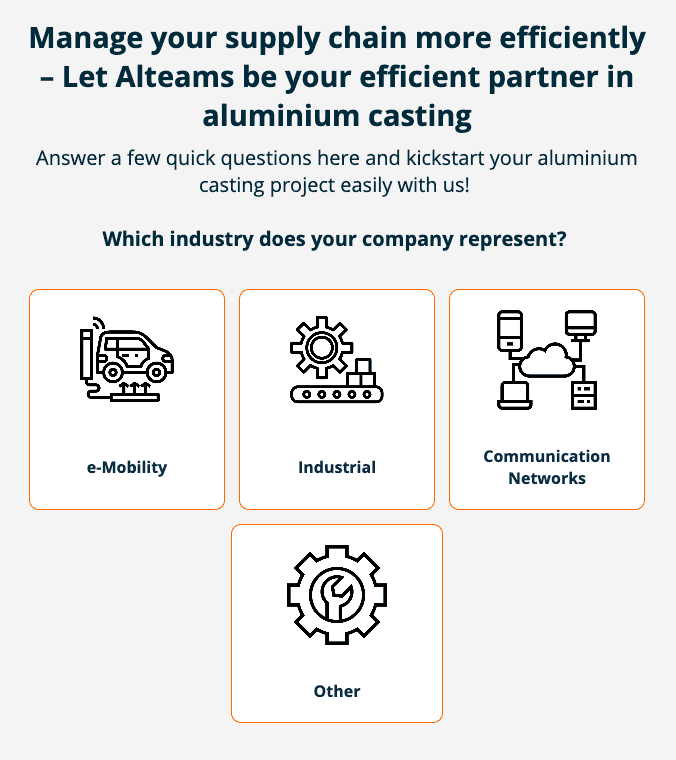
The VisualBot pictured above is taken from Leadoo client AlTeams, who use the bot to help engage visitors to help provide insight to their intent.
Firstly, an interactive experience creates a stronger connection between visitors and your brand by making the interaction more memorable and personal – meaning that from the outset, users have a positive view of your company and its product. Today’s visitors expect personalisation as standard, and to integrate this with some level of interactivity only helps to build trust in your brand and its products.
By engaging and activating your visitors with a variety of interactive content, you garner their attention, pique their interest and get them thinking about your product. When a user is given the option to decide how they interact with your content, they’re more likely to form a positive connection with you and your company, making you more memorable and giving that visitor a better experience. People also tend to more easily remember interactive experiences than they do passive ones, especially if that experience is something extraordinary or something they’ve not seen before.
Interactive content can also be an excellent lead generation strategy. This is especially true if you create a level of challenge for your visitors – by offering a quiz, or the opportunity to test themselves or compete against others, you not only engage the reader and improve your rapport with them, but you also – when done right – helpfully get their first party data too. After all, if they really want that branded bandana for their dog, they’ll give you the details to make it possible for you to deliver on your promise.
Activation and engagement of your visitors is proven to help with increasing conversions, and so by providing interactive content you increase the likelihood of this happening with each visitor, driving them to take action. That could mean signing up for a newsletter, making a purchase, or taking any other step towards the conversion goals you set out when creating your site and content. This helps you to feed your sales team’s pipeline with potential leads, as well as a notion of their level of intent based on the type of conversion they complete.
This brings us to possibly the most important reason why interactive content is so effective – assessing customer intent and collecting their data – so you know where they’re at in the buying funnel and make strategic decisions to nurture or prospect them based on the information available to you. You could even create super specific retargeting campaigns that speak to your customers about their problem and how your solution can help. In addition, you can use this information to make your content even more engaging, if you have the tools that allow you to see what works, and what doesn’t.
The best way to use interactive content to increase conversions is to make conversions the focus of your marketing efforts. This will ensure anything you create is done so with the intention of qualifying and converting the customer, and interactive content should form a key part of this process.
You can utilise interactive content to increase conversion by:
As you can see, interactive content is a powerful tool that can be used to build trust and rapport with your communities and visitors, improve your understanding of your customers, and increase the number of visitors you convert through your website.
Content is king. The cliche that we as marketers are quite used to hearing by now. We’ve invested heavily into content marketing, as many companies have, and yet the rewards of those efforts are not as great as we’d hoped. It’s a scenario many find themselves in – being seemingly unable to drive conversions using content marketing – and that’s because their current strategy needs a few tweaks.
Content marketing is the process of creating and distributing valuable, relevant, and consistent content to attract and retain a clearly defined audience – creating content that helps attract buyers and piques their interest in your products in a more covert way; gently, and nurturing. Content marketing gives your brand authority within your space, helps with your SEO efforts, and allows you to target each of your buyer personas with the content most appropriate for them, leading to them spending more time on your site and giving you lots of information about their intent (which you can act upon later).
It’s probably a good idea to cover some of the conversion basics before we launch into how content marketing can help improve your conversion rate. If you’re a seasoned marketer and don’t need a reminder, you could remind yourself of the conversion rate benchmarks for your industry, or skip to the meat of the article below 👇
Conversion
A conversion is any desired action a visitor takes on your website, and these can be split into hard and soft conversions. Hard conversions are the final click of the button when a customer requests a demo or discovery, or checks out their basket in a B2C situation. These are the actions that directly contribute to revenue and so are important. But soft conversions can be just as vital – these are smaller actions customers take on your site, such as downloading a guide or subscribing to a newsletter. Whilst these actions don’t link immediately to revenue, they do give us an insight of customer intent (and therefore potential revenue in the future). Focusing on soft conversions too provides us with the opportunity to understand, and be able to nurture, our prospects and encourage them towards making that final purchasing decision no matter where they are in the buying funnel.
Conversion Rate
The conversion rate of your site can be calculated using a simple equation, but is also available for you to see on Google Analytics (or some other analytics platforms, like Leadoo). Your conversion rate tells you what percentage of visitors are converting into leads on your website. It’s calculated using the following formula:

Or, if you’re like us and you like it when technology does things for you, you can use our free Conversion Rate Calculator to work your conversion rate out.
Conversion Rate Optimisation
This simply means taking action to improve your conversion rate. There are many things you can do to optimise for conversion, and we’ll be looking at some ways that you can optimise your conversions by optimising the content on your site.
Most marketers are familiar with the AIDA model, or some variation of it. The model exists to describe the buyer’s journey, and the phases they go through when they are considering purchasing a product or service. The model works as follows:
Attention (also known as awareness): If a prospect is in the awareness phase, then this is where you’re aiming to provide awareness of your company, brand, products, and the value you can offer. At this stage, you are looking to grab the attention of your prospects in a positive way. This could be through meeting some charming members of your team at an event, or through informative and helpful content on your blog. The theme of the day is demonstrating high value to them, delivered concisely.
Interest: When a prospect is in the interest phase, your job is to convince them that they have a potential need for your product or service – ideally to the point that they’re ready to do more research into the product. This is again a critical point in their journey to explain the value you can bring to your prospect, as often they’ll be researching and comparing with competitors. At this stage, you’re looking to garner their interest so that they want to learn more. This could be via content on your website such as industry and business relevant case studies that resonate with your prospects and evidence the value your solution can bring.
Desire: You’ve successfully grabbed their attention, and piqued their interest so they’re looking for more. Now your job is to make them want your product, to think of nothing but your product… Ok, maybe that’s a bit far (although it would make the next step a little bit easier if that’s how they felt). This is the point where they’re starting to seriously consider the product, and so you want to provide materials such as competitor comparison whitepapers, success stories and case studies, as well as pricing and FAQ information.
Action: Action is the phase where you’ve finally convinced them with enough evidence that they should take action to buy the product or service you’re offering.
During each phase of the buyer’s journey, prospective buyers have different wants and needs for the types of content they’d like to see relating to their level of intent. This is something that businesses often get wrong, but if you want to drive conversions then you need to do that during all stages of the process, and not just at the end.
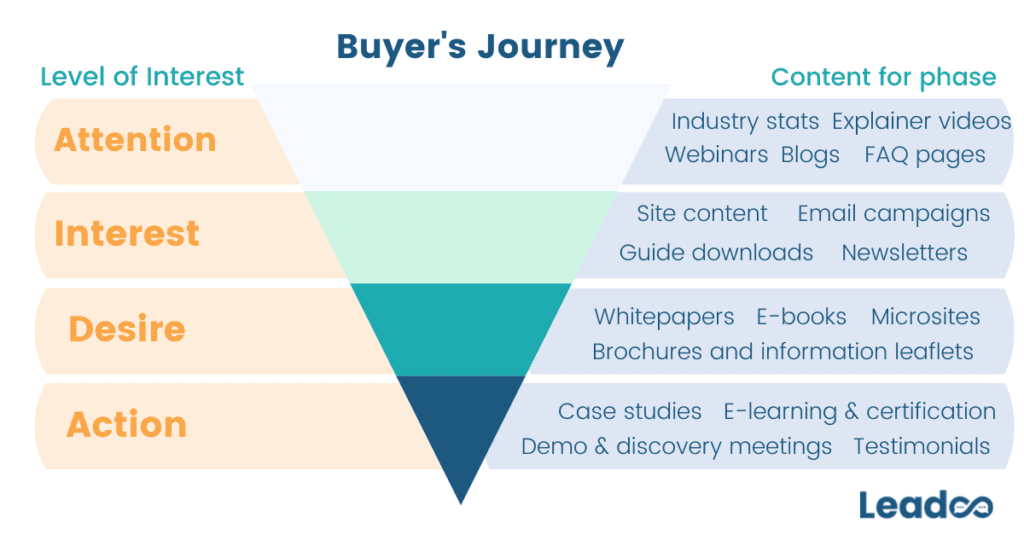
The type of content your buyers are selecting to read or engage with as they move through their journey also makes a difference in determining their intent – we refer to these as soft conversions (for example, a prospect downloads a guide or signs up to your newsletter). They’re not final conversions linked directly to revenue generation, but they do give us an insight into each visitor’s wants, needs and position in the buying funnel.
We can even take the information gleaned from our content creation and customer engagement to further improve the offer we provide and come closer to meeting customer needs. Let’s say you realise that customers who tend to visit Page A, also tend to immediately visit Page B. This could mean a few things;
A simple fix would be to look at the time spent on each page and what was interacted with to work out what people are seeking on Page B, then look to move some or all of this over to Page A – shortening the time it takes your average visitor to convert.
We’ll take a dive into how you can optimise your content marketing efforts for conversions using 3 easy steps.
Every customer that visits your website isn’t ready to convert there and then; 96% of people who visit your site, on average, aren’t. Only 2% on average actually convert. So your job, on top of trying to increase the number of hard conversions you get, is also to focus on the vast majority – the people who aren’t at the bottom of the funnel quite yet.
This means you need to create content that speaks to the prospect at each stage of the journey. You wouldn’t, for example, publish a white paper text in its entirety as an advert. Not only because logistically – and visually – it would be a mess, but because someone you’re targeting with an advert has a different level of intent to someone who would be willing to take the time to read a white paper. With an advert, you’re tailoring your message to those in the Attention (and potentially even Interest) phase of the buyer’s journey – providing them with the facts that will make them look for more.
With a white paper, you’re looking to provide detailed, analytical information which often provides a formal comparison or explicit value offering.
Your content should have the same consideration given to it – who is going to see this content? What are they likely to be looking to get out of this content? How am I going to make them want more or take the action I want them to take?
You can easily create content with generative AI tools like WPSEOAI.com that isn’t only great to generate content, but especially to generate SEO optimised content as well.
One of the first issues our Conversion Experts tend to identify regularly across many clients who we work with in their initial phases is that they usually aren’t using their Call to Actions effectively. They have poor placement, bad phrasing, or a lack of CTAs all together. There isn’t a correct answer for what works perfectly for your customers, so much of this optimisation relies on A/B testing different phrasing and button placement/visuals to find the most optimal CTAs for your customers.
In addition, many clients also simply don’t have CTAs (instead offering a contact form only – or perhaps worse, just a telephone number or email address), or don’t have enough of them. Placing CTAs isn’t an exact science, as mentioned above, but having them on the page in the first place is an excellent place to start. They should be located in places that make sense for the journey each customer goes through – for example, after a paragraph of important information has been given that might help a customer decide they’d like to get in touch or to be able to arrange a demo.
Within longer form content pieces, you should look to provide a CTA at least at the end of the article. You can also provide links throughout to other pieces of your own (or external) content, to signpost the reader to other articles which they might find useful and to push them down the funnel and closer to converting.
Personalised experiences are the gold standard of our time, and so it’s important that any content you’re providing is not only tailored to the visitor’s location in the funnel, but also to their interests and needs. This be achieved by creating more dynamic CTAs through carefully crafted bot conversations – through a single bot you can offer for the visitor to read more, and signpost them to other relevant articles, book a demo, find answers to FAQs and more, all in one place to meet needs of customers at the different stages of the funnel.
In addition, by using high-quality bots, such as the Leadoo InpageBot, you can embed a contextual conversation straight into the content you’re working with. For example, if your visitor is looking at your pricing page, then the bot on that page will only discuss pricing packages and topics you deem relevant to this with that visitor. The same approach can be taken across the whole site, ensuring customers receive valuable help and guidance alongside the content itself that is always in context and in tune with the customers’ needs.
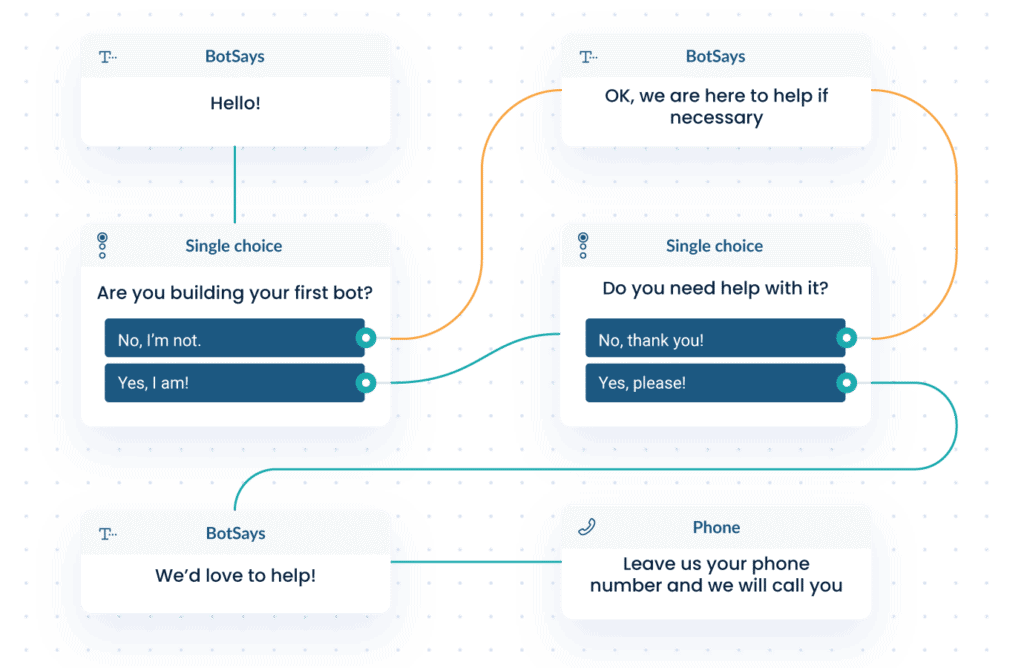
By placing Leadoo bots, this also allows you to understand a prospect’s position within the buyers’ funnel and analyse their intent through conversation-level analytics, as to well as the support of our Conversion Experts – here to continuously optimise your bots to meet the needs of the visitors coming to your site.
Content marketing can be easily utilised to help optimise your site for conversion by providing a seamless experience for every visitor – no matter their intent or stage in the funnel. By focusing on soft conversions and accommodating for these, you can ensure your content speaks to more visitors on your site, and increases the number of conversions along the way.

