AI chatbots have never been more accessible. At Leadoo, we’ve seen great success with our AI-powered conversational tools and our internal AI Bot Builder feature that lets customers draft new bots from scratch with AI.
With modern LLMs, no-code tools, APIs, and AI development frameworks, it’s now possible for some in-house marketing and development teams to build website chatbots themselves.
Teams understandably ask “Can we build this?” when looking at conversational marketing solutions. But as we’ll lay out here, the real questions are:
Just because you can build it – should you? And what will it ultimately cost?
Because while launching a basic AI chatbot is easier than ever, building one that actually performs, scales, stays compliant, continuously improves, and doesn’t balloon in cost is significantly harder than most teams expect.
In reality, many companies discover that the hidden costs, operational burden, and long-term ownership challenges make in-house AI chatbot development far less viable than initially imagined. And the horror stories of when in-house chatbots go wrong are very damaging indeed.
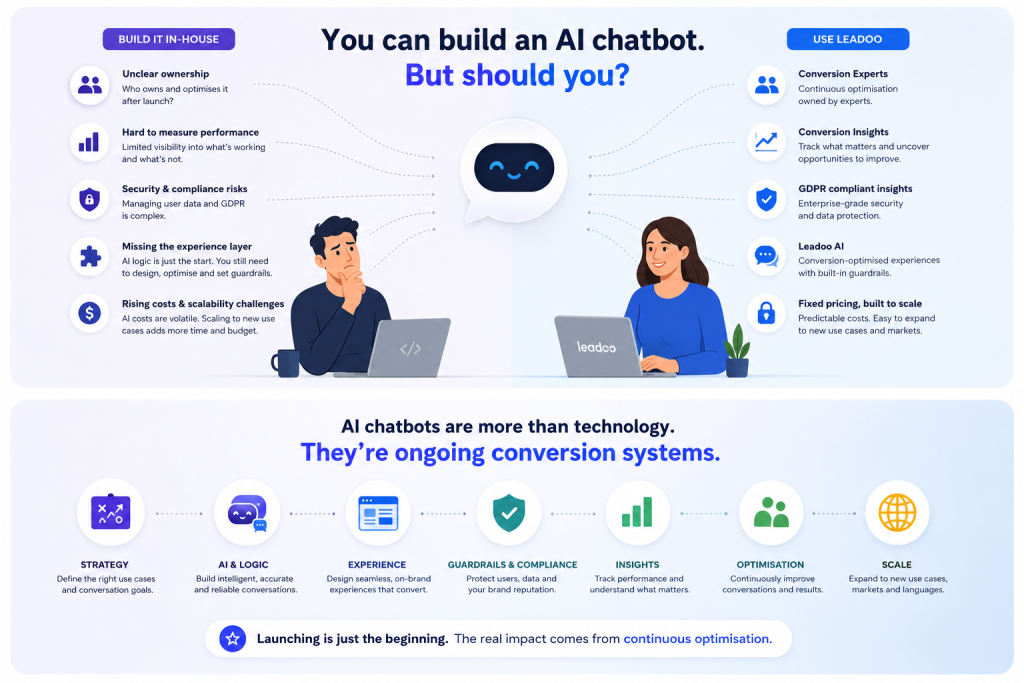
Building the Bot Is the Easy Part
Most AI chatbot projects begin with excitement.
A team experiments with OpenAI, Anthropic, or Gemini APIs. They connect a chatbot to the website. They upload some documentation. Maybe they even launch a pilot within a few weeks. Technically, it works.
But then the real questions start appearing:
- Who owns this long-term?
- How do we know if it’s converting?
- How do we manage hallucinations and guardrails?
- What happens when marketing wants new or edited journeys?
- What about GDPR compliance?
- Why are AI costs suddenly rising every month?
- Why are users dropping off halfway through conversations?
This is the moment many businesses realise:
AI chatbots are not just software projects. They’re ongoing conversion systems.
And successful conversion systems require strategy, optimisation, analytics, governance, and continuous improvement.
Who Actually Owns It After Launch?
One of the biggest challenges with in-house chatbot projects is ownership. At launch, there’s usually enthusiasm and cross-functional collaboration. It is the newest and shiniest thing on the website after all.
But several months later, ownership often becomes unclear, especially as the difficult questions above start popping up. Without clear accountability, many AI chatbot projects quietly stagnate.
The chatbot remains live, but nobody is truly responsible for improving it. This is where businesses often underestimate the value of a specialist conversion partner.
With Leadoo, optimisation doesn’t stop after implementation. All customers get dedicated Conversion Experts whose role is to continuously improve performance, refine journeys, identify friction points, and maximise ROI.
Because launching a chatbot is not the finish line. It’s the starting point. Check out the quality and value of our customer service for yourself on review sites like G2.
How Do You Know It’s Actually Working?
Many businesses measure chatbot success incorrectly or incompletely. They focus on number of conversations, engagement rates, or time on site.
But none of these metrics necessarily translate into business outcomes. The real question is:
Are my chatbots driving conversions? And if not:
- Where are users dropping off?
- Which journeys perform best?
- Which audiences convert most effectively?
- Which pages need different or bespoke AI experiences?
Most DIY AI stacks provide logic and infrastructure, but very little meaningful conversion insight.
This creates a dangerous situation where teams assume the chatbot is successful simply because it exists. Leadoo approaches this differently.
Through advanced Conversion Insights, businesses can clearly understand how conversational journeys influence pipeline generation, lead quality, conversion rates, and customer behaviour.
More importantly, optimisation becomes continuous rather than reactive. Because AI without performance visibility quickly becomes expensive guesswork.
Security & GDPR: AI Compliance Is Complex
Security and compliance are unfortunately sometimes treated as secondary concerns during AI experimentation. Until legal teams get involved.
Or customer data starts flowing through prompts…
AI chatbots frequently process personally identifiable information. And many businesses underestimate the operational complexity of managing this securely and compliantly.
Key questions that any AI chatbot builder or provider MUST be able to answer include:
- Where is data stored?
- Which models process it?
- How is consent managed?
- How are prompts logged?
- What happens to sensitive information?
- Are conversations used for model training?
- Is everything GDPR compliant?
These concerns become even more significant for companies operating across multiple regions and jurisdictions. And in-house teams frequently cannot answer these without getting into an uncertain legal minefield. Leadoo’s platform is built with GDPR-compliant insights and enterprise-grade governance in mind – reducing risk while allowing businesses to scale conversational experiences confidently. Because compliance is not something you bolt on later.
The Experience Layer: AI Logic Alone Isn’t Enough
This is one of the most overlooked challenges in AI chatbot development. Most AI tools provide the intelligence layer.
But they don’t solve the experience layer. And the experience layer is what users actually interact with. It includes: UI and conversational design; timings and triggers; mobile responsiveness; brand consistency; guardrails and fallback handling; and escalation paths.
In practice, companies often spend far more time designing and refining user experiences than building the AI itself. And without careful optimisation, AI chatbots can easily become inconsistent, off-brand or just generic (see the famous Air Canada example).
Worse still, poorly implemented, or just non-optimised, AI experiences can actively harm conversion rates and customer trust.
Leadoo AI combines conversational intelligence with conversion-optimised user experiences and built-in safeguards. Helping businesses deploy AI experiences that are not only intelligent, but commercially effective, with the help of Conversion Experts.
Because users don’t judge your chatbot on its architecture. They judge it on the experience. Here’s an example of how Leadoo AI can dramatically improve UX – even in a highly regulated industry.
Cost & Scalability: The Hidden Economics of DIY AI
Many companies pursue in-house AI chatbots because they assume it will reduce costs.
Initially, this can appear true. The first prototype may only require a developer and API access.
But costs rarely stay there. As adoption grows, complexity grows too. Before long, the organisation isn’t managing ‘a chatbot’. It’s managing an evolving AI platform.
And unlike Leadoo’s fixed package pricing, internal AI infrastructure costs are highly volatile with changes to AI models; token usage; and increasing computational requirements.
Internal teams also absorb hidden operational costs when it comes to maintenance, prompt tuning, analytics integrations and setup, QA and infrastructure monitoring.
What initially looked cheaper can quickly become significantly more expensive.
The Integration Problem Nobody Talks About
AI chatbots rarely operate in isolation. To create meaningful business outcomes, they need to connect with CRM, MA systems, analytics tools, or product databases.
Every integration introduces additional complexity, maintenance, and failure points. And when something breaks, diagnosing whether the issue sits within the AI or integration layers can become extremely time-consuming for internal teams. And can reignite the ownership question we mentioned earlier.
This is another reason most businesses eventually prefer managed conversational platforms over fragmented DIY stacks.
Speed Is Important, But Sustainability Matters More
There’s no question that modern AI tools have democratised chatbot development. Businesses absolutely can build powerful AI experiences internally.
But the more important consideration is whether they should dedicate long-term internal resources to owning, managing, optimising, securing, scaling, and continuously improving those systems.
Because successful AI chatbots are not one-time projects. They are ongoing commercial programmes. And as shown, if they go wrong, it can be catastrophic for internal teams.For many businesses, the true challenge is not launching an AI chatbot. It’s sustaining one successfully over time.
That’s where Leadoo AI and our Conversion Experts shine.