PPC and Leadoo AI: How We Help Marketers Get More From Their Paid Ads
Paid advertising is one of the fastest ways to drive traffic to your website. But it’s also one of the easiest ways to waste budget.
If you’ve ever looked at your PPC reports and thought “We’re paying for the clicks… but where are the conversions?”, you’re not alone. Many marketers pour significant spend into paid search and paid social, only to see visitors bounce, hesitate, or disappear without taking action.
This is exactly where Leadoo AI helps marketers bridge the gap between clicks and conversions.
We combine PPC with personalised onsite conversations to dramatically increase the value of paid traffic. Let’s break down what that means, and how you can apply it.
The PPC Problem: Paying for non-converting Traffic
Pay-per-click (PPC) generally works. It generally gets relevant people to your site at relevant moments.
The issue? What happens after the click?
Many paid visitors bounce for two main reasons:
They don’t have time or interest to read through an entire landing page
They’re not ready to buy yet, but might be later
Either way, the cost is the same. You’ve already paid for that click.
This is one of the biggest leaks in paid ad performance. If your landing pages rely only on static content and forms, you’re asking visitors to do all the work themselves. And they will make decision to either buy, or not buy, they choose the latter 98% of the time on average.
Why Landing Pages Alone Aren’t Enough
Even the best-designed landing pages can struggle to:
Address every visitor’s intent
Adapt to different keywords or ad messages
Engage users who are still researching
Provide answers to their specific questions or concerns
PPC traffic isn’t one-size-fits-all. Someone searching “enterprise chatbot software” has very different needs from someone searching “website lead generation tools”, even if they land on the same page.
Without personalisation, both visitors see the same experience. And that’s where conversions (and budget!) are lost.
The uncomfortable truth is: if you’re paying to get eyeballs onto your landing pages but aren’t engaging them onsite, you’re leaving money on the table.
How Leadoo Unlocks More PPC Value
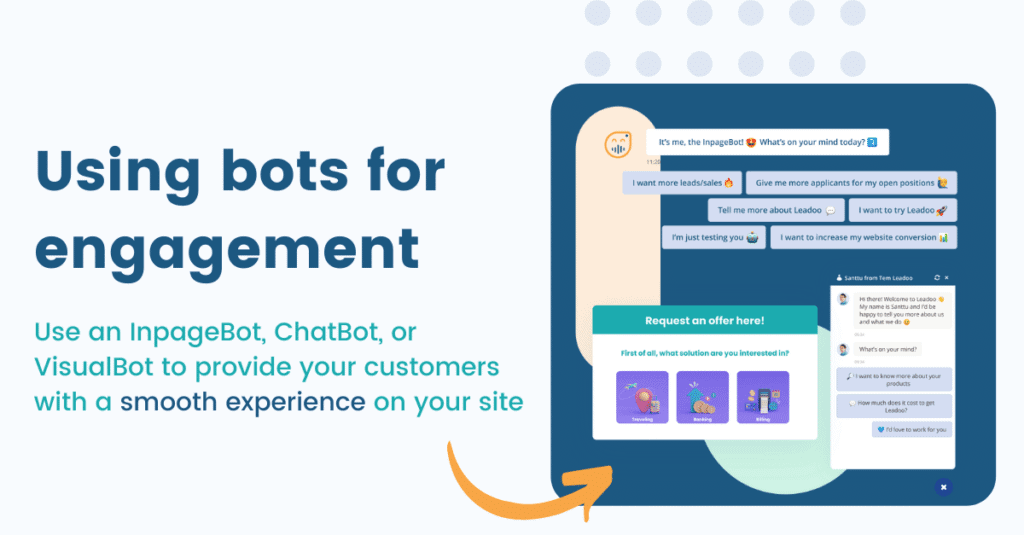
Leadoo adds conversational tools to your paid landing pages. Turning passive landing pages into interactive experiences.
Personalised bots for specific keywords and ads
Instead of hoping your landing page copy covers paid visitors’ needs, Leadoo allows you to:
Match bots to specific landing pages
Tailor conversations to keywords, ad copy, and search intent
Ask directly what the visitor is looking for, and start nurturing from there
So if someone clicks an ad tied to a specific feature or problem, the bot immediately continues that conversation. Without making them hunt for answers. This keeps users engaged in the moment, when their intent is highest. And when you’ve just paid money to acquire them!
Not every PPC visitor is sales-ready. That’s not a problem. In reality, the majority won’t be at any given moment.
Leadoo helps you:
Qualify visitors conversationally instead of forcing a form
Offer helpful next steps (content, demos, downloads, consultations, etc)
Capture intent and data without pressure
Instead of losing those visitors forever, you keep them engaged and moving forward. Turning paid clicks into future opportunities.
Why Conversational Engagement Boosts ROI
When you combine PPC with Leadoo, you’re no longer just paying for attention, you’re paying for interaction.
This means:
Lower bounce rates on paid landing pages
Higher engagement from high-intent visitors
More qualified leads from the same ad budget
If you are paying to bring someone to your digital storefront, the only way to truly maximise ROI on that spend is to engage them properly. Just like a store assistant would do in a physical store.
PPC and Leadoo AI: Scale Your Paid Ads
Paid Ads are often a key growth channel. But scaling PPC sustainably means getting more value from every click, not just buying more traffic.
By combining targeted ads with personalised onsite conversations, Leadoo helps marketers:
Reduce wasted ad spend
Improve conversion rates without redesigning pages
Turn more paid traffic into meaningful conversations
If you’re serious about maximising your paid ad performance, the next step isn’t more budget. It’s better engagement.
👉 Want to see how Leadoo can help you get more out of your PPC spend?
Why are we always so focused on traffic?
As marketers, we’re bombarded with advice and proposals for acquiring more website traffic.
A quick skim through a marketer’s LinkedIn feed is likely to include everything from the latest tips for ranking highly in Google, to how to increase PPC click rates, to email open rate advice.
More traffic from any of these sources can be invaluable to marketers. And there are plenty of qualified agencies and consultants who can improve performance in these channels.
It’s easy to get caught up in the idea that more traffic equals more conversions. Many marketers seem to have this idea that if they keep flooding traffic through the gates, eventually, they will convert into leads or sales.
But since our websites are our digital shop fronts, let’s think about a shop…
Imagine you’ve just opened a brand new retail store. You’ve got your products set out nicely, the atmosphere of your store is very trendy and appealing. You’re also in a prime location that gets a lot of footfall, and people are coming into the store regularly.
The only problem is they aren’t buying as much as you need them to.
You’ve got a hiring choice. Do you…
Hire a sign-spinner or leafletter to try and drive even more people into your store?
…or…
Hire a sales assistant in the store to help and engage customers, thus increasing the chance of them buying something?
For most people, the answer is obvious. You’d turn your attention to trying to get the most out of each potential customer who you’d already brought into the store.
Unfortunately when it comes to websites, marketers often fall into the trap of buying digital sign spinners or leafletters. Simply focusing on driving as much digital footfall as possible, hoping the website will convert in roughly the same way it always has.
Unfortunately, expecting your site visitors to do the heavy lifting and figure out the buying journey for themselves often doesn’t cut it. They get bored, or frustrated, or simply enticed by a better experience they’ve had on a competitor site. So it’s no surprise that the average conversion rate for most websites is just 2%.
This means that ultimately, around 98% of your site traffic is leaving your website without doing what you actually need them to do.
This is particularly costly for marketers when we are paying to acquire traffic, say through PPC or referral links. But it can affect any source of traffic you have put a lot of effort into acquiring. One of the most common areas we see this is from Organic Search engine traffic.
A Lack of Conversions From SEO
There are many URLs that rank highly in Google or LLMS for popular searches, but simply do not generate conversions from all the traffic they bring in.
We recently had a Leadoo AI customer – a luxury holiday provider – experiencing exactly this. They had a blog ranking highly for ‘New York flights to the Caribbean’.
Clearly a highly desirable and competitive search term. But despite bringing in tens of thousands of organic sessions, and having several ‘buy your holiday now’ CTAs on the page, they had not captured a single sale from all that organic traffic.
That’s because most of the traffic was still in the research – or ‘holiday inspo’ – phase. Showing them hard CTAs wasn’t going to make them buy an expensive holiday.
So we embedded one of our Visual Bots on the page, which put the emphasis back on the user to ‘build’ their perfect holiday.
This gamified experience led to a major increase in on-page interaction, and crucially, many more users reaching potential conversion points. They had planned their perfect holiday, and could see trust signals that the company could provide this, all while never having left the blog they landed on from Google.
We consistently see this at Leadoo AI. Marketers put lots of time and resources – often successfully – into traffic acquisition. But they aren’t able to convert all that new traffic into leads or sales.
Lead Generation: The Ultimate Goal of Marketing
And that’s worrying because the ultimate goal of marketing should never be how much traffic you can drive. Whilst traffic can be a means to an end, marketing’s role is to understand customers and help drive positive commercial outcomes from them.
And that’s why, we’re seeing a big shift towards marketers focusing on conversions rather than traffic. Not just to measure performance, but to justify activity internally.
Among specialist or technical B2B companies, you often hear a common sentiment when it comes to websites. Our products or services are so complex that it’s impossible to explain them simply online.
It is true that many products or services are complex. It is difficult to distill Aerospace components, or Actuarial software, or AI-driven anything down into simple straplines or bullet points.
But it’s important not to conflate complex information with a complex buying journey.
Believe it or not, your website can very simply and succinctly guide users to conversion points – no matter what you sell. And still provide buyers with all the information they need to know about specifications, invoicing, case studies, manuals, procurement details or anything else complex.
If they can create simple online journeys selling those, so can anyone!
And it’s essential that even niche B2B providers do. Research shows that more than 4 out of 5 B2B buyers want to make buying decisions online. Even for things as complex as solar panels or statistical analysis. Simplifying digital buying journeys has become essential, whatever you sell.
Make It Instant & Interactive
As established, B2B buyers want to research and go through their buying decisions online. So it’s only natural that they would expect websites to be interactive, able to answer their questions, and make enquiries easy.
If you’re sending visitors to a website which does the following things – you aren’t meeting their demands:
Buries products and services in a series of category pages that have be uncovered through menus
Doesn’t clearly and easily signpost to relevant videos, case studies or use cases
Directs enquiries to generic contact pages where users have to have fill in multiple form fields or find numbers to call
These are all too common in many specialist websites. But the reason they don’t work and result in low conversion rates is because they place the burden on the potential buyer. Learn more about Traffic vs Conversions.
Buyers often have to parse through multiple sections or pathways of a website to find a product relevant to them. Or content that shows it off in action. Or to ask a simple question to a sales rep – that they have no idea when it will get answered.
And with 80%+ of buying decisions happening online, you better believe they’ll be looking at competitor websites too. If they get an instant and interactive experience that allows them to find these things more efficiently on another site – you’re forever playing catchup.
In the Universal Robots example from the video above, as soon as potential buyers come onto the site they are greeted by the on-brand ArthUR – who asks them what he can help them with. Anything from submitting a sales enquiry to discovering the right robot for you, can be taken care of by ArthUR.
In that Universal Robots example, if you click through to the full showroom of products, you can filter by product types, applications, etc. Or you can simply click back into ArthUR. But instead of showing you the same options as before, he knows he sent you to the showroom.
So now he just asks – did you find the product you were looking for? And if you didn’t, or you have a question, you can type it directly into the bot that the customer service team will get back to you on.
No sending you to a contact form page. No forced telephone or live chat options that requires a team on call. We landed on the homepage, got advice on choosing a relevant robot, saw all our available solutions, and were able to submit a question – all in a handful of clicks. And without ever having to even scroll down pages.
Make Conversions Simple
Hopefully the above has given you ideas for how to make the initial browsing of your specialist B2B website more interactive, relevant and instantaneous.
If you can implement a similarly efficient pathway, either through web design or conversational tech like chatbots,you’ll have a lot more people reaching relevant product and services pages.
But then you need to get those potential conversions over the line. Universal Robots do a fantastic job of this. Firstly, their product pages contain very digestible graphics, specifications, and traditional CTAs above the fold.
You can also scroll down and see tabs of images, more in-depth specs, and even product manuals in clearly marked tabs in the page. So whether it’s a product expert or a procurement department visiting the page – the user has all important info available to them.
But, remember we’re trying to make the buying journeys as simple and interactive as possible! Some users might not even want to have to scroll through these pages.
So that’s where ArthUR comes back into play. This time he pops up as an Inpage bot, as you scroll through the product page organically.
And again, without being directed to another URL, you can do anything from asking a question specifically about the UR3 robot, to seeing case studies of it in action, to downloading technical support manuals.
A product as complex as an industrial robot, summarised in an inpage bot with 5 interactive prompts. That allows the user to answer any questions they have it about – and even start the buying process.
Ah, yes. The good old contact form. They’ve been around for decades, coming in all different shapes & sizes.
Unfortunately, for many websites, the journey set out for site traffic to convert to a tangible lead is often long and ugly. And contact forms are at the centre of that.
Hubspot’s blog says a good contact form should convert around 2-5%. Most of us aren’t satisfied with such a low conversion rate, so we (as savvy marketers) turn to other methods to help us be more proactive, improve end-user experience, and maximise conversions.
So without further ado, here’s 8 good reasons why you should say bon voyage to your old contact forms.
Reason #1 – Contact forms have no visual appeal
Many contact forms are U-G-L-Y.
If you’ve been on the developing end, you know how hard it is to doll up a contact form. Ask any marketer that’s worth their weight in gold and they’ll tell you that aesthetics are key when it comes to keeping site traffic engaged.
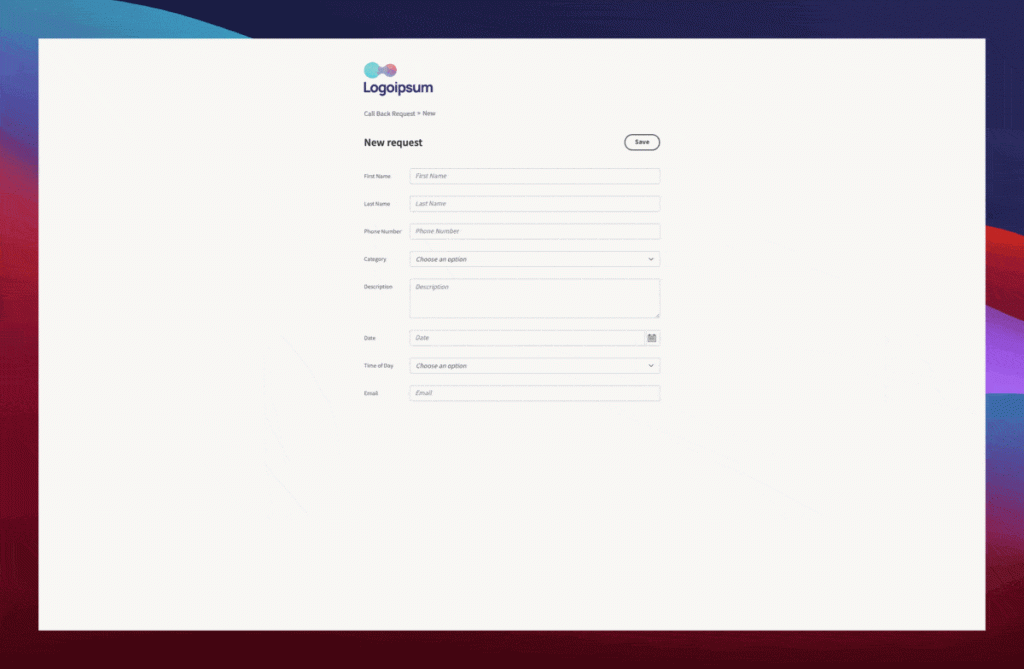
The reality is most contact forms look like they were dropped onto the page with no real care, visually overwhelming those that care to give it a second look.
Does this look anything other than a turn off for users?
Reason #2 – Most contact forms are too long
In today’s digital landscape, people value two things above all else. Significance and convenience.
When it comes to contact forms, it can be pretty tough to try and get what you need from your site visitors without your form looking like War & Peace.
Unnecessarily long contact forms can be a massive turn off to site visitors who have made it that far, so it’s vital that you keep it short & sweet.
Research from 2022 found that contact forms with 3 fields (uncommonly short) had a conversion rate of around 25%. With 5 fields this decreased to 15%. And each subsequent field in the form significantly decreased conversion rate from there.
If you have long contact forms, you are tying one arm behind your back when it comes to conversion rate.
Reason #3 – Handing your contact info over feels like a big commitment
Contact forms feel like a significant commitment because the act of filling them out is pretty transactional.
Your site visitor hands over their personal data in exchange for a piece of information (this could be a guide, eBook or even a demo request.)
The problem is that most people are aware that the only reason they’re handing over data is so the door is opened for future communication between a business and a prospective buyer. Some may opt out of this idea entirely.
(If you haven’t got a checkbox on your contact form allowing users to opt out of marketing communications, we highly encourage you to do so!). Learn more about How to Collect GDPR-Compliant Data
Remember, it’s 2023. Data breaches are rife. Most users will not want to hand over their personal information without first establishing a foundation of trust or relevance.
This is why it’s so important for modern brands to sharpen their buyer’s journey before their traffic reaches a stage of commitment. You can do this by…
Making information that could influence a buying decision easily available.
Understanding where your visitors are in the funnel.
Serving dynamic or personalised content based on these factors.
Even looking at this feels like a chore…
Reason #4 – Anyone can fill out your contact form
You’ve probably already experienced this yourself.
Contact forms are famous for receiving spam or even low quality lead submissions because of the fact that anybody can fill one out.
We hate to plug our product halfway through a blog, but Leadoo can actually help with this.
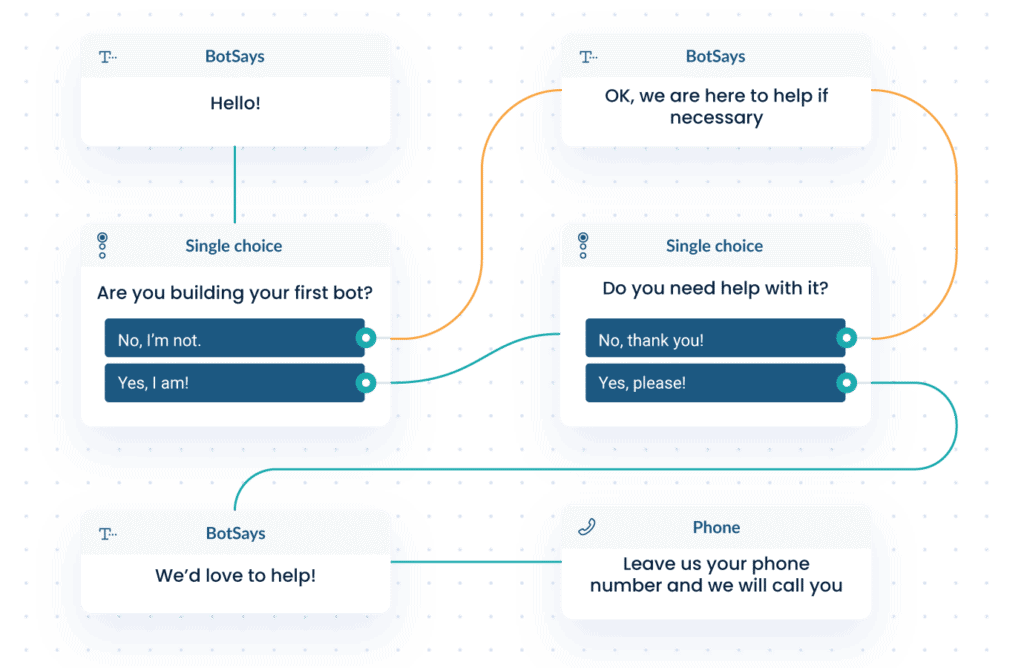
Your buyer’s can be routed down a variety of different options in place of a contact form, sequentially disqualifying leads that don’t meet your pre-set criteria. It’s also much harder for a bot to complete a dynamically loaded in-page bot, compared to say a contact form specifically housed on its own URL.
Below is a demonstration of one of our Visual Bots.
Give it a go for yourself and see Leadoo’s lead qualifying magic first hand. ✨
Reason #5 – No urgency to convert.
Another big issue with contact forms is the lack of any level of urgency or pressure to finish converting. Once a visitor begins engaging with your form, the decision to convert is left completely in their hands.
A traditional contact form offers no level of interactivity or urgency to convert there and then. Meaning your site traffic can abandon the conversion process pretty early on.
If this sounds pretty similar to what you’re experiencing, a contact form might not be the best option available for you.
Fortunately, Leadoo’s conversion kit offers all the tools you need to engage & activate your web traffic.
You can serve as many dynamic prompts within a Leadoo bot conversation as you like. And the nature of conversational tech itself creates much more of a sense of urgency and responsiveness, compared to a traditional contact form URL.
Reason #6 – Contact forms lack personalisation
Another area that contact forms miss the mark is failing to tailor the user experience based on where your visitor is at in the buying journey.
A popular conversion myth is that any two conversion journeys are the same. We know that this isn’t the truth, so why treat them like they are?
Visitors who return to your site post discovery might be further along in their decision making process and might find your contact form too generic and not fit for purpose.
In contrast, offering a more personalised approach such as offering content or recommendations based on how much your visitor knows, or what content they have engaged with onsite, can help you maximise conversions.
Imagine your contact form could trigger based on these conditions…
Reason #7 – You don’t get any data or insights from contact forms
The lack of critical data or insights is one of the biggest drawbacks when it comes to contact forms.
For example, if a thousand visitors hit your website today but only a few convert, contact forms won’t help you figure out why the rest didn’t (or how close they came to actually converting.)
Plus, if for any reason your visitors bounced due to any number of the problems listed above, you’re left with no actual valuable insights, making it guess work to try and fine tune or optimise your website experience.
This brings us to our final point…
Reason #8 – There are better options out there!
You’re probably wondering what contact form alternatives are out there. Fortunately, there’s plenty of great products to choose from that can help you improve your chances of landing conversions from your website.
Let’s talk about Leadoo.
We help businesses convert more of their web traffic by transforming your website’s user experience using interactive content in place of legacy methods (contact forms, we’re looking at you…👀)
But what does this have to do with contact forms?
Our Conversion Kit offers a range of on-page tools that you can use to replace your contact form, offering unique experiences to every site visitor based on factors such as:
Where they’re at in their journey.
What they already know about your brand.
Whether they’re ready to make a buying decision.
Not only do they look a lot better (example of our InPage bot below…)
A conversion rate calculator is typically used to determine the effectiveness of a website, landing page or campaign by telling you the rate at which users are completing conversion actions.
An ROI calculator weighs up campaign or marketing spend against generated revenue, and tells you whether you’ve made a profit or loss based on the value of the leads or conversions generated. So conversion rates can impact ROI calculations heavily. Learn more about Traffic vs Conversion Rate.
Our Conversion Rate & ROI Calculator will estimate the increase in web leads with Leadoo in place, using real aggregated data of how Leadoo has increased customer conversion rates across different industries.
When combined with your existing website stats, we can calculate potential increases in your conversion and lead levels. So you can make an informed decision on whether Leadoo AI is the right choice for you.
How do I calculate the ROI of Leadoo AI?
Simple. Give us your approximate number of monthly site visitors & leads and we’ll calculate the number of leads you could be getting, using historical data that we’ve recorded working with clients in the same industry, as you can see in The Conversion Crunch: 800.
If you can tell us roughly what your average order value is too, we’ll then estimate potential revenue increases and compare that against how much Leadoo costs. Which will quantify the potential return from investing in a conversion platform.
If you’d like to see real examples of Leadoo delivering ROI for customers, check out our many success stories.
How will Leadoo AI increase my conversion rate?
Leadoo enhances conversion rates using a variety of engaging onsite bots and tools, powerful in-journey personalisation, company identification tools, sales alerts, analytics & revealing insights.
And to help you get up and running, our team will help you identify areas of quick improvement across your site where Leadoo will fit in quite nicely.
Crucially, Leadoo helps you increase conversion rates. Which helps deliver lead increases even if your website traffic stays the same – or drops.
However, the increase in conversion rates that Leadoo brings often more than offsets the cost, meaning that our conversion platform could pay for itself and then some!
Busting 5 CRO & Conversion Myths
As marketers, we often find ourselves researching best practices when trying to achieve an end goal. And when it comes to conversions – our ultimate goal for traffic on our websites – it is tempting to look for ‘best practice’ advice from anywhere and everywhere.
The only problem is that there’s a lot of misinformation and split opinions out there that can leave you stuck on who to believe.
And just because a strategy, technique or method worked for someone else….
Doesn’t mean it’s going to work for you too.
Here, we’ll debunk 5 common Conversion and CRO myths.
Myth #1 – Conversions only mean sales 💰
Obviously, a conversion can mean a sale, but let’s not limit ourselves here.
As a modern marketer, you’re probably already aware that most customers won’t convert after a single touchpoint. So restricting conversions to mean sales & sales only is a serious injustice to your customer journeys.
It also creates a very narrow view of your attribution, meaning you might over-value the channel that brought in the final sale, but under-value channels that contributed to it earlier in the journey.
Most (eventual) customers will move through a series of different website touchpoints before they even consider buying.
At Leadoo, we have some customers with sales cycles can last a year or more. Meaning they could involve 20-30 site touchpoints and 5-10 different conversion types. Read about how we tripled ICE InsureTech’s leads here – despite their particularly long sales cycles.
Unfortunately, some marketers will focus too heavily on desired outcomes and miss out on tonnes of vital data points in between.
So, instead of hard pressing for sales as the end goal, why not open yourself up to the idea of a conversion being…
A subscription to a mailing list or a newsletter?
An opt in/download for a free eGuide, eBook or information pack?
An enquiry through a contact form, live chat, or phone call?
Or even a registration for a free trial, demo, webinar or other events!
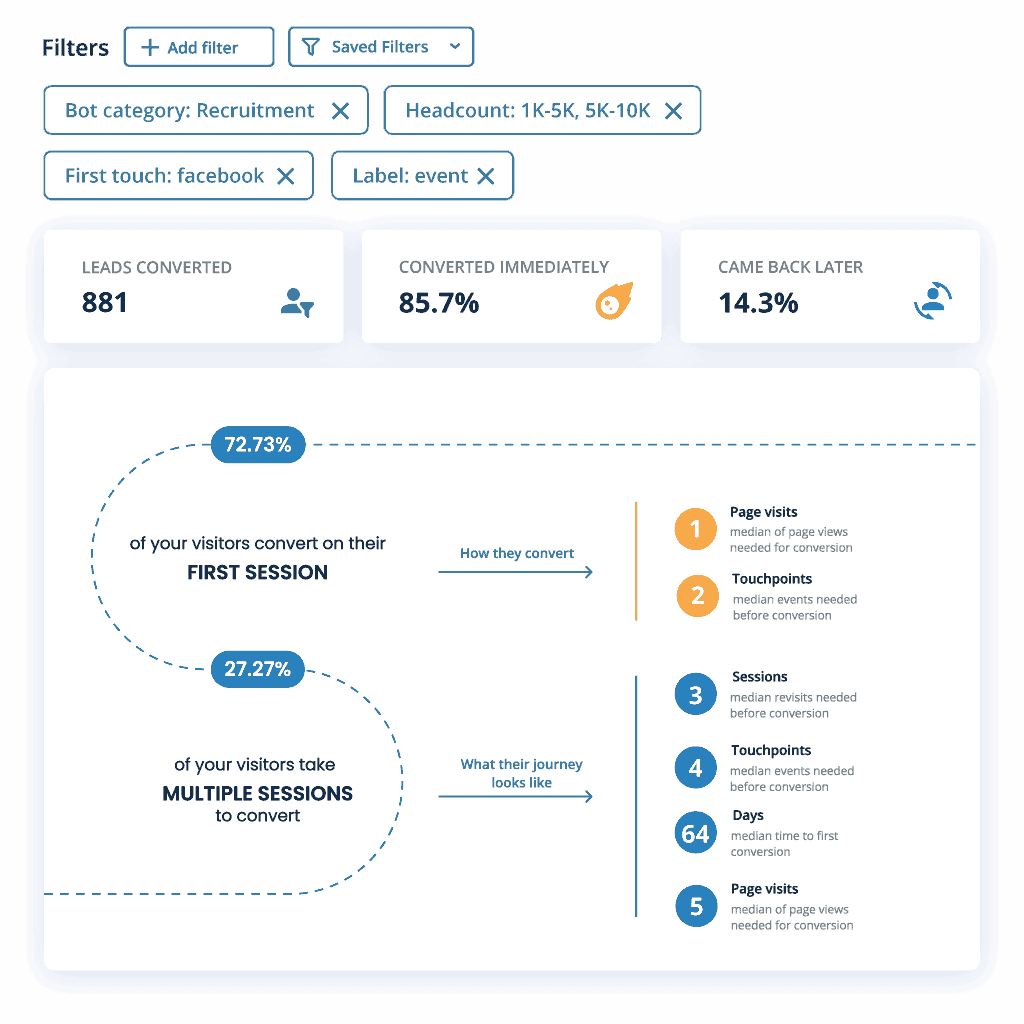
Leadoo Source Insights shows you the full journey attribution journey of each site visitor. 🤩
Myth #2 – More traffic = more conversions.
More traffic does give you more conversion opportunities on paper, however, it doesn’t guarantee an increase in conversions.
Also, if you’re paying to acquire traffic from external sources like Google or Social Ads but don’t have the right conversion strategy in place, you’ll find yourself wasting money on sessions that don’t ultimately convert.
As a matter of fact, we’ve seen a large portion of customers end up with more conversions from a similar – or on some occasions even lower – traffic levels after implementing Leadoo.
This is due to them having the right conversion strategy in place and a good understanding of their customer journeys.
They were able to become more targeted and purposeful in acquiring users, helped those users get to where they needed to go quicker onsite, and had the right tools in place to ultimately convert them.
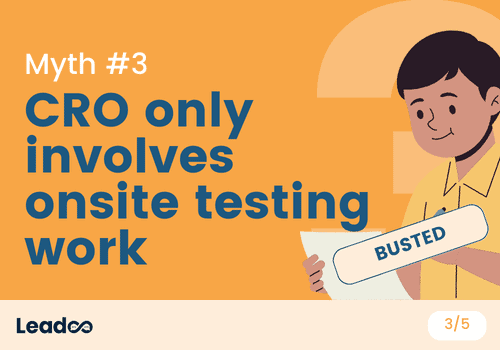
Conversion Rate Optimization is often thought about as getting many website visitors as possible to take conversion actions.
So ‘CRO tactics’ commonly involve making aesthetic changes to websites, testing different calls-to-action, visuals, or page types against each other to see which leads to the most conversions.
But true CRO isn’t just onsite tweaks & tests. It involves truly understanding customers and getting down to the nitty gritty.
The best way to optimise a customer journey is to ask yourself the following questions:
What is my ideal customer trying to achieve when they visit my website?
How do I give them what they’re looking for as fast as possible?
Does the journey my website take them on give them everything they need to make an informed purchase?
Hopefully, once answered, those questions will give you insight on what changes you need to make to maximise impact.
(Unfortunately, making your CTA buttons bigger and brighter isn’t enough 😉)
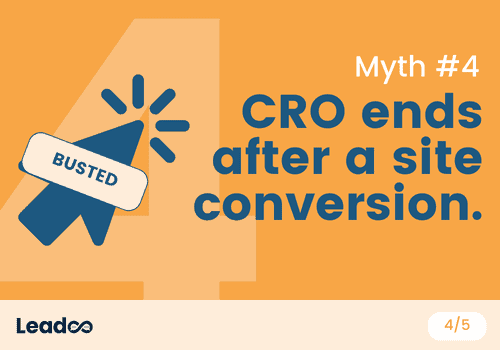
Myth #4 – CRO ends after a site conversion.
Marketers might be tempted to simply pass website leads into a CRM platform or directly to sales and then forget about them.
But just because someone completed a conversion action doesn’t mean…
They’re ready to buy OR…
Their buying journey has ended.
Understanding true lead engagement takes time. Ultimately your best chance of being able to grasp buyer lifecycles is if you’re tracking users every step of the way, pre and post conversion actions.
If you’re interested in turning your website into a well oiled lead machine, you should probably look into Leadoo.
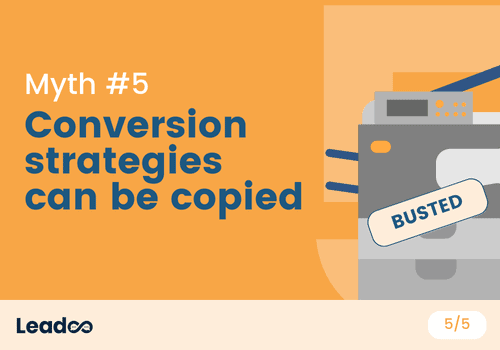
Myth #5 – Conversion strategies can be copied.
It’s tempting to study competitors and even more tempting to copy their approach to conversion optimization.
While there are best practices when it comes to CRO, there is no one size fits all approach for converting leads to paying customers.
All websites have different traffic sources, target audiences, technical specs, and marketing budgets behind them.
You aren’t your competitors, so why try and convert your own customers like they do?
Content is king. The cliche that we as marketers are quite used to hearing by now. We’ve invested heavily into content marketing, as many companies have, and yet the rewards of those efforts are not as great as we’d hoped. It’s a scenario many find themselves in – being seemingly unable to drive conversions using content marketing – and that’s because their current strategy needs a few tweaks.
Content marketing is the process of creating and distributing valuable, relevant, and consistent content to attract and retain a clearly defined audience – creating content that helps attract buyers and piques their interest in your products in a more covert way; gently, and nurturing. Content marketing gives your brand authority within your space, helps with your SEO efforts, and allows you to target each of your buyer personas with the content most appropriate for them, leading to them spending more time on your site and giving you lots of information about their intent (which you can act upon later).
Conversion rate fundamentals
It’s probably a good idea to cover some of the conversion basics before we launch into how content marketing can help improve your conversion rate. If you’re a seasoned marketer and don’t need a reminder, you could remind yourself of the conversion rate benchmarks for your industry, or skip to the meat of the article below 👇
Conversion
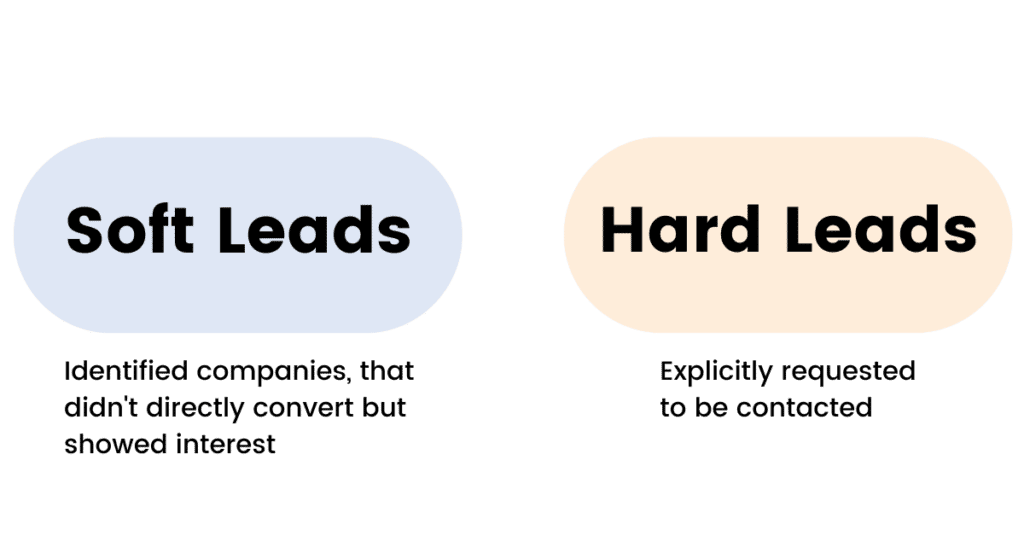
A conversion is any desired action a visitor takes on your website, and these can be split into hard and soft conversions. Hard conversions are the final click of the button when a customer requests a demo or discovery, or checks out their basket in a B2C situation. These are the actions that directly contribute to revenue and so are important. But soft conversions can be just as vital – these are smaller actions customers take on your site, such as downloading a guide or subscribing to a newsletter. Whilst these actions don’t link immediately to revenue, they do give us an insight of customer intent (and therefore potential revenue in the future). Focusing on soft conversions too provides us with the opportunity to understand, and be able to nurture, our prospects and encourage them towards making that final purchasing decision no matter where they are in the buying funnel.
Conversion Rate
The conversion rate of your site can be calculated using a simple equation, but is also available for you to see on Google Analytics (or some other analytics platforms, like Leadoo). Your conversion rate tells you what percentage of visitors are converting into leads on your website. It’s calculated using the following formula:
Or, if you’re like us and you like it when technology does things for you, you can use our free Conversion Rate Calculator to work your conversion rate out.
Conversion Rate Optimisation
This simply means taking action to improve your conversion rate. There are many things you can do to optimise for conversion, and we’ll be looking at some ways that you can optimise your conversions by optimising the content on your site.
What does the buyer’s journey look like?
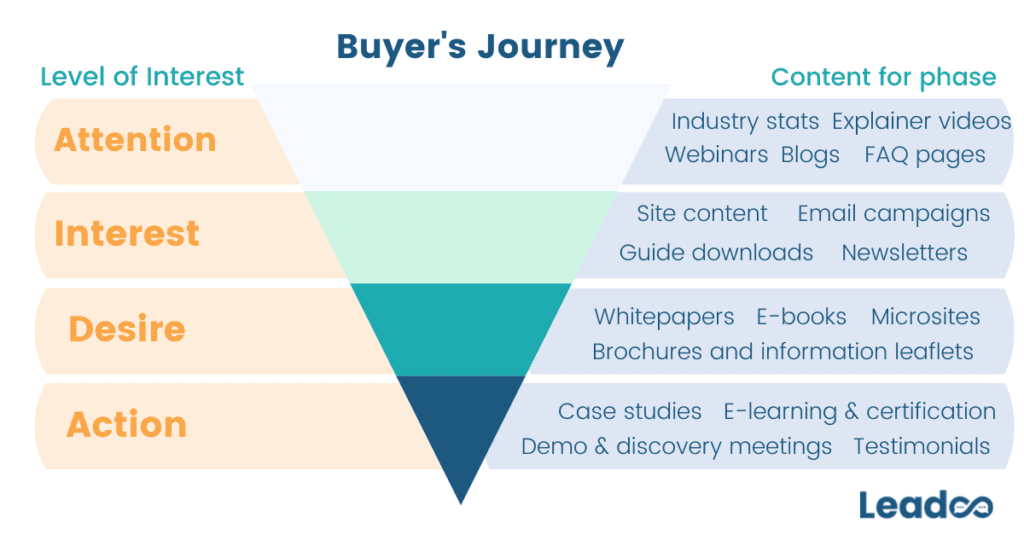
Most marketers are familiar with the AIDA model, or some variation of it. The model exists to describe the buyer’s journey, and the phases they go through when they are considering purchasing a product or service. The model works as follows:
Attention (also known as awareness): If a prospect is in the awareness phase, then this is where you’re aiming to provide awareness of your company, brand, products, and the value you can offer. At this stage, you are looking to grab the attention of your prospects in a positive way. This could be through meeting some charming members of your team at an event, or through informative and helpful content on your blog. The theme of the day is demonstrating high value to them, delivered concisely.
Interest: When a prospect is in the interest phase, your job is to convince them that they have a potential need for your product or service – ideally to the point that they’re ready to do more research into the product. This is again a critical point in their journey to explain the value you can bring to your prospect, as often they’ll be researching and comparing with competitors. At this stage, you’re looking to garner their interest so that they want to learn more. This could be via content on your website such as industry and business relevant case studies that resonate with your prospects and evidence the value your solution can bring.
Desire: You’ve successfully grabbed their attention, and piqued their interest so they’re looking for more. Now your job is to make them want your product, to think of nothing but your product… Ok, maybe that’s a bit far (although it would make the next step a little bit easier if that’s how they felt). This is the point where they’re starting to seriously consider the product, and so you want to provide materials such as competitor comparison whitepapers, success stories and case studies, as well as pricing and FAQ information.
Action: Action is the phase where you’ve finally convinced them with enough evidence that they should take action to buy the product or service you’re offering.
During each phase of the buyer’s journey, prospective buyers have different wants and needs for the types of content they’d like to see relating to their level of intent. This is something that businesses often get wrong, but if you want to drive conversions then you need to do that during all stages of the process, and not just at the end.
The type of content your buyers are selecting to read or engage with as they move through their journey also makes a difference in determining their intent – we refer to these as soft conversions (for example, a prospect downloads a guide or signs up to your newsletter). They’re not final conversions linked directly to revenue generation, but they do give us an insight into each visitor’s wants, needs and position in the buying funnel.
We can even take the information gleaned from our content creation and customer engagement to further improve the offer we provide and come closer to meeting customer needs. Let’s say you realise that customers who tend to visit Page A, also tend to immediately visit Page B. This could mean a few things;
Page A doesn’t provide enough information
Page A doesn’t have a Call to Action (CTA)
Page B provides one/both of these
A simple fix would be to look at the time spent on each page and what was interacted with to work out what people are seeking on Page B, then look to move some or all of this over to Page A – shortening the time it takes your average visitor to convert.
We’ll take a dive into how you can optimise your content marketing efforts for conversions using 3 easy steps.
How to drive conversions using content marketing: 3 easy ways
1. Create content for each stage of the funnel
Every customer that visits your website isn’t ready to convert there and then; 96% of people who visit your site, on average, aren’t. Only 2% on average actually convert. So your job, on top of trying to increase the number of hard conversions you get, is also to focus on the vast majority – the people who aren’t at the bottom of the funnel quite yet.
This means you need to create content that speaks to the prospect at each stage of the journey. You wouldn’t, for example, publish a white paper text in its entirety as an advert. Not only because logistically – and visually – it would be a mess, but because someone you’re targeting with an advert has a different level of intent to someone who would be willing to take the time to read a white paper. With an advert, you’re tailoring your message to those in the Attention (and potentially even Interest) phase of the buyer’s journey – providing them with the facts that will make them look for more.
With a white paper, you’re looking to provide detailed, analytical information which often provides a formal comparison or explicit value offering.
Your content should have the same consideration given to it – who is going to see this content? What are they likely to be looking to get out of this content? How am I going to make them want more or take the action I want them to take?
You can easily create content with generative AI tools like WPSEOAI.com that isn’t only great to generate content, but especially to generate SEO optimised content as well.
2. Make the most of every conversion opportunity: Call to Action
One of the first issues our Conversion Experts tend to identify regularly across many clients who we work with in their initial phases is that they usually aren’t using their Call to Actions effectively. They have poor placement, bad phrasing, or a lack of CTAs all together. There isn’t a correct answer for what works perfectly for your customers, so much of this optimisation relies on A/B testing different phrasing and button placement/visuals to find the most optimal CTAs for your customers.
In addition, many clients also simply don’t have CTAs (instead offering a contact form only – or perhaps worse, just a telephone number or email address), or don’t have enough of them. Placing CTAs isn’t an exact science, as mentioned above, but having them on the page in the first place is an excellent place to start. They should be located in places that make sense for the journey each customer goes through – for example, after a paragraph of important information has been given that might help a customer decide they’d like to get in touch or to be able to arrange a demo.
Within longer form content pieces, you should look to provide a CTA at least at the end of the article. You can also provide links throughout to other pieces of your own (or external) content, to signpost the reader to other articles which they might find useful and to push them down the funnel and closer to converting.
3. Provide a personalised experience with content – seamlessly in context
Personalised experiences are the gold standard of our time, and so it’s important that any content you’re providing is not only tailored to the visitor’s location in the funnel, but also to their interests and needs. This be achieved by creating more dynamic CTAs through carefully crafted bot conversations – through a single bot you can offer for the visitor to read more, and signpost them to other relevant articles, book a demo, find answers to FAQs and more, all in one place to meet needs of customers at the different stages of the funnel.
In addition, by using high-quality bots, such as the Leadoo InpageBot, you can embed a contextual conversation straight into the content you’re working with. For example, if your visitor is looking at your pricing page, then the bot on that page will only discuss pricing packages and topics you deem relevant to this with that visitor. The same approach can be taken across the whole site, ensuring customers receive valuable help and guidance alongside the content itself that is always in context and in tune with the customers’ needs.
By placing Leadoo bots, this also allows you to understand a prospect’s position within the buyers’ funnel and analyse their intent through conversation-level analytics, as to well as the support of our Conversion Experts – here to continuously optimise your bots to meet the needs of the visitors coming to your site.
Key Takeaway: CRO and UX go hand in hand
Content marketing can be easily utilised to help optimise your site for conversion by providing a seamless experience for every visitor – no matter their intent or stage in the funnel. By focusing on soft conversions and accommodating for these, you can ensure your content speaks to more visitors on your site, and increases the number of conversions along the way.
If you’d like to know more about how we can help you increase conversions via content marketing get in touch or chat to the bot below ⬇️
Sometimes marketers might have trouble working out what the right text for a CTA (call to action) button is, or what the right kind of content for a newsletter or campaign might be. Sometimes it comes naturally, but more often than not, it doesn’t, and this is where A/B testing can come in handy to help you increase the number of conversions you get from your efforts.
What is A/B testing?
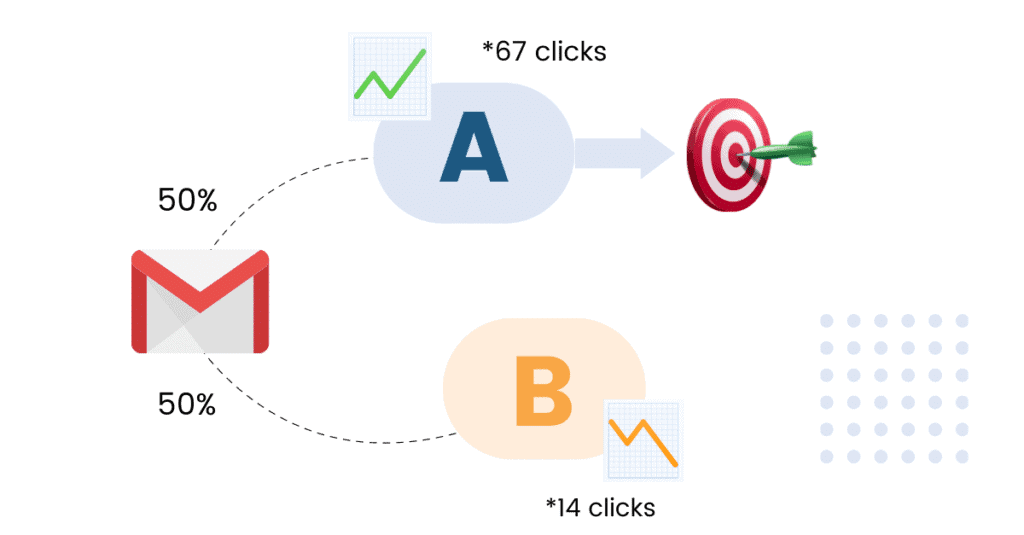
A/B testing simply means testing different options; one target group is shown one set of content, and another is shown something else. You can then analyse the performance of both pieces with the relevant target audience in order to determine which one is the better option. A/B testing can have a significant impact on the performance of your website when you test different options for layouts and optimisation to ensure you’re getting the most from it.
The best thing about A/B testing is that you can test pretty much anything, including different parts of your website. This could be, for example, the placement, wording or colour of the CTA button, the wording, placement and visualisation of pricing, the contents of the body text, the question fields on the contact form, or the number of images on the pages. These examples can be sorted into tests that seek to improve the user experience of the website, for example, or tests related to improving the design and navigation of the pages.
How do conversion optimisation and A/B differ?
Sometimes the two might seem to be almost the same thing, but in reality they are very different. Conversion optimisation focuses especially on researching a potential customer’s purchase path and therefore improving a site’s conversion rate, with the hope of increasing leads and sales in the long run. By examining each step of the buying path individually, you can make interesting findings or potentially spot problem areas that might be a barrier to a potential buyer. For example, A/B testing is one way to run different tests in conversion optimisation, but it’s important to note that it’s not the only way to optimise your website and improve your conversion rate.
However, let’s take a look at how to perform A / B tests in four easy steps.
How to run an A/B test
1. Define timeline, set goals and look at problem areas
Before you begin A / B testing, it’s important to determine what you want to find out from the tests. Whether it’s testing copy for email marketing, websites, or trying out different campaign pages, you will still need to be able to quantify the results. Measurable goals could be, for example, the number of clicks, leads, or orders received. You will also need to set a reasonable timeline for the test, linked to your goal. Let’s say for example, you wanted to gain data from 10,000 web visitors, and you get 1000 visitors a day, you would need to run the test for 10 days.
If you’re just getting started with A/B testing, a good place to start is to focus on critical points on your website, such as your main conversion points, or using analytics to study your site’s bounce rate. You can then take steps to try to reduce it, and see what works best using A/B testing. The lower the bounce rate on your pages, the more likely you are to increase the conversion rate of your pages when you do get a visitor to your site.
2. Form a hypothesis
Before you start testing, it is important to make a hypothesis about the desired outcome. As the name implies, a hypothesis is just a “guess” about the outcome, and for that reason you need a test to verify it. Your hypothesis should detail what the variable will be, and this helps you to focus your research and allows you to plan next steps no matter what the outcome of the tests are.
3. Run the tests
To start A/B testing, you need to create two different versions of the same content, with the only change being the variable as defined in the hypothesis. The two versions will then be shown to two audiences of the same size. For example, you can use the visual website optimiser, Optimizely, or Google Optimize tool to perform this testing.
4. Monitor and analyse
In order to be able to reliably analyse the results of your test, it is important that the test has been visible to the target groups long enough and that the reach is large enough to provide valid data. You will then be able to compare the results with the set hypothesis and see if the hypothesis you set was correct. When analysing the results, it is especially important to pay attention to the goals you set and the measurable characteristics that support them.
Performing the analysis is a critical part of A/B testing. By looking at two different variations, you can make discoveries about exactly what kind of things or content are more likely to actually make someone who’s engaging with your content convert.
5. Plan the next test
Even if you are very happy with the test results, don’t stop there! You might feel that you’ve achieved what you wanted, but it’s important to continue optimising your content to continue improving your results. A/B testing is a continuous learning process, and performing only one test may not achieve the desired results.
For example, you can always create a new “challenger” for the winner of your first test and see if it would be possible to achieve even better results. Or you could also continue to form entirely new hypotheses and focus on slightly different perspectives or audiences to improve your goals.
Key takeaway: A/B testing and CRO go hand-in-hand
A/B testing is a key part of optimising your content for conversion, but it’s not the only way to do it. It can be a really helpful way to gain insight into your audiences and to understand their behaviour and intentions.
If you want to know more about A/B testing and how it can help improve your conversion rate, get in touch or chat to the bot below 👇
UX, or user experience, is swiftly becoming one of the key parts of any company’s marketing strategy. No longer is it good enough to be ‘good at marketing’, now, the companies offering the customer the best experience are those that win 👑
User Experience (UX): What is it?
User experience is, according to the Interaction Design Foundation, defined as the way in which your customers experience and engage with your company. This can be both digital and in-person, ranging from the experience a customer has in a physical shop to the experience they have when they visit your site. These experiences, in their entirety, is what helps to create the brand and identity of your company in the customers mind – and so by creating a positive experience at every interaction, you’re helping to create a positive image of your brand.
And it’s not just each interaction, happening independently of the others, that creates your user’s experience. UX designers do work with the product, but their focus is on the whole process; from introduction, to feedback on the product, to help and support customers might need in using it. UX designers deal in experiences rather than products, as they recognise that the experience is where a customer sees true value and differentiation.
Take the iPhone as a prime example of a UX-focused product. The User Experience is its Unique Selling Point and what differentiates it from its competing products. The customer’s experience starts on their site, with its user-friendly navigation and support at every turn, or in their stores with their church-esque stature and their never ending supply of helpful and knowledgeable store assistants all matching in dress and singing from the same hymn sheet (as, of course, a choir should). This consistent, supported user experience is part of the reason why Apple is as much of a global success as it is, and consequently enjoys some of the most loyal customers across the world.
What makes a good user experience?
What makes a good user experience is to some extent determined by the customer or prospect, and is mostly driven by their needs and expectations. Often, customers visiting B2C sites, for example, know what they want – and they want to find it quickly. To provide a good user experience for these customers, the business can focus on providing user-friendly, intuitive navigation, product selection help (either with AI or by directing customers to a real-time support agent), and a smooth checkout experience. The aim of the game is always to make it as easy as possible for that customer to buy something.
With B2B, especially in wide-reaching industries such as SaaS, customers quite often aren’t actually sure what they want specifically. They know they have a problem, or a pain point, but aren’t sure exactly what is available or is able to plug the gap and solve the problem for them. Businesses can again make use of product selector style bots on their site, and ask qualifying questions to understand each individual customer’s needs so these needs can be addressed with a product suggestion, or by putting them in contact with a salesperson from the business.
And both of these types of customer won’t hang about if your page load speed is slow, your interactive elements don’t work effectively, or your website isn’t user-friendly. It works the same way for any in-person experience too – take our Apple example from earlier, if you visited the Apple store and there was nobody there to provide swift assistance, or the tech in the shop didn’t work, or the shop was difficult to move around, then you’re probably not going to hang about for long. Speed of service, or page load speed on a website, is crucial to customers staying long enough to buy something. On websites, bounce rates increase by over 20% when the page loading time is slowed by just a few seconds.
A visitor’s user experience doesn’t have to just be when they’re buying something – consider potential candidates for any given vacancy advertised on your site. Looking for candidates for a role is largely the same process as sales, and these visitors should be treated as such. The experience they have of navigating your site, the language and tone, imagery and level of technology and interactivity used will all influence their first impressions, and may be an influencing factor when they make their decision to apply for, or even accept, a job working with you.
Interactive elements, such as Leadoo’s InpageBot, help to activate and engage your visitors, provide them with a consistent, on-brand experience, qualify their needs, and send them to the relevant team automatically without the need for manual movement of leads. In recruitment, they can even be used to ask questions to determine experience and cultural fit, rather than relying on the hiring manager sifting through CVs for hours on end. The best thing about the bots is that they’re the lightest tech on the market, with only a nominal effect on page load speed, meaning your ranking with Google won’t be affected by poor technical performance.
Conversion Rates: why they matter
Conversions are any desired action a visitor takes on your site. These can be divided into hard conversions (those which are directly linked to revenue or sales), and soft conversions (those which aren’t directly linked to a sale but do give us a really good insight into the customers’ intentions and how far along the buying journey they are).
You can calculate your conversion rate by using the below formula:
Or, if you’re like us and you like it when technology does things for you, you can use our free Conversion Rate Calculator to work your conversion rate out.
Conversion rates are an important metric for marketers to monitor and embed in their strategy – they provide a measure for your return on the efforts you have put into driving traffic to your site. Traffic only tells you how many people visit, not what they do when they get there. 98% of the people who visit your site, on average, leave without converting – which is a huge waste of time and money spent on driving people there in the first place.
5 top UX tips for increasing your conversions on your site
1. CTAs and placement of CTAs
Calls to action (or CTAs) are providing the customer with a way to act on their decision to purchase. These can be for a soft conversion, such as signing up to a newsletter, or for a hard conversion, such as booking a demo or a discovery session.
The availability, wording, and placement of CTAs all have an impact on how likely they are to convert customers. The general rule is the more CTAs the better – although too many and your customer is likely to feel overwhelmed as it’s something akin to standing in the middle of 30 screaming car salespeople all vying for your attention. 2-3 per view that the customer has is plenty – any more and you may risk overloading the customer, or making them feel extra guarded once they realise it’s a sales pitch.
In terms of wording for your CTAs, this very much depends on your customers and what works best for them. Here, A/B testing can come in handy, and can help you work out what works best. Our conversion experts often find that different CTAs work better on particular pages, and so these tests help you to determine which you should use.
2. Make it mobile-friendly
This one almost goes without saying. We are, after all, in 2022. We are a generation of people on the move, and so a large part of our work is done via our phones. The same is true for your potential customers – reading and information gathering during their decision making process can be done on the go, and you need to be able to facilitate that if you want to be considered. In addition, mobile optimisation improves the experience for the customer, and helps with SEO and ranking.
Making sure your site is optimised for mobile allows you to make the most of customers visiting from all kinds of devices, and ensures you don’t miss out on converting traffic coming from different places, at different times.
3. Make it easy to navigate
You want your customers to find what they need without hurdles or barriers preventing them from doing so. Customers who are committed to buying generally have a low tolerance for jumping through hoops to get what they want. Customers who haven’t committed to buying have an even lower tolerance, if at all, and so it’s important that customers are able to find what they need without hindrance.
This can come back to navigation across the site. Is your product packaged in a way that makes sense for the customer? Can they easily identify which products or services are for them, and which aren’t? If not, then they’re unlikely to spend a long time searching, instead choosing to find what they need from your competitor (whose site is much easier to navigate, and makes it immediately obvious to the customer what they need).
One solution for improving navigation is to implement bots on the site which work to quickly understand what each customer needs and providing them with a direct navigation to the relevant page, or collecting their information to pass onto a sales team if they are ready to proceed to purchase.
4. Activate and engage with interactive elements
The amount of time your customers actually spend on your site can be increased by providing interactive elements to engage them. This could be in the form of a video, clickable imagery, or a bot strategically placed within the content.
Engagement also helps you to work out what each visitor is looking for, their intentions, and where in the buying process they’re at. Using chatbots to qualify customer needs and help them to navigate through to what they need provides a positive, personalised experience for the customer and increases the likelihood that they’ll convert.
5. Check your technical performance
Your technical performance affects how your visitors experience your page. Page load speed is a contributing factor to having a high bounce rate – we’re not very patient as a species – and so if your site takes too long to load pages up, customers will likely get frustrated and look to your competitors for what they need.
You can run a Google Lighthouse check and check the technical performance of your page, including your page load speed. We’ve also written an article on technical performance and SEO, and how Leadoo’s solutions are built with this in mine.
Key Takeaway: CRO and UX go hand in hand
Without users, you have no conversions, so you drive traffic to your site. But if those people are having a terrible experience or can’t find what they need, they’re not going to stay long enough to convert. User experience is therefore absolutely critical for helping to increase conversions and ensuring that prospects stay interested and don’t bounce.
We can help you to embed conversions into your marketing strategy and improve the UX of your site for your customers – if you want to know more, get in touch or chat to the bot below ⬇️
Do you actually know what your customer journey looks like for the average person visiting your site? Do you have visibility over who they are, when they visit, and how often, as well as which content and CTAs increase your conversion rate with these customers – or which ones don’t?
Perhaps this isn’t something you’ve ever thought you should, or could, measure. But oversight of these data points are becoming ever more important in a world where customers expect instant response, personalisation, and quick access to information.
If you’re among the many marketers or small business owners who either didn’t know this was a possibility, or possibly didn’t see the value in it, keep reading. We’re going to show you in this article why a solid analytics offering is an important consideration for all businesses to help provide you with a holistic view of your customers’ journey and their activity on your site.
The main problem: the customer journey isn’t linear
The customer journey isn’t linear. Customers in our world have access to tons of information, as well as access to international markets, meaning that in most scenarios, they have a reasonable amount of choice when they make a decision. The average person is exposed to 5000 adverts and messages a day – messages that can influence their buying behaviour, and another reason why it is really important for you to understand what each customers’ journey looks like.
A typical customer for even a B2C product, something from Amazon for example, usually has several touchpoints and might not purchase on the first visit to the site. They might have had intention, sure – but they might have spent that visit reading reviews, or checking out similar products across the site. And this is where the problem lies.
After all, we are humans, and we don’t ever tend to take the simplest path in life, and our purchasing decisions are varied and subject to change in their nature at short notice. The end point described above – the actual purchase – is what’s known as a hard conversion. A hard conversion is one in which a customer has taken a desired action. You can see your conversion rate for free via Google Analytics, or through many of the paid platforms such as SEMRush.
This is okay, if you’re only interested in the people converting at the end. Perhaps you’re a salesperson and are only interested in the hottest of hot leads. But, those other visitors, hiding in the shadows silently collecting information – they’re potential leads too. Maybe they downloaded a guide, or subscribed to your newsletter. Whatever it might be, those smaller interactions are known as soft conversions. Soft conversions are smaller actions that customers take that give us a good idea of their intent.
Soft conversions matter too
This needs a whole section of its own because soft conversions are so important. They map out your customers’ intentions and let you build a picture of what they’re looking for based on the interactions they’ve had with your site. Any analytics worth its salt needs to provide information on these because these are what gives you the best picture of your customers’ buying habits and purchasing intentions. Soft conversions provide us with the opportunity to understand, and be able to nurture, our prospects and encourage them towards making that final purchasing decision.
Soft conversions also mean we get a better overview of this zig-zag journey that most customers end up taking. We can see where in the funnel they are based on what they engage and interact with, and we can arm our sales teams with the information accordingly. A salesperson armed with knowledge is a formidable force indeed.
For example, if a salesperson can see that one particular visitor has read a few blogs on conversions, and then downloaded a guide to conversions – they can gather that this person is probably trying to learn about conversions and perhaps has a pain point linked to this. It’s an avenue for a conversation and the beginning of a discussion and nurturing process that can lead that unsure visitor to becoming a confident customer.
If you add bot solutions to the mix – tailored to the content of each page and the needs of each visitor – then you can qualify each visitor even further, allowing marketers to qualify leads based on intent and position in the funnel, so sales teams can approach at the right time, every time.
Also, if you use Google Analytics and are interested in visitor attribution – i.e. where the visitor originated in order to end up on your site – then you’re not going to get the most accurate information by looking at Google Analytics alone. GA only measures the final visit of a customer, the visit on which they converted, when looking at attribution. So, if that customer actually came through Facebook adverts, and then visited the site a few times before their final visit, you won’t see that. You can only see the final time, where they might have gone straight to the URL or visited via a quick Google search.
There are ways around this, if you’re incredibly intimate with the way attribution modelling works and have the time to play around with Google Analytics. We’ll bet most of you don’t, though, and this is where Leadoo’s Conversion Insights (and the expertise of our Conversion Experts) takes centre stage.
Hold my beer 🍺
Conversion Insights: a magical crystal ball to look at your website visitors with 🔮
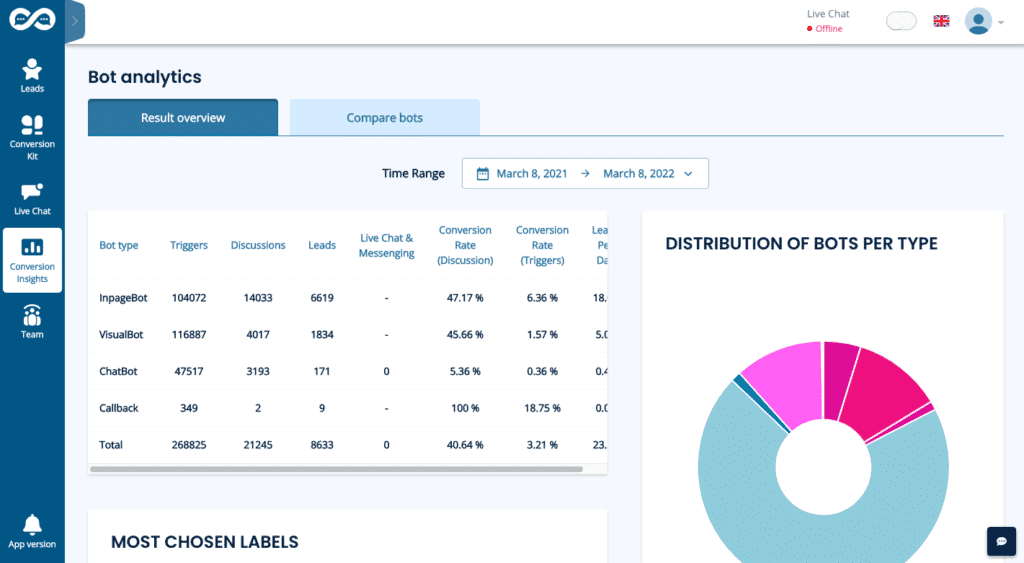
Leadoo’s Conversion Insights is the one-stop dashboard for all things conversion-related. Your personalised dashboard allows you to see:
✅ How your website is performing from the conversion point of view
✅ Best converting pages on your website
✅ Which sources bring the best results. Easily compare different traffic channels to see which channels perform the best.
✅ What the buyer’s journey looks like.
✅ How many days on average does a typical customer journey last – the touch points it consists of, and interactions it requires.
✅ Attribution modelling of your website conversions so you know which traffic channels affect successful conversions throughout the buying journey and not only the last click
✅ Understand which channels are the most efficient in attracting new visitors, which ones are great for getting the visitors back, and which channels empower the final visit that leads to a conversion
✅ Specific types of conversions using filters, and analyse conversion insights and journeys using comprehensive data
With Conversion Insights you get a 360° picture of all your online marketing efforts and how each action is affecting your conversions so you can make proactive decisions in order to optimise your site and increase your conversions.
Conversion Insights solves the issue for marketers who are trying to steer their ship blind in the night in the darkest depths of winter – instead it shines a bright light on a huge range of data points and analysis for you to leverage. Additionally, it helps to organise your leads into an easy-to-use and interpret dashboard, making it easier for everybody within your organisation to understand what is happening with each.
Consider that Leadoo isn’t only for marketing – we help your sales teams hit their targets, and provide customer support functionality inside the platform. It’s an all-in-one solution for conversions, lead generation and lead handling, with an added sprinkle of excellent data and insights.
Who wouldn’t want a taste?
If you want to know more about how we can help improve your conversions through providing actionable insights, get in touch or chat to the bot below 👇