Conversational marketing is the process of brands communicating relevant, personalized and real-time messages to audiences. Or simply put, having actual conversations with their users.
Crucially though, companies no longer have to be in the same physical space as a customer to do conversational marketing. Thanks to modern tech like chatbots and personalised website experiences, every brand can now have 1-2-1 conversations with users at scale.
Conversational Marketing on Websites
It’s often said that websites are our digital storefronts.
Now, imagine a physical store that is beautifully laid out. Has all the products on display, has striking visual elements to lure you in, and has promotional offers splattered across the walls. But, when you enter this beautiful store, there is no one to help you or show you around.
No one to answer your questions. No one to help you pick the right product or service. No one to talk you through what happens after you buy. And no one to even help you complete your purchase. Would you buy anything?
This is the trap many modern websites fall into. Visually striking, lots of sales messages, but no relevant help or support for users. Support that might ultimately be the difference between the user continuing their buying journey on that website or not. In short; no personalization, no interactivity, no conversation.
Benefits of Conversational Marketing
In today’s digital world, where information is instantaneous, users expect quick answers and tailored solutions. This is true across all industries, from B2C to B2B. Gone are the days when customers were willing to sift through dense websites or wait for an email response.
Users want instant, contextual interactions – and they want them now. This trend is only likely to accelerate, since as a society we are becoming more used to relying on AI and pilot tools.
A website without conversational elements risks alienating potential customers, leading to poorer user experiences (UX), lost sales, and missed opportunities.
Let’s break down why conversational marketing matters:
Improved Conversion Rates: A guided experience helps users find the information or products they need, streamlining their journey toward making a purchase or taking the desired action. If users cannot find what they are looking for on websites quickly, many simply give up and bounce. Read how Conversational Marketing helped a glass supplier increase revenue per visitor by 62%.
Conversational marketing might sound complicated to do, particularly at scale, but it is surprisingly simple with the right technology.
To revisit our storefront analogy from earlier, think of what you would want from a customer assistant in a physical store. You would want them to greet potential customers, ask them if they need help finding anything, answer FAQs about your products, and help them through the buying process by providing trust signals.
There is no reason a website can’t do all of those things through conversational marketing. Here’s some examples of tools that can be employed to do so:
Chatbots: To act as a constant ‘customer assistant’ should the user decide they have a specific question to ask.
Inpage Tools: To spark conversations organically with users as they browse specific content.
Visual Interactive Experiences: To ‘gamify’ the process of browsing your site, and to create interactive memorable connections.
Smart Forms & Calendars: To allow users to have conversations with you at their own time and convenience.
Live Chat: To give your users the extra trust signal of talking to a real person associated with your business.
Conversational AI Marketing
Naturally, AI has supercharged the potential of conversational marketing. Since brands can now use generative and conversational AI to speak to users in real-time.
With tools like Leadoo AI, users can now ask any questions they want, and brands can shape how an LLM will respond to them instantly, and what onsite pathways it will direct them to.
Even better, because of the power of LLMs, tools like Leadoo AI can:
Conversational AI creates incredible possibilities for marketers, but also some potential pitfalls. After all, it is by definition ‘artificial’ intelligence, and marketers can never know exactly how AI will respond to each individual user.
That’s why if marketers are employing conversational AI, they must be clear on its guardrails and prompting. With Leadoo AI, this takes the form of Knowledge Bases, where customers control the exact content AI models are trained on, and respond with.
A knowledge base can be a single URL, an entire domain, or a catalog of files you upload. Our model is then trained on this content, and uses it to answer questions, with customers able to specify exactly what it can or cannot comment on. The length and tone of responses it should give. Or even if it should prioritize certain topics or links in its responses.
With these kind of guardrails in place, marketers are in a position they never have been before. Where AI can power real-time conversational marketing in ways we could only have dreamt of a few years ago.
If they get it right, this can lead to enhanced UX; improved Conversion Rates; true real-time Personalization; and efficiency in both Sales & Customer Support.
As marketers, we’re bombarded with advice and proposals for acquiring more website traffic.
A quick skim through a marketer’s LinkedIn feed is likely to include everything from the latest tips for ranking highly in Google, to how to increase PPC click rates, to email open rate advice.
More traffic from any of these sources can be invaluable to marketers. And there are plenty of qualified agencies and consultants who can improve performance in these channels.
It’s easy to get caught up in the idea that more traffic equals more conversions. Many marketers seem to have this idea that if they keep flooding traffic through the gates, eventually, they will convert into leads or sales.
But since our websites are our digital shop fronts, let’s think about a shop…
Imagine you’ve just opened a brand new retail store. You’ve got your products set out nicely, the atmosphere of your store is very trendy and appealing. You’re also in a prime location that gets a lot of footfall, and people are coming into the store regularly.
The only problem is they aren’t buying as much as you need them to.
You’ve got a hiring choice. Do you…
Hire a sign-spinner or leafletter to try and drive even more people into your store?
…or…
Hire a sales assistant in the store to help and engage customers, thus increasing the chance of them buying something?
For most people, the answer is obvious. You’d turn your attention to trying to get the most out of each potential customer who you’d already brought into the store.
Unfortunately when it comes to websites, marketers often fall into the trap of buying digital sign spinners or leafletters. Simply focusing on driving as much digital footfall as possible, hoping the website will convert in roughly the same way it always has.
Unfortunately, expecting your site visitors to do the heavy lifting and figure out the buying journey for themselves often doesn’t cut it. They get bored, or frustrated, or simply enticed by a better experience they’ve had on a competitor site. So it’s no surprise that the average conversion rate for most websites is just 2%.
This means that ultimately, around 98% of your site traffic is leaving your website without doing what you actually need them to do.
This is particularly costly for marketers when we are paying to acquire traffic, say through PPC or referral links. But it can affect any source of traffic you have put a lot of effort into acquiring. One of the most common areas we see this is from Organic Search engine traffic.
A Lack of Conversions From SEO
There are many URLs that rank highly in Google or LLMS for popular searches, but simply do not generate conversions from all the traffic they bring in.
We recently had a Leadoo AI customer – a luxury holiday provider – experiencing exactly this. They had a blog ranking highly for ‘New York flights to the Caribbean’.
Clearly a highly desirable and competitive search term. But despite bringing in tens of thousands of organic sessions, and having several ‘buy your holiday now’ CTAs on the page, they had not captured a single sale from all that organic traffic.
That’s because most of the traffic was still in the research – or ‘holiday inspo’ – phase. Showing them hard CTAs wasn’t going to make them buy an expensive holiday.
So we embedded one of our Visual Bots on the page, which put the emphasis back on the user to ‘build’ their perfect holiday.
This gamified experience led to a major increase in on-page interaction, and crucially, many more users reaching potential conversion points. They had planned their perfect holiday, and could see trust signals that the company could provide this, all while never having left the blog they landed on from Google.
We consistently see this at Leadoo AI. Marketers put lots of time and resources – often successfully – into traffic acquisition. But they aren’t able to convert all that new traffic into leads or sales.
Lead Generation: The Ultimate Goal of Marketing
And that’s worrying because the ultimate goal of marketing should never be how much traffic you can drive. Whilst traffic can be a means to an end, marketing’s role is to understand customers and help drive positive commercial outcomes from them.
And that’s why, we’re seeing a big shift towards marketers focusing on conversions rather than traffic. Not just to measure performance, but to justify activity internally.
Content is king. The cliche that we as marketers are quite used to hearing by now. We’ve invested heavily into content marketing, as many companies have, and yet the rewards of those efforts are not as great as we’d hoped. It’s a scenario many find themselves in – being seemingly unable to drive conversions using content marketing – and that’s because their current strategy needs a few tweaks.
Content marketing is the process of creating and distributing valuable, relevant, and consistent content to attract and retain a clearly defined audience – creating content that helps attract buyers and piques their interest in your products in a more covert way; gently, and nurturing. Content marketing gives your brand authority within your space, helps with your SEO efforts, and allows you to target each of your buyer personas with the content most appropriate for them, leading to them spending more time on your site and giving you lots of information about their intent (which you can act upon later).
Conversion rate fundamentals
It’s probably a good idea to cover some of the conversion basics before we launch into how content marketing can help improve your conversion rate. If you’re a seasoned marketer and don’t need a reminder, you could remind yourself of the conversion rate benchmarks for your industry, or skip to the meat of the article below 👇
Conversion
A conversion is any desired action a visitor takes on your website, and these can be split into hard and soft conversions. Hard conversions are the final click of the button when a customer requests a demo or discovery, or checks out their basket in a B2C situation. These are the actions that directly contribute to revenue and so are important. But soft conversions can be just as vital – these are smaller actions customers take on your site, such as downloading a guide or subscribing to a newsletter. Whilst these actions don’t link immediately to revenue, they do give us an insight of customer intent (and therefore potential revenue in the future). Focusing on soft conversions too provides us with the opportunity to understand, and be able to nurture, our prospects and encourage them towards making that final purchasing decision no matter where they are in the buying funnel.
Conversion Rate
The conversion rate of your site can be calculated using a simple equation, but is also available for you to see on Google Analytics (or some other analytics platforms, like Leadoo). Your conversion rate tells you what percentage of visitors are converting into leads on your website. It’s calculated using the following formula:
Or, if you’re like us and you like it when technology does things for you, you can use our free Conversion Rate Calculator to work your conversion rate out.
Conversion Rate Optimisation
This simply means taking action to improve your conversion rate. There are many things you can do to optimise for conversion, and we’ll be looking at some ways that you can optimise your conversions by optimising the content on your site.
What does the buyer’s journey look like?
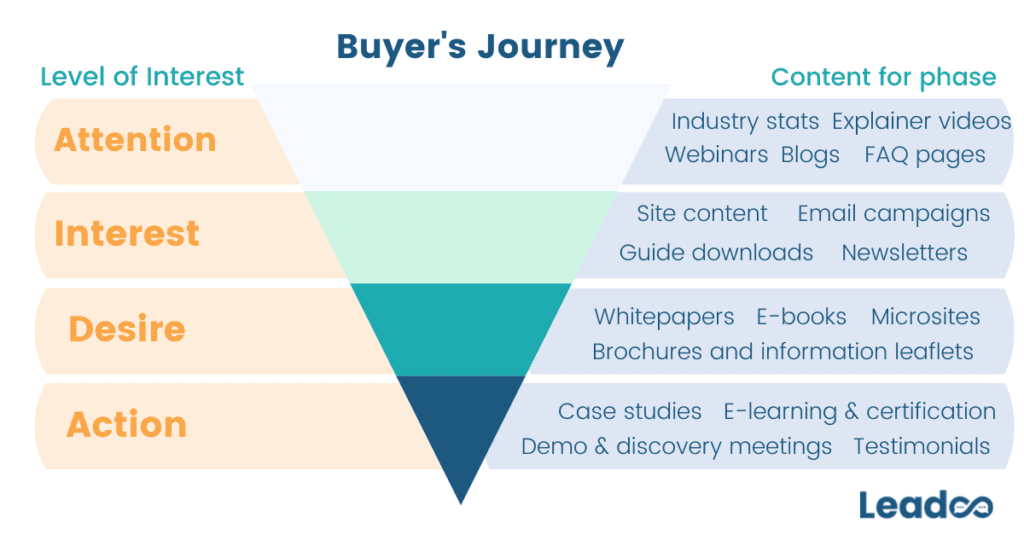
Most marketers are familiar with the AIDA model, or some variation of it. The model exists to describe the buyer’s journey, and the phases they go through when they are considering purchasing a product or service. The model works as follows:
Attention (also known as awareness): If a prospect is in the awareness phase, then this is where you’re aiming to provide awareness of your company, brand, products, and the value you can offer. At this stage, you are looking to grab the attention of your prospects in a positive way. This could be through meeting some charming members of your team at an event, or through informative and helpful content on your blog. The theme of the day is demonstrating high value to them, delivered concisely.
Interest: When a prospect is in the interest phase, your job is to convince them that they have a potential need for your product or service – ideally to the point that they’re ready to do more research into the product. This is again a critical point in their journey to explain the value you can bring to your prospect, as often they’ll be researching and comparing with competitors. At this stage, you’re looking to garner their interest so that they want to learn more. This could be via content on your website such as industry and business relevant case studies that resonate with your prospects and evidence the value your solution can bring.
Desire: You’ve successfully grabbed their attention, and piqued their interest so they’re looking for more. Now your job is to make them want your product, to think of nothing but your product… Ok, maybe that’s a bit far (although it would make the next step a little bit easier if that’s how they felt). This is the point where they’re starting to seriously consider the product, and so you want to provide materials such as competitor comparison whitepapers, success stories and case studies, as well as pricing and FAQ information.
Action: Action is the phase where you’ve finally convinced them with enough evidence that they should take action to buy the product or service you’re offering.
During each phase of the buyer’s journey, prospective buyers have different wants and needs for the types of content they’d like to see relating to their level of intent. This is something that businesses often get wrong, but if you want to drive conversions then you need to do that during all stages of the process, and not just at the end.
The type of content your buyers are selecting to read or engage with as they move through their journey also makes a difference in determining their intent – we refer to these as soft conversions (for example, a prospect downloads a guide or signs up to your newsletter). They’re not final conversions linked directly to revenue generation, but they do give us an insight into each visitor’s wants, needs and position in the buying funnel.
We can even take the information gleaned from our content creation and customer engagement to further improve the offer we provide and come closer to meeting customer needs. Let’s say you realise that customers who tend to visit Page A, also tend to immediately visit Page B. This could mean a few things;
Page A doesn’t provide enough information
Page A doesn’t have a Call to Action (CTA)
Page B provides one/both of these
A simple fix would be to look at the time spent on each page and what was interacted with to work out what people are seeking on Page B, then look to move some or all of this over to Page A – shortening the time it takes your average visitor to convert.
We’ll take a dive into how you can optimise your content marketing efforts for conversions using 3 easy steps.
How to drive conversions using content marketing: 3 easy ways
1. Create content for each stage of the funnel
Every customer that visits your website isn’t ready to convert there and then; 96% of people who visit your site, on average, aren’t. Only 2% on average actually convert. So your job, on top of trying to increase the number of hard conversions you get, is also to focus on the vast majority – the people who aren’t at the bottom of the funnel quite yet.
This means you need to create content that speaks to the prospect at each stage of the journey. You wouldn’t, for example, publish a white paper text in its entirety as an advert. Not only because logistically – and visually – it would be a mess, but because someone you’re targeting with an advert has a different level of intent to someone who would be willing to take the time to read a white paper. With an advert, you’re tailoring your message to those in the Attention (and potentially even Interest) phase of the buyer’s journey – providing them with the facts that will make them look for more.
With a white paper, you’re looking to provide detailed, analytical information which often provides a formal comparison or explicit value offering.
Your content should have the same consideration given to it – who is going to see this content? What are they likely to be looking to get out of this content? How am I going to make them want more or take the action I want them to take?
You can easily create content with generative AI tools like WPSEOAI.com that isn’t only great to generate content, but especially to generate SEO optimised content as well.
2. Make the most of every conversion opportunity: Call to Action
One of the first issues our Conversion Experts tend to identify regularly across many clients who we work with in their initial phases is that they usually aren’t using their Call to Actions effectively. They have poor placement, bad phrasing, or a lack of CTAs all together. There isn’t a correct answer for what works perfectly for your customers, so much of this optimisation relies on A/B testing different phrasing and button placement/visuals to find the most optimal CTAs for your customers.
In addition, many clients also simply don’t have CTAs (instead offering a contact form only – or perhaps worse, just a telephone number or email address), or don’t have enough of them. Placing CTAs isn’t an exact science, as mentioned above, but having them on the page in the first place is an excellent place to start. They should be located in places that make sense for the journey each customer goes through – for example, after a paragraph of important information has been given that might help a customer decide they’d like to get in touch or to be able to arrange a demo.
Within longer form content pieces, you should look to provide a CTA at least at the end of the article. You can also provide links throughout to other pieces of your own (or external) content, to signpost the reader to other articles which they might find useful and to push them down the funnel and closer to converting.
3. Provide a personalised experience with content – seamlessly in context
Personalised experiences are the gold standard of our time, and so it’s important that any content you’re providing is not only tailored to the visitor’s location in the funnel, but also to their interests and needs. This be achieved by creating more dynamic CTAs through carefully crafted bot conversations – through a single bot you can offer for the visitor to read more, and signpost them to other relevant articles, book a demo, find answers to FAQs and more, all in one place to meet needs of customers at the different stages of the funnel.
In addition, by using high-quality bots, such as the Leadoo InpageBot, you can embed a contextual conversation straight into the content you’re working with. For example, if your visitor is looking at your pricing page, then the bot on that page will only discuss pricing packages and topics you deem relevant to this with that visitor. The same approach can be taken across the whole site, ensuring customers receive valuable help and guidance alongside the content itself that is always in context and in tune with the customers’ needs.
By placing Leadoo bots, this also allows you to understand a prospect’s position within the buyers’ funnel and analyse their intent through conversation-level analytics, as to well as the support of our Conversion Experts – here to continuously optimise your bots to meet the needs of the visitors coming to your site.
Key Takeaway: CRO and UX go hand in hand
Content marketing can be easily utilised to help optimise your site for conversion by providing a seamless experience for every visitor – no matter their intent or stage in the funnel. By focusing on soft conversions and accommodating for these, you can ensure your content speaks to more visitors on your site, and increases the number of conversions along the way.
If you’d like to know more about how we can help you increase conversions via content marketing get in touch or chat to the bot below ⬇️
Quizzes are fun, aren’t they?
Not the type we all sat through on repeat from March-July 2020 delivered via Google Meet. We’d be happy never seeing one of those again.
But quizzes can actually be a super easy and fun way to engage an audience on a web page. This is often successfully used on ecommerce sites, where product selectors can help customers find the product they are looking for quickly.
This has uses in lead generation and conversion too – by carefully curating those questions, you can qualify visitors to your site and continue to nurture them after their visit.
How are quizzes an effective tool for conversion and lead generation?
With the rise of inbound marketing and the increasingly important focus on website conversions, quizzes provide an opportunity to activate visitors, engage them with your content, move them through your funnel, qualify them and their needs, and finally to collect their information as a lead.
1. Increased brand awareness and traffic
Quizzes are surprisingly good at generating traffic – our research online, and with our own clients, indicates that they generate traffic well, or moderately well, around 70% of the time. This, when compared with 36% for static content, makes an excellent case for having a quiz somewhere on your site. We’ll give you some ideas of how this could look a bit later in the article.
2. Better customer experience
An interactive quiz makes a users’ experience on your site much more personal – they’ve interacted with your site and your brand and now most likely have some understanding of your product and what you can offer them. This is a perfect time to point them in the right direction based on their position in the funnel – it could be encouraging them to sign up to a newsletter; or to book a demo with a salesperson.
Leadoo’s Conversion Platform not only allows you to create dynamic quizzes with complex logic and calculation functionality, but it also allows you to direct prospects to book a meeting directly onto a sales person’s calendar via our calendar integration function.
3. Adaptability in many situations
One of the best things about quizzes is that they are adaptable to many situations, in any industry or niche. It’s easy to use an Inpage, content-specific bot, or a VisualBot, to create a lead generating quiz, and our experts are always on hand to discuss and help with your industry-specific questions and ideas.
4. Qualification, segmentation and retargeting
By using one of the solutions suggested in point 3, you can create converting conversations that qualify, segment and allow you to retarget and nurture your prospects, to ensure you never miss a lead again. Using Google Tag Manager integration in Leadoo allows you to create super-targeted micro segments for even more specific targeting of campaigns.
5. Real-time, informative analytics
Visitor responses give you an excellent insight into their intent and position in the funnel, and allow you to make better marketing decisions to nurture them better.
Using Leadoo’s Conversion Insights, you get a clean, user-friendly dashboard with all the relevant analytics you need to monitor customer journeys and use this knowledge to increase your conversions. You can even optimise for conversions at the conversational level by using Conversation Analytics, and each bot is created to be fully customisable and bespoke for your business’, and customers’, needs.
Different types of quiz
With Leadoo, you can create a quiz for any purpose, and our Conversion Experts are always on hand to help create your vision, but we thought it might be useful to provide some inspiration and examples of ways quiz bots can be used.
Product Recommendation Quiz
When you provide a product recommendation quiz, not only are you identifying the needs of the customer immediately; you’re also gathering information that can help you to continue to nurture that customer if they aren’t in a position to purchase on that occasion.
If they are ready to purchase, you’re leading them straight to the product they need, by asking qualifying questions and creating unique conversation pathways that are context-specific to each product.
CareCo, the UK’s leading mobility specialists, provide the option for website users to get recommendations from the bot based on carefully selected qualifying questions. This option is provided in the right hand corner pop-up chatbot, which also provides users the option to speak to a live chat representative to get product advice, too.
If the customer wants to use the automated product selector, they can select this option, and the bot will take them through a set of questions to identify their needs and guide them to view products that they might find suitable.
The bot also offers opportunities to educate along the way – not all customers know what exactly they need and so sometimes it’s your job to help them know. For example, on the CareCo bot, when a customer is presented with the option of a power chair or wheelchair, they also have an option to select which will provide them with an explanation between the two. Super handy.
Once you reach the end of the conversation, and the product is selected, it gives you the option to leave contact details so an advisor can call you and continue the buying process from there. This means sales advisors are already armed with the information on what each prospect is looking for prior to speaking to them.
Calculator/scored quiz
Cooling Castle Barn is a wedding venue in Kent, U.K., offering luxury weddings in beautiful surroundings. As with all wedding venues, their prices differ based on day of the week, number of guests, and season, and so to provide pricing to a customer they would need this information.
Asking questions is the perfect opportunity to provide relevant and helpful information to the user – for example, if I were looking for a wedding venue and needed a price quotation, I could check out Cooling Castle Barn’s price calculator to see how much it would cost to get married there.
The customer provides details, and, using logic routing and calculations based on user inputs, it calculates the cost of the price based on pre-set parameters and provides this to the customer. It also allows them to book a tour, book a meeting and ask a question – to provide the opportunity to continue to nurture the customer towards booking their wedding day.
It also means Cooling Castle Barn’s sales team have an idea of the customers’ price range and information about their ideal wedding prior to contacting them, so that they can prepare accordingly and only provide the customer with wedding packages and extras within their budget and needs.
Another basic example of this would be our handy Conversion Rate Calculator – by inputting visitor and conversion numbers in, it provides you with the conversion rate for your site. Check it out 👇
Personality quiz
For something a bit more fun, but still great for engagement, you could try offering a personality quiz. It will depend on the industry and sector you’re in – not many people need to know which sort of roof tile their personality is most like – but something relevant to the customers that visit your site won’t go amiss. As humans, we love to talk about ourselves, and what better way to do that than fill out a personality quiz.
Some of our favourite examples of these come from BuzzFeed, which gained the majority of its reputation and awareness amongst its target audience through providing personality quizzes on a huge range of topics. They’re famed for their not-so-serious quizzes, from ‘Which Harry Potter character are you?” to ‘Can you see all these shades of blue?’.
Obviously BuzzFeed’s examples are much less serious, but there are ways to do these on-brand, whilst gaining some seriously useful information. Pair this with visitor identification, and you have a whole load more data that you can use to make smarter marketing decisions.
In Art Attack style, here’s one we made earlier as a different sort of example:
Key Takeaway
Quizzes can be a super-powerful tool for improving your users’ experience on your site, engaging customers with your brand, and qualifying and collecting lead data. When used with a conversion platform such as Leadoo, you gain excellent Conversion Insights to allow you to optimise your solutions and bots to increase conversions and generate leads on every page of your site.
Get in touch with us or chat to the bot below to find out how we can use quizzes and other solutions to help you up your engagement and conversions 📈
What is a chatbot? When and why should you use chatbots?
Table of Contents
What is a Chatbot?
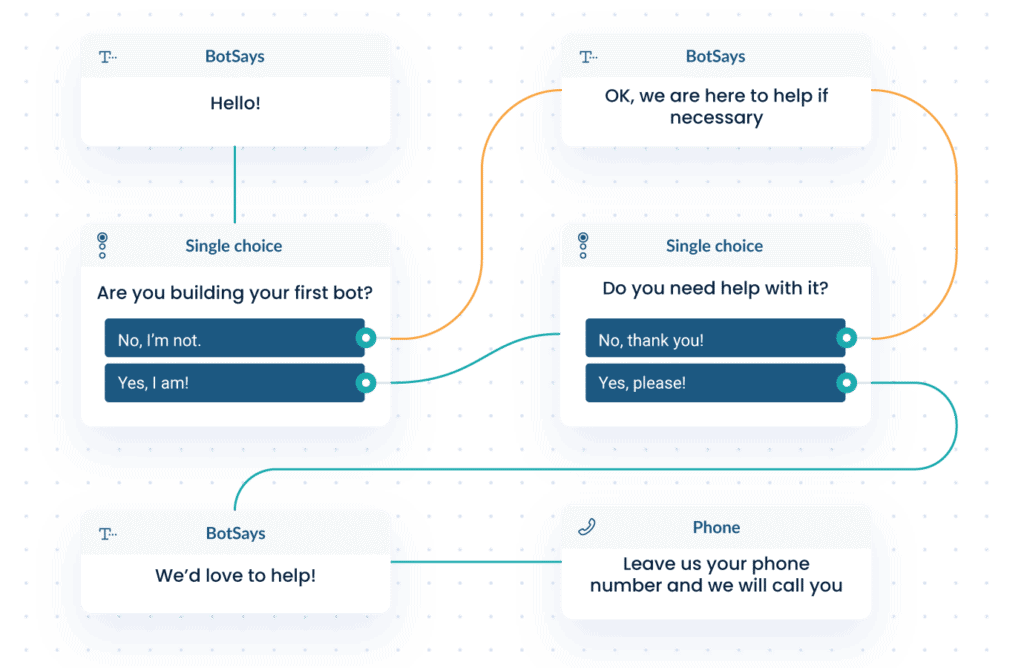
Lets start by defining what is a chatbot. A chatbot, or a “bot”, is a software application used to conduct an online conversation. Chatbots are designed to simulate human conversations but on scale by automating different conversation paths.
The purpose of a chatbot is most often to provide personal service and help for website visitors. But they are as effective when used in sales, lead generation and also in the recruitment process. The use cases for chatbots are basically unlimited.
Some people might be intimidated by bots and machine conversations taking over. Most likely, though, you’re not one of these people as you’re already here. What might come as a surprise is that website visitors often don’t care whether it’s a machine or a person, as long as they get help quickly. And actually chatbots are in many ways just as humane as people.
This article offers a deep dive in the world of chatbots and consists of the following topics:
The Benefits of Chatbots
How Do Chatbots Work? And the Differences Between AI, ML and Rule-Based Chatbots
Chatbot Use Cases
How Do I Know If I Need a Chatbot?
How to Choose the Right Chatbot For Our Business?
We’ve dropped bits and pieces of interesting chatbot data and facts here and there. So, all in all, you’ll find this article bursting with facts about bots.
The value of bots is often underappreciated because they are seen primarily in terms of customer service. Whilst this is still true, benefits such as personalization, engagement, visitor activation, and lead generation are just some of the modern ways chatbots add value to your customer relationship. Below we go into more detail with 8 essential values of chatbots:
Fast Response
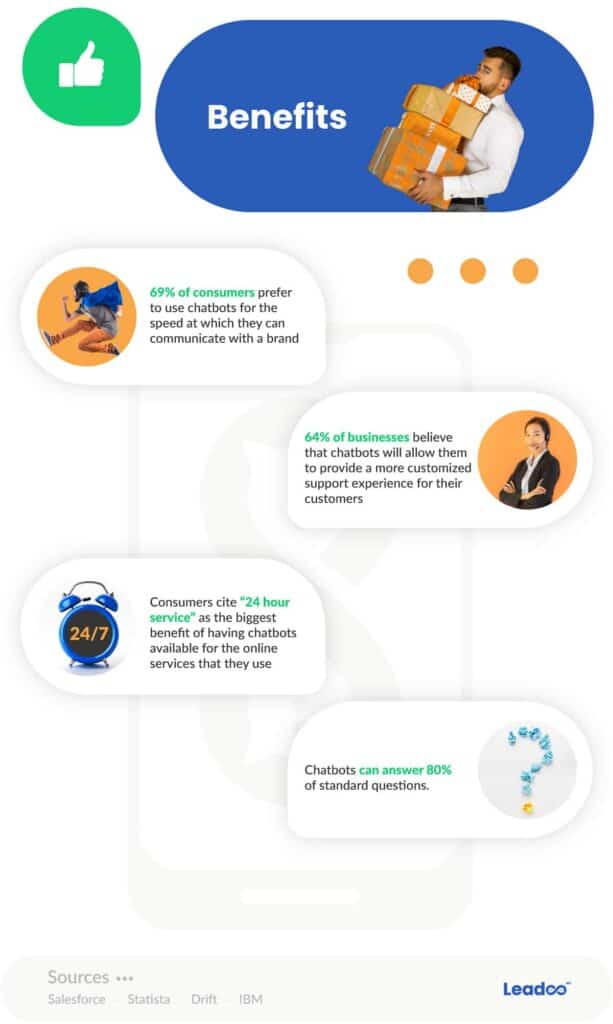
In today’s marketplace, speed and convenience beat price more often as the most valued asset. Sinch found 68% of customers with a positive experience of chatbots, said they liked them because they answered questions more quickly. If you’re not able to offer customers a response on Live Chat within the first minute, then you need to think about bots.
Increase Sales
Well-designed chatbots can not only provide great customer support, they can use the information about the visitor’s interests and preferences and provide advice, offers and purchase suggestions. The traditional way to convert people from a website has been through a contact form. But there are several reasons why and how chatbots outperform them by a mile.
Reduce Costs
Chatbots have long been a great way to reduce costs. They can automate basic questions and conversations that suck up the time of your people. Even if you have Live Chat agents, bots respond more quickly. This is especially true when the dialogue is directed by the business.
Scale Staffing Resources
Much of the customer service experience and buying journey needs to follow a simple question and answer interaction. Sales reps want to be engaging in the most critical and valuable points on the journey, as do your support teams. Free up their time and see the energy and effectiveness of your staff improve as they eliminate repetitive work.
Enhance Customer Experience
As well as being fast, chatbots offer many other attributes that enhance CX, from anonymity and accuracy to multitasking and unwanted phone conversations. We all know what effect retention and decreasing churn have on the bottom line.
24/7 Service
Customers are increasingly enjoying positive experiences with chatbots, with many citing the speed and ease of access as the key benefit. Bots are based on predefined answers, so they can choose the question. Also, humans need to sleep but chatbots are there, 24/7.
Personalization is a major factor in modern marketing and customers expect a relationship with their brands. Companies need to mirror more and more closely what consumers would receive from an in-person exchange. Conversational data can be analyzed and deliver invaluable insight into individualized marketing campaigns.
There is this one really thorough article we wrote about the benefits of bots for a better online customer experience that you might want to read. But now, let’s continue forward!
Featured material
Increasing Website Conversions with Chatbots
Find out how much chatbots can improve website conversion rates in your industry. Incl. data for 25 categories + pro tips for getting started.
Leadoo Report Chatbot conversion data from 400 companies
There are several different ways to operate bots. The world is buzzing about artificial intelligence (AI) and machine learning (ML) chatbots. The truth is that most chatbots are rule-based and they do their job even better than the fancy high-tech bots. In all honesty, who hasn’t run into an AI chatbot that gets stuck when it doesn’t understand what you’re trying to ask of it…? No matter what kind of chatbot you go for, building a solid conversation flow is the key.
Like always, every different kind of chatbot has their pros and cons.
Rule-Based & Handcrafted Conversational Chatbots
In essence, this means that the conversation paths are defined and built into the bot. The underlying tech may be simpler (no machine learning or artificial intelligence involved) but this approach emphasizes the need to understand your target audience. In fact, understanding the needs and behaviors of your users and customers is essential whatever bot technology you employ…
USER EXPERIENCE: Users of handcrafted conversational bots are limited by a defined set of alternatives. The big difference is they won’t hit a wall on the way to conversion because the dialogue is based on a decision tree that always works. With handcrafted bots, if you know your target audience, a few chosen options are all you will ever need. Often, a set of defined options can actually be preferred because typing (especially on mobile) can be cumbersome. Plus, the conversation always flows towards a goal defined by you.
SETTING IT UP & OPTIMISING: Rule-based bots are quick to setup. It takes just a few hours to get started and you don’t need developers to help you get up and running. It’s also easy to adjust a handcrafted conversation compared to an algorithm. No need to re-think or re-teach an algorithm. Easy customizability means that you will actually make the adjustments when there’s a need for it. In the best-case scenario, your provider will even suggest improvements and take care of them for you.
AI & ML Chatbots
Essentially, AI or ML chatbots provide chatbot conversations by using sets of data. As the available data expands, they should become better as they gather and learn from the information.
USER EXPERIENCE: Most of the AI and ML chatbots are designed to handle a single task. This is due to the required processing power, storage and use of data and the like being quite expensive and not yet very sophisticated. If the user is set to complete a really niche task, the chatbot user experience is remarkably good. However, if the issue concerns a more complex task then the chatbot runs into trouble. For example, users in the process of purchase, seeking to confirm a delivery-related detail, might find the chatbot fails if it’s designed for customer service rather than sales.
SETTING IT UP & OPTIMISING: The setting up of AI & ML chatbots takes months or even years. It requires a vast amount of data and tech-savvy people in addition to customer support, marketing and/or salespeople to train the chatbots. The project team needs to invest a lot of time into the project. Even though you might think that AI and ML chatbots would optimise themselves, that’s seldom the case. AI chatbots require constant effort from the project team to improve.
Chatbot Use Cases
As mentioned earlier, a lot of companies are using chatbots for customer support whereas only a few are using them for generating more leads or online sales. In addition to those two use cases, chatbots can be used for recruitment, in the fight against a certain deadly virus, and many others. In truth, you are only limited by your own imagination.
Here are some of the most common chatbot use cases:
Customer support
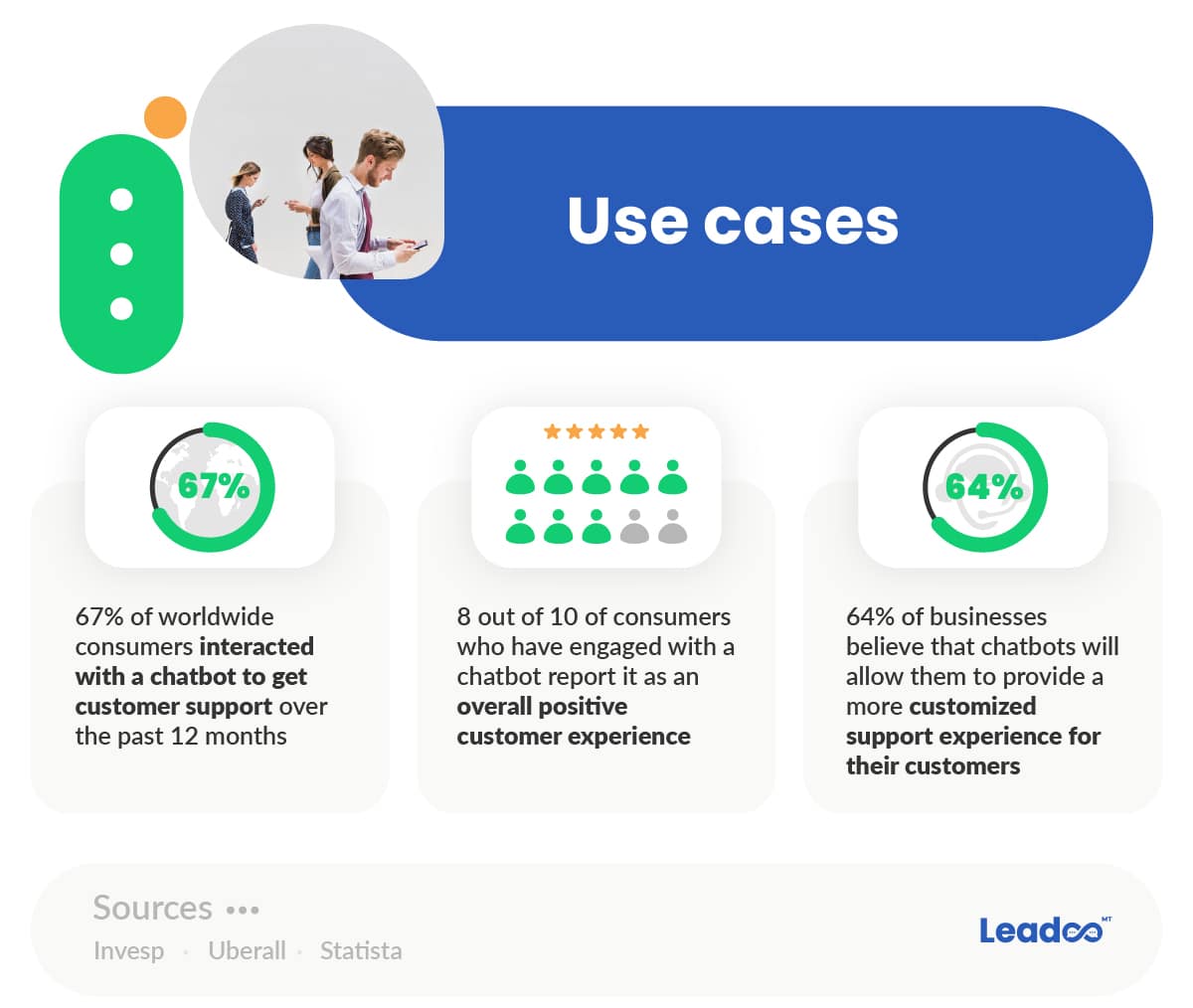
Well, this is by far the most common way of using chatbots. Automating the frontline of customer support allows the customer support functions of a company to focus on the most difficult issues. Bots can take care of the repetitive tasks that would normally overwhelm the support desk.
Generating leads
Live chat has been a source of leads for many websites for several years already. In light of this, it’s strange that it’s not common practice to use chatbots for the same purpose.
Chatbots can ask a visitor the same questions a sales rep would (within limits of course – you don’t want to annoy visitors). In addition, chatbots won’t need lunch breaks or have an ‘off day’. Finally, while many customers visit websites during the weekday, often evenings and weekends are the most lucrative.
Utilising chatbots for improving website conversion is a new tool to help you to reach your lead generation targets.
Increasing online sales
Often, we all require some reassurance about an issue before clicking that final “order” button in a webshop. Clicking on live chat in the bottom corner is one solution but it often takes a while for an agent to show up or the live chat is closed and there’s no one online.
With chatbots, it’s very easy to automate these “FAQ conversations” so that people get the help they need and get it quickly (it’s amazing how impatient many of us can be online!).
Using chatbots in recruitment is not yet very common but is about to disrupt the industry. As a sector, recruitment has been focused on internal processes rather putting the candidate first. However, this approach is changing fast as companies engage in a constant race for talent.
Chatbots in recruitment can lower the barrier for people to apply whilst also offering pre-screening on behalf of the recruiter. Chatbots are brilliant at dealing with the first phase of the recruitment process. Automated job interviews save hours of wasted time in screening and tailoring CV’s. Avoid the worst case scenario where all that unnecessary information is just copy-pasted into a company’s recruitment platform.
Utilizing chatbots as the first phase of the recruitment process also plays with our basic psychological need: the need to be recognized. That’s why a combination of chatbots and gamification offer the perfect hook to attract more and better talent to your open vacancies.
How Do I Know If I Need a Chatbot?
Chatbots are not necessarily for everyone and you need to ask yourself the right questions to determine if they will work for you. Below are some of the ways to examine the feasibility for yourself:
Engage & Activate
A whopping 97% of your website visitors are passive so only 3% are actively seeking a solution right then and there. This means that only a handful of people visiting your website will move mountains to get where they want to be. The majority will leave if you don’t activate and engage with them. Is your website activating visitors? Can they easily find what they are looking for? If you hesitate in answering either of these two question, you might want add chatbots or some other activating elements to your site.
Repetitive Questions
Ask yourself, how much time is spent by your teams answering common questions or redirecting people to different departments? What about trying to locate information on your website? Time spent with these repetitive queries is time away from more complex issues that truly need a human touch.
Poor CX
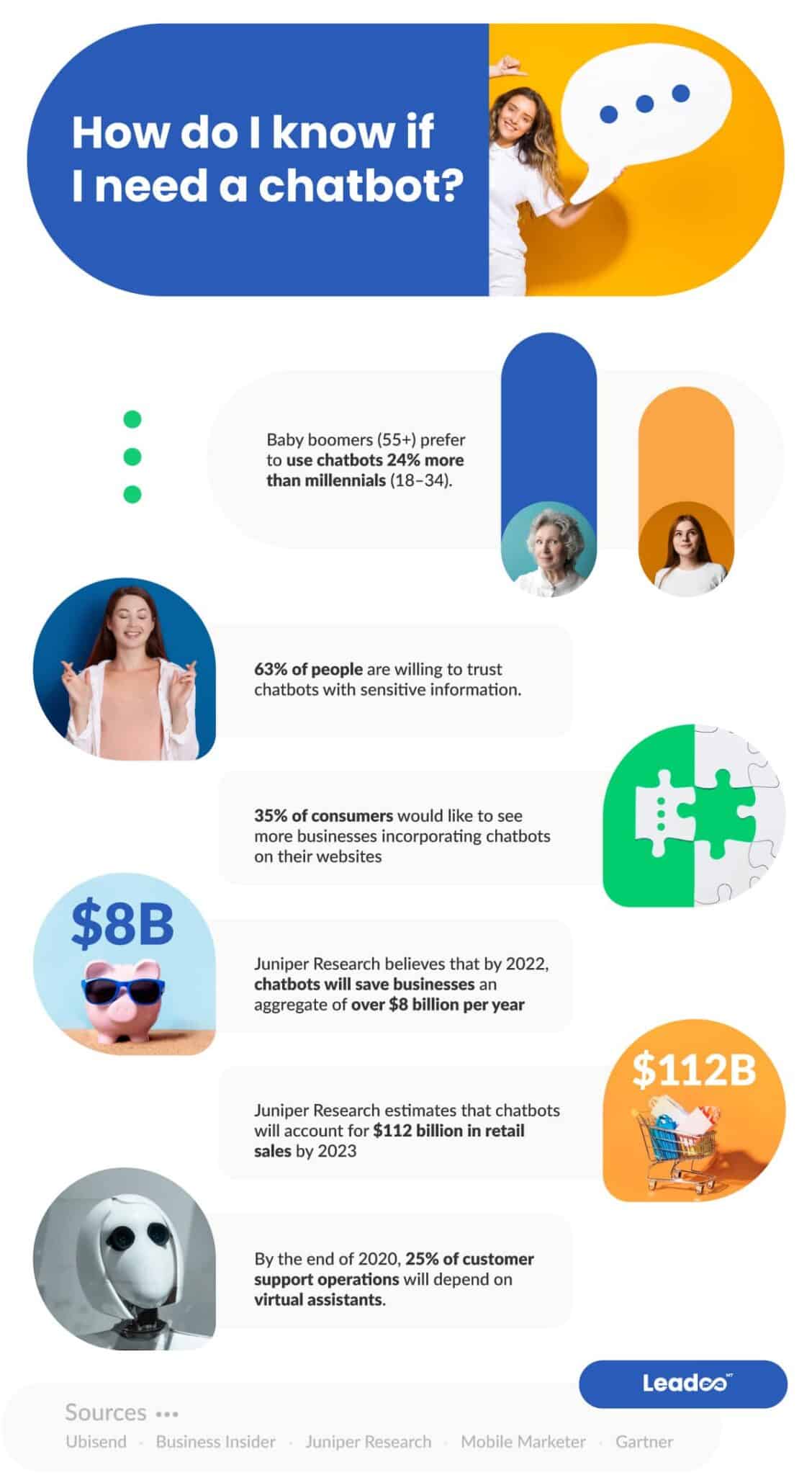
The question you need to ask yourself here is, how fast is fast enough? 82% of consumers expect an immediate response when they have a sales or marketing question. Our world is a demanding and instantaneous one, so if your team isn’t able to respond to customers fast, it’s time for a chatbot.
Maintain Privacy
When thinking about chatbots, consider customer data issues and how the information is shared and stored within your customer support systems. Some industries need to handle sensitive information. It’s important to consider security in your chatbot decision, but these privacy concerns shouldn’t hold you back. You’ll see below that Banking and Health sectors, for example, are major beneficiaries of chatbots.
Lead Qualification
Chatbots are great at qualifying leads. Two signs chatbots are right for you. First, that you have yet to define a clear lead qualification process. Second, that your sales team is overwhelmed by the number of potential leads coming in. In the first case, you should factor chatbots into your planning. In the second case, get a chatbot – like, yesterday!
Multi-channel Messaging
The last question to consider is, are you interacting with customers and leads in the medium they most prefer? We’re all using social media like Facebook and WhatsApp on a daily basis and some chatbot providers now offer integrations. This enables your team to manage all customer and visitor communication in one place.
There are few main things that can help you identify what kind of chatbot to choose for your company.
Time Available
How much time do you and others in your organisation have for setting up the chatbots? Can you you be there to constantly optimise, teach and maintain the chatbots? Do you want the value of chatbots but with a no-fuss, quick setup?
AI and ML chatbots are time-consuming projects but it doesn’t stop there. Someone needs to constantly train an AI bot as well as monitor the algorithm. Essentially, it’s not a project or tool, it’s an entirely new process for your company to manage.
Rule-based chatbots, on the other-hand, are quick and easy to set up and some providers even create and optimise bot conversations for you. Good customer support will pick your brain about your industry, customer behaviour and your company’s strengths and then create the bots for you.
Skills
What kind of skills do you possess in-house? Do you have skilled data and IT professionals committed to the project?
To get them up and running, all chatbots need the customer knowledge from your people (including sales, marketing and customer service). There’s no way around that. Then it comes down to what other competences you have in your organisation, like data and IT specialists. Have you got these kind of people in-house and how committed will they be? If you’re even a little unsure, taking AI or ML chatbots will probably lead to bad bots that don’t help anyone. If you only have business people involved, rule-based bots are definitely the way to go. Rule-based bots are quite easy to setup – check out our best practices here.
Setup Time
This is quick & easy to assess: do you need chatbots up and running asap? If your answer is yes, then go with rule-based chatbots. If not then you can allow other considerations to influence your chatbot decision.
Budget
Are you willing to invest hundreds of thousands into your chatbots or are you more interested in getting started with something smaller? Does the investment need to be precisely budgeted or do you have space to move if you need to invest more into your project?
Rule-based chatbots are fairly cheap and easy to budget. It is also quite easy to calculate the ROI for your investment.
The cost of AI and ML chatbot projects tend to start in the tens of thousands or even hundreds of thousands. Like many other IT projects, it’s hard to estimate the expense accurately beforehand.
Versatility
You are most likely planning chatbots for a specific use case, like automating website customer service or for lead generation purposes. Bear in mind that chatbots have several other use cases as it states in this article. Don’t let the chatbot technology you choose limit your options in the future.
Optimization & Analytics
One might think it’s easy to create conversations that help website visitors. Actually, that’s not always the case. That’s why it’s really important to have proper analytics in place when operating your chatbot. Analytics will show you which parts of the conversation work and which don’t.
AI, ML or Rule-Based chatbot?
All have technological pros and cons. For example, in all their intelligence, AI-bots still tend to have a low tolerance for real human language. Another weakness is that if people are given the opportunity to ask the bot anything then they really will. As a result, the conversation isn’t always moving towards conversion. On the other hand, handcrafted conversational bots don’t reach the adaptability level of AI. Nor do they have the ability to learn like ML bots do.
Much of the decision-making comes down to the service part of the deal. Having a dedicated expert guiding you through the design process, challenging your assumptions and providing further optimisations, can make all the difference in ensuring a return on your investment. In most cases, AI chatbots are unnecessary, particularly for smaller and (most) medium-sized businesses. Larger companies needing to organise customer service for thousands or millions of consumers are a better fit for AI and ML.
If your goal is to generate leads from your website, you should already know the questions and concerns that your prospects are seeking answers to. The same goes for handling frequently asked questions. In other words, nothing is stopping you from designing conversation paths that address your website visitors’ needs perfectly well. Handcrafted conversations are surprisingly effective. On top of that, they’re quick to get started with and easy to improve as you go.
If you are interested to dig deeper into the differences between AI, ML and Rule-Based chatbots, we wrote this thorough article on the subject.
Chatbot providers to look at:
Leadoo – A chatbot provider that offers chatbots along with messaging features and tools for the mapping of a customer journey. Focuses on making websites convert more sales and leads and enhance the customer experience. (Note: author of this article.)
Drift – A conversational marketing chatbot provider focusing on creating a better user experience through chatbots.
Intercom – A customer service-oriented chatbot provider that originates from live chats.
Hopefully it is apparent to you that there are several benefits and use cases chatbots cater for. Chatbots can not only help you save money and time but also generating additional revenue by increasing online sales or lead generation.
This article contains the basics of bots whilst also offering some additional detail to help you deepen your understanding on the subject.
We hope you found this article useful. We would be especially grateful if you have time for some feedback by talking with our chatbot (obviously) below 😉 ⤵️
Are you looking for ways to increase engagement with your brand? Do you feel like the content you painstakingly produce just isn’t cutting through? Maybe it’s time you tried incorporating gamified elements into your material.
Gaming is not the same as gamification
For some this may be obvious but gamification is not the same as gaming. Gaming is the production of a separate medium whereas gamification is the application of the principles of gaming to marketing or educational material. What gamification seeks to achieve is increased engagement and understanding of content through our natural attraction to game principles.
The following post will explain how gaming principles leverage our human instincts for competition and game scenarios, what these gaming principles actually are, and finally ways those principles can be introduced to provide value to your business.
What’s the psychology of gaming?
Gamification activates the following elements of human motivation:
1. Competition
– The first is our desire to compete. Whether we are trying to demonstrate our knowledge on a subject by taking a quiz or completing a crossword, or whether we want to establish a position in a community, competition is a deep survival instinct. We either want to demonstrate our strengths or we see what others have done and want to receive the same benefits.
2. Status
– Next is the importance we attach to status. Like all of these motivations they fluctuate depending on the individual, however, most of us take pride in having others recognise our position in a community. Although status through gamification doesn’t hold the prestige of work or education, it can be just as powerful, especially when applied to mundane or routine tasks.
3. Achievement
– This is the most obvious gaming motivation. Dopamine release is triggered in our brains whenever we achieve even the smallest of goals or targets. The design of a challenge can trigger this sense of achievement in itself but recognition of the achievement will also have the same effect.
There are other motivational elements applied in gamification principles, such as self-expression or altruism. However, these are less common and powerful than the three mentioned above, as well as being more difficult to incorporate into a basic gamification strategy.
Good examples of the principles of gamification in practice
Competition
All gamification principles and ideas can be categorised under the umbrella of competition, status and achievement. In the first place, our competitive instincts are what draw us into the idea of a challenge. It’s worth remembering that ‘challenge’ is a flexible term. Think about all those ridiculously easy facebook quizzes that state only ‘3 out 10 people can name all these cities’. You know they’re clickbait and obvious but you just can’t help yourself! We love the idea of proving to ourselves (and others) that we are smart.
A good example is the National Geographic competition run in order to promote interest in the second season of its show Genius. Spread out over a period of five days were clues that fans of the channel had to figure out. In this case, the questions were a real test of knowledge regarding topics such as architecture and history. Even though there was a prize at the end, you can be sure there were many who were hooked on the idea of demonstrating just how clever and capable they are.
Status
If your gamification strategy is being built for the long-term, then it’s important to think about status. Individual progress should be measurable through the accumulation of points. Those points can lead to different levels and be recognised on a leaderboard. The issue of external status is one element but then appreciation of personal progress is another.
One example I know well (because my mother-in-law is hooked on it) is the foreign language learning software Duolingo. They have different leader boards for whatever learning stage you’re at, and in whatever language you’re practicing. If you don’t keep at it everyday then you lose your position. Also, if you lapse and forget, there’s some notification reminders that evoke a sense of disappointment. It’s all designed to help tackle the daunting challenge of learning a foreign language by breaking it up into manageable pieces.
Achievement
Whether or not you can create an effective gamification challenge alone doesn’t necessarily matter if you can supplement it with a system of rewards. Coupons, prizes, giveaways etc. have been used by businesses for a long time. Lavish holidays or expensive cars are now commonplace. However, again you don’t have to break the bank in order to activate the human desire for rewards. Earning badges or certificates are a great example of a budget reward mechanism. Prizes and goods can be initially virtual and then could be exchanged for tangible assets if the programme proves successful.
The company SAP needed to quickly get its huge global team of sales staff to quickly engage in a new portfolio. It did this by tapping into the competitive nature of sales people through its Roadwarrior programme. Sales reps answered questions from simulated interactions with customers, winning badges and earning points in the process. Reps then challenged coworkers and the overall strategy helped train employees.
Statistical tracking and a deeper relationship with your audience
Like with most things, the data behind the process is critical. It’s essential that you keep a track of how much each user interacts with the gamification strategy. This is not just for your benefit but theirs as well. Reflecting on how much and how successfully they engage is the biggest (and cheapest) reward you can provide. The more creative ways you can illustrate and reflect this information the more attention you will capture.
This is also how you foster a much deeper relationship with your audience. Not every company can provide a huge customer support team or respond individually to community members. This is why a gamification strategy can help. Companies can do much more to embrace customers than, say, simple loyalty schemes. For example, using chatbots to engage website visitors in conversations. These bots can also be easily linked to your gamification strategy as a way of inspiring visitors to engage more with your content.
Gamification is a much more interesting way to reach and interact with your audience. That’s what people nowadays expect: to be entertained and engaged.