KNOWLEDGE
Case StudiesBlogsEventsSupport & Starting
Support Articles & HubSupport Videos (Youtube)Try Leadoo Free (Leadoo Lite)Partners & Careers
PartnershipsCareersSecurity & Privacy
Security at Leadoo AIGeneral Terms & ConditionsData & GDPRKNOWLEDGE
Case StudiesBlogsEventsSupport & Starting
Support Articles & HubSupport Videos (Youtube)Try Leadoo Free (Leadoo Lite)Partners & Careers
PartnershipsCareersSecurity & Privacy
Security at Leadoo AIGeneral Terms & ConditionsData & GDPRSo very often website carries little-to-no weight, if we’re being quite honest. This holds true especially when it is hard to measure, due to lack of insights and cross-team metrics.
We can leadoo you on a secret; you can turn your website into your best-performing sales channel with the right tools and insights.
In this webinar, we’re going to cover exactly how you can do this, and what are the small actions you can start implementing immediately.
In this webinar we’ll be covering the following topics:
💡 Why personalisation matters when considering your website as a sales channel
💡 Why your website visitor’s customer journey needs to be accounted for for the best results
💡 What small actions you can take immediately
Sign up and get ready to see the results 🚀
No buyer wants to have the exactly same experience as all the other buyers. They want personalised experiences, they want to feel like you fully understand their problems and pain points and customise the solution just for them. This applies to all touchpoints, your website included.
So, we want to give you a heads-up when it comes to tailoring those personalised website experiences, and how to cater to your audience’s ever-growing needs.
In this webinar, we’re going to cover exactly how you can do this, and what are the small actions you can start implementing immediately.
We’ll be covering the following topics:
💡 Why personalised website experiences matter
💡 Why it brings better results
💡 How to make your website UX personalised to your visitors’ needs
💡 What small actions you can take immediately
Sign up and get ready to see the results 🚀
Are you able to track your buyer’s whole journey, from each website visit, to each action, to eventually a customer?
If not, you’re not probably spending your marketing budget as wisely as you could.
Worry not, we’re here to help you get on track with your marketing budget optimisation, and we’ll give you helpful tips on how to track your buyer’s journey effectively!
In this webinar, we’re going to cover exactly how you can do this, and what are the small actions you can start implementing immediately.
In this webinar we’ll be covering the following topics:
💡 How the buyer journey has changed and changed the way we measure
💡 Why tracking the whole buyer’s journey is important
💡 How to track the whole journey instead of the last touch-point
💡 What small actions you can take immediately
Sign up and get ready to see the results 🚀
So very often website carries little-to-no weight, if we’re being quite honest. This holds true especially when it is hard to measure, due to lack of insights and cross-team metrics.
We can leadoo you on a secret; you can turn your website into your best-performing sales channel with the right tools and insights.
In this webinar, we’re going to cover exactly how you can do this, and what are the small actions you can start implementing immediately.
In this webinar we’ll be covering the following topics:
💡 Why personalisation matters when considering your website as a sales channel
💡 Why your website visitor’s customer journey needs to be accounted for the best results
💡 What small actions you can take immediately
Sign up and get ready to see the results 🚀
Instead of providing all of your website visitors with the same, broad, generic experience, provide them with a highly personalised experience. Audience-specific landing pages out-perform the main site in 9/10 cases, and that’s hugely due to the fact that the landing page is customised and personalised for the audience.
You can now do that with your whole website. Are you ready to see the results it brings?
In this webinar we’ll be covering the following topics:
💡 Why landing pages perform better than main website
💡 How to turn any website into a personalised experience
💡 How to get started
Sign up and get ready to see the results of personalisation 🚀
You’ve given blood, sweat and tears to that blog post, guide, or video. It’s almost given you sleepless nights, and the impression of a thousand open tabs from all your research is now permanently impressed on the inside of your eyelids. Yet that content you lovingly crafted isn’t converting people, or even pushing them further down the funnel, and you can’t help but wonder why. We know this is something many people struggle with – knowing how to create content that converts well – so we thought some handy tips on improving conversions throughout your content would be appreciated by our marketing friends.
When we talk about content, this can take many forms – from blog posts to videos, graphics, web pages and images. Whatever form it takes, it needs to be helpful and educational for your audience, as well as doing its job of signposting visitors to your website or a CTA where they can learn more about you and your products. Most importantly, it needs to be tailored to the buyer’s position in the buying funnel and whether or not they are ready to buy; providing opportunities for soft conversions.
We’re going to look at the main things you should focus on when you’re looking to create ultra-converting content for your site.
Firstly, a common misconception within content marketing is that volume is the most important factor. And whilst this does help somewhat in terms of SEO, it doesn’t actually help you convert the people who are on the page reading the content. Quality content attracts visitors and makes them stay. It’s that simple.
It should also be noted that quality can look different depending, again, on the needs of your customer base – some of your prospects may feel overwhelmed with too much text when they’re looking for facts, for example, and this may cause them to leave your page without reading much of your content at all. For these customers, shorter form content, infographics and visuals are the key to maintaining their attention and encouraging them to want to learn more.
Quality is therefore mostly about recognising the needs of your customers and ensuring you’re providing for how they want to consume your content. For example, if your target audience tends to be younger, then it’s likely much of their content consumption is via audiobooks and podcasts, rather than traditional media such as newspaper articles or even blog posts, and you should tailor your content offering to meet this need. Content not in the form that your customer is looking for will cause them to seek it out in their desired format elsewhere – meaning you lose that customer into the ether potentially forever.
At the heart of all content marketing strategies should be a deep understanding of your customer – without this, you have nothing. You should firstly decide who it is that makes up your target audience. There are a million ways to categorise these (ok, perhaps not quite a million), but you can of course start by segmenting people using the old favourites; demographics, psychographics, behavioural and geographic segmentation should give you a good starting point to identify common characteristics in your typical customer. It may be the case that you end up with several personas, each representing a different type of prospect, and that’s perfectly fine – very few businesses solely sell to one very small segment or niche market, and even niche markets tend to have one or two overlapping customer personas.
Once you know who your audience is and what they look like, you can start to identify the common problems amongst this group and how your product is able to help. You can start by asking some basic questions about your identified personas; What do they care about? What do they struggle with? What are their motivations and fears? What are their goals?
Figuring all of this out is the first step, and then you can then create content which they actually find interesting and relevant so are therefore more likely to consume it. This is where you can make use of all that market research you probably spent hours conducting when creating your brand and product strategy – by making yourself intimately familiar with your target audience’s pains and frustrations, you can identify the ways in which you can help. Communicating the value of your product or service is the key, and each persona or target group identified will have differing uses for your solution. This makes it really important to alter the messaging and value proposition offered to each group and persona so that it’s always relevant for them. More on this later in the article.
Once you know who you’re targeting with your content, you should look to set some simple goals for the content you produce. Three simple things to start you off thinking here:
1. What stage of the funnel is my reader going to be at?
Not every customer is ready to make a purchase the second they land on your site for the first time. You need to know where they’re at, and then ensure that there is content available that is relevant to their stage of the funnel. For example, if they are only visiting for the first time, you can look at which pages they looked at and how long they looked at it to assess the intent of your visitor (and even leverage this in retargeting campaigns).
2. What do I want them to do as a result of engaging with my content?
This is important because it determines the calls to action you should set within your content – if you want them to read more information, then you need to provide a signpost of some description to get them there. This could be a CTA, a linked bit of text, or a chatbot that directs them to the next step. This would also count as a soft conversion (and remember, they’re really handy for helping us understand our customers better).
3. How can I make number 2 happen?
Just because you have the ability for your visitors to take the next desired step, it doesn’t mean they will. Your job is to provide all the information they need to make a decision about whether or not to take that step. Then, if they decide to do what you wanted them to, then you need to make it as frictionless and easy as possible for them to take that step. Don’t overwhelm your visitor with a 50-field contact form. Ain’t nobody got time for that, and they won’t fill it out.
This is of course not an exhaustive set up, but it does provide a good starting point for you to start creating content that is relevant to every audience you’re trying to reach. Before you start the creation process, you should be able to clearly identify what problem your content solves and how it does so, so that you can ensure you’re communicating the value of your product for these issues. You can of course then set more official objectives for your content, to help you focus the contents of each piece on the target audience specifically. The objectives could be as simple as getting a better understanding of what sort of content works for your audience, or a harder KPI like improving the conversion rate of content on your blog.
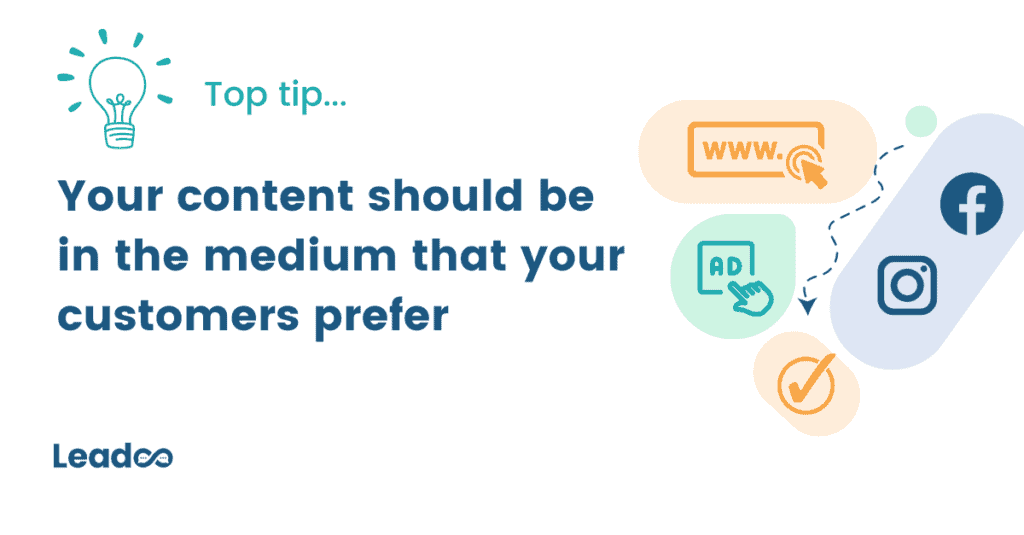
Now that you’ve given consideration to the purpose of the content, and its intended audience, you need to think about what medium your target audience most often consumes other content through. For example, if you’re targeting a younger audience, then it makes sense (considering 90% of Gen Z have at least one social media profile) to create content designed to be shared via social media channels such as Instagram and TikTok. Alternatively, if your target demographic is sales and marketing professionals, LinkedIn is your friend. No other social platform offers access to a business network like LinkedIn, and the targeting capabilities on LinkedIn are decent. LinkedIn is used by professionals to share business insights, job opportunities and industry news, and so content created for LinkedIn should be created with this in mind.
It may be the case that the message you need to convey is a more complex one, better suited to a video or a podcast, perhaps due to the sheer volume of information. Some consumers prefer to digest information that is presented visually, such as through infographics, while others prefer to read long-form text. Get to know your audience (point number 1!) and make sure that you’re delivering the content to them in the medium they prefer.
Making your ‘book a demo’ button bigger and brighter, or your contact form longer, is not the catch-all solution you probably think it is.
In our extensive experience of working with clients across a huge number of industries all across Europe, we know that this just doesn’t work. If you want to convert your audience, then you need to give them plenty of opportunity to do so, and make it really easy for them. Presenting your prospects with an arduous contact form (or just an email address to email), isn’t going to fly with today’s customer. They expect an easy experience, personalisation and immediacy – none of which a contact form bigger than your dreams will solve.
And, whilst the standard analytics tools like Google Analytics and Hubspot can help you track things like where your audience comes from, how long they stay on your site, and what they do while they’re there, they don’t necessarily give you the most holistic view. If you want to focus on converting your visitors across your site, then a Conversion Platform, such as Leadoo, is what you need. Leadoo provides you with a comprehensive platform that gives you oversight and control of the conversions happening on your site. With Leadoo, you can see who is visiting, how long they stay on each page, where they’ve come from (using more than the last touchpoint, making your attribution much more accurate), which companies people are visiting from, as well as key contact data on company decision-makers and individual visitors.
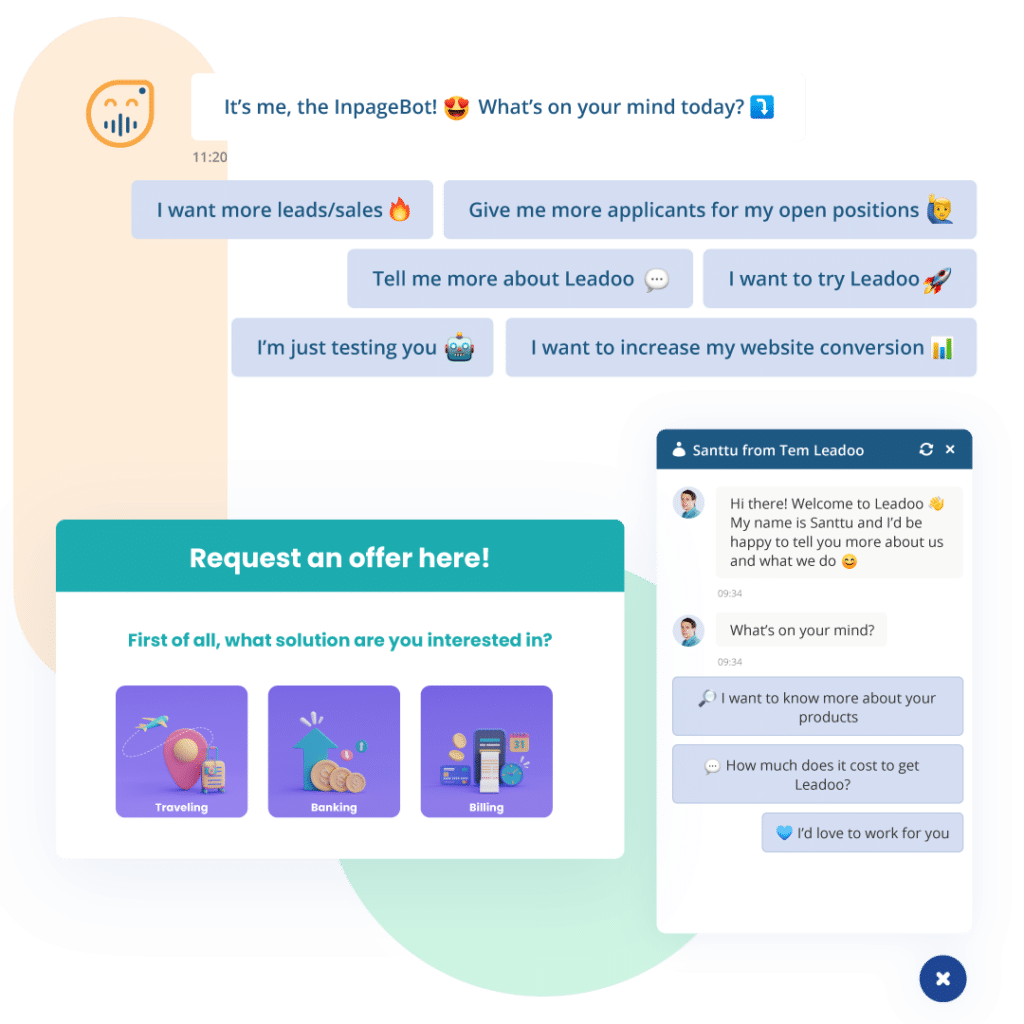
Leadoo also provides interactive, personalised conversations for your web pages to allow visitors to interact and ask questions about your products, get help from an agent, or be referred to the relevant sales team.
At the end of the day, creating content is a lot of work, but it’s also fun. You get to stretch your creative muscles, work with your team, and build something that will ultimately help your business and your customers. Follow the tips above, and we have every bit of faith that your content will start converting the way you want it to.
Implementing Leadoo AI is extremely easy. Simply add the Leadoo bot script to your website header or the pages of your choice. You can also implement the chatbots to your website by using Google Tag Manager.
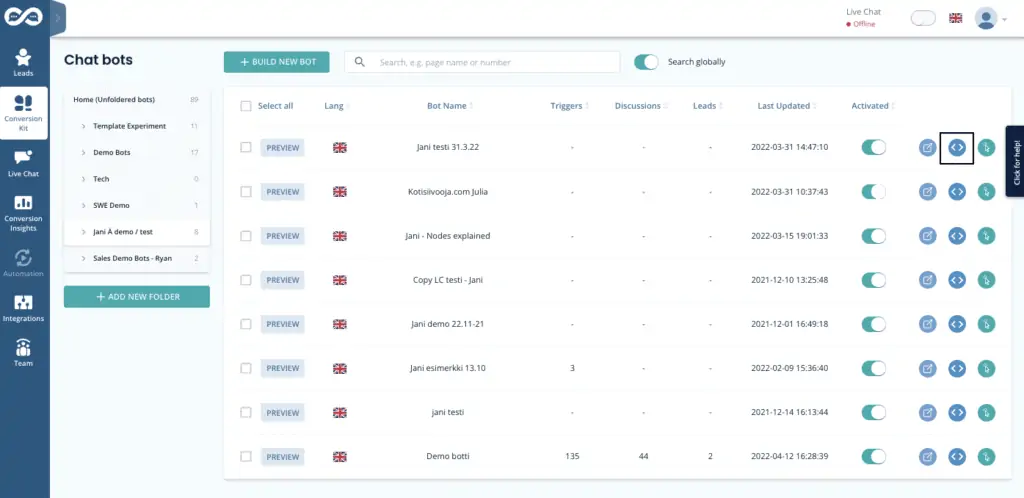
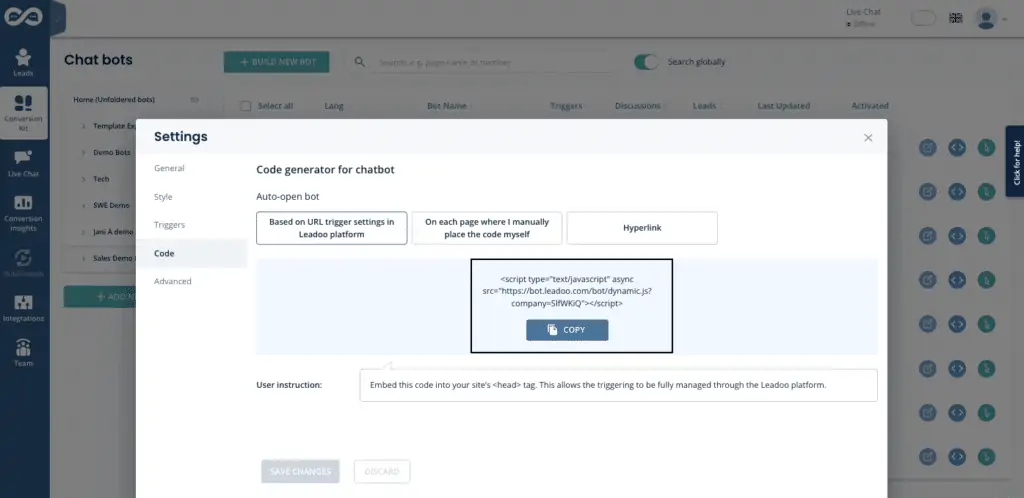
We recommend placing the script within the <head> tags of you websites global header. This allows the triggering of the chat to be managed fully through your Leadoo platform and you never have to add any other Chat / CTA scripts. <head> tags can usually be found from the site’s “Theme editor” (within header.php file).
Alternatively, you can copy paste the script within <body> tag of each page you want the bot to appear in. The content of <body> is often accessible through the pages’ html (text) editor.
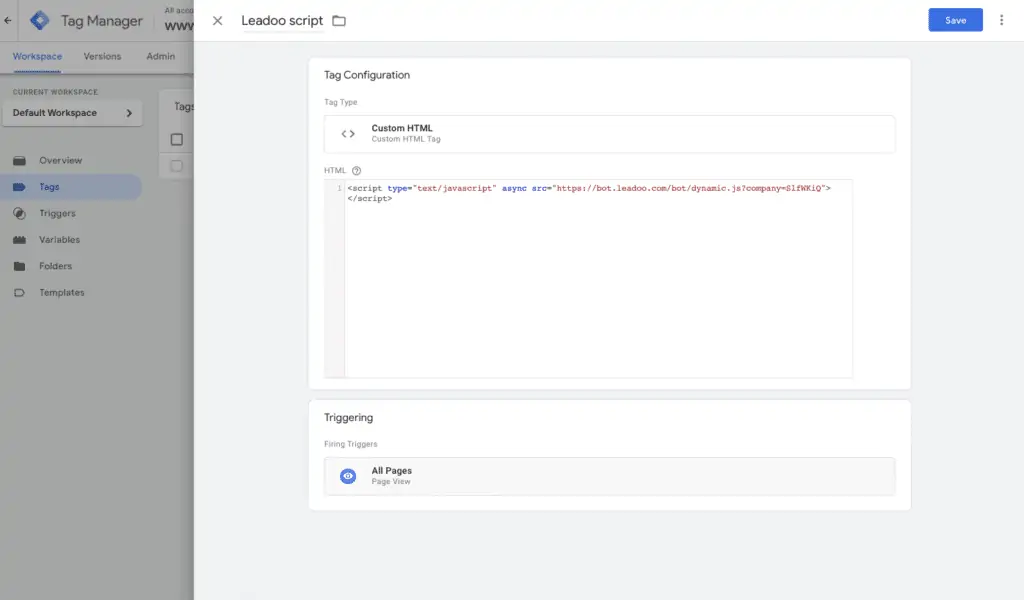
Adding script via Google Tag Manager
We advise you NOT to embed any Leadoo scripts through Google Tag Manager:
When you are embedding an InpageBot / VisualBot, you have multiple options to choose from to find the way to embed, that fits you best.
Both bot types are embedded similarly.
We recommend using the Dynamic Embedding method when embedding InpageBots and VisualBots. That way you can manage the bots on your website directly from Leadoo’s platform and you don’t need to access you CMS anymore every time you want to change the bots on your website.
Basically you create slots on your website (eg. Blog-post-slot & Front-page-slot-footer) and then you decide on Leadoo platform, which bot goes in to which slot. Now when you want to update all your blog post bots, you don’t have to change all those manually, but instead you just select different bot to be shown on that specific slot.
Go to Conversation Kit -> General Bot Settings -> Dynamic Embedding
To create your first bot slot, click on + Add new bot slot. Once you click save the slots will automatically sort into alphabetical order to help you find them easier.
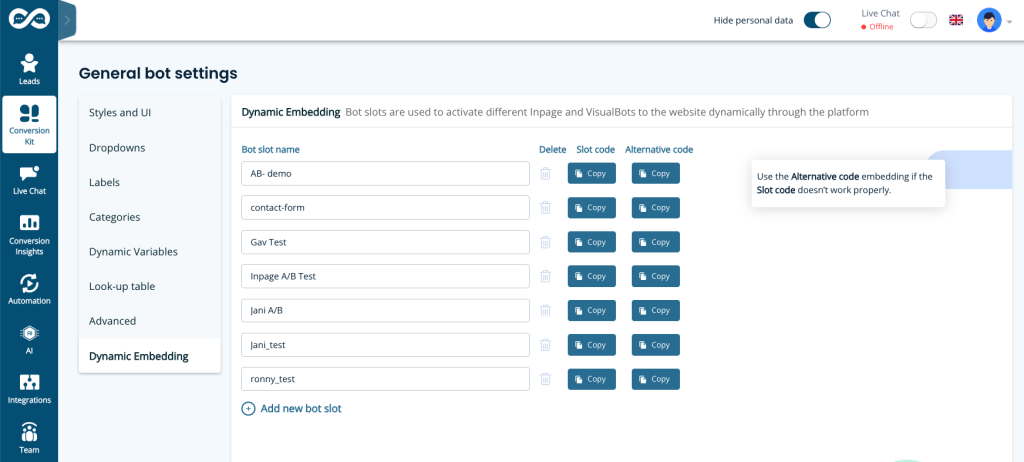
Use URLs to name the bot to make it easy to find and understand where the slot is used.
If you use bot slots on multiple pages, use the same naming logic as in chatbots (wildcards / ie. *leadoo.com/*)
Another way of naming slots is like in the picture above ie. “Front-page-header” etc.
Note! If you rename the slot, you will need to update the script on your website too. Because of this, we don’t recommend renaming them after they have been embedded on your website. If you do rename them, you can always rename them back to what they were to fix this issue.
After creating bots slots, you can assign which bot will appear in each bot slot. For example, find the bot created for blog posts, go to settings then triggers, and select the correct clot e.g. Blog-post-slot. Save, and repeat for each InpageBot and VisualBot as needed.
Note! You can only insert one bot into each slot unless you are running an A/B test.
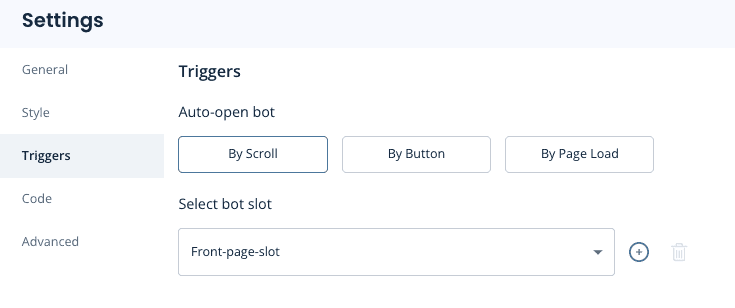
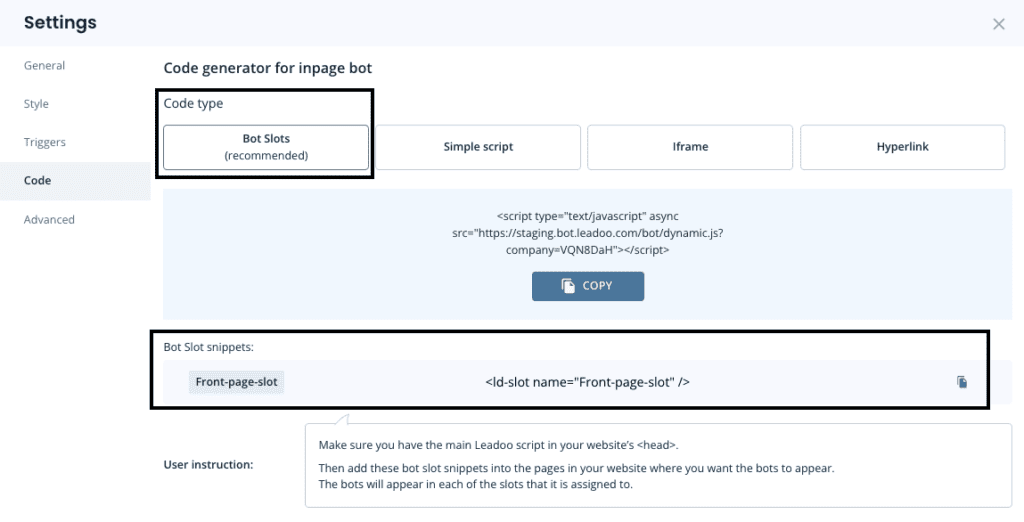
Now you can copy the slots from the Leadoo platform and add them to your CMS. (If you haven’t selected any bots to be seen on those slots yet, nothing will go live, so you can do this even before making the bots.)
Remember to add the Leadoo dynamic bot script (found in individual bot settings -> code) to your website header. This enables bot slots to work on your site.
If you are a developer or advanced user, you can also click “Show the full list of code” to see all possible options available.
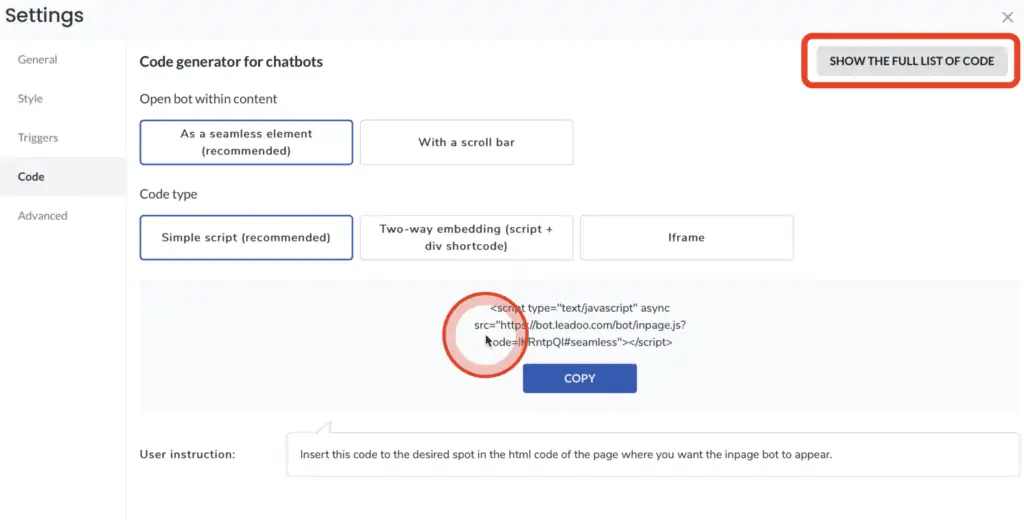
Click the “copy” icon to get the code to your clipboard.

Once you have the code copied, you can go to your website management. If you are using WordPress, the easiest way to embed the bot is to go to your editor. In this example we are embedding with Elementor. But this logic works for any other website management system.
Choose the section where you want to embed the bot. Click on it to open it.
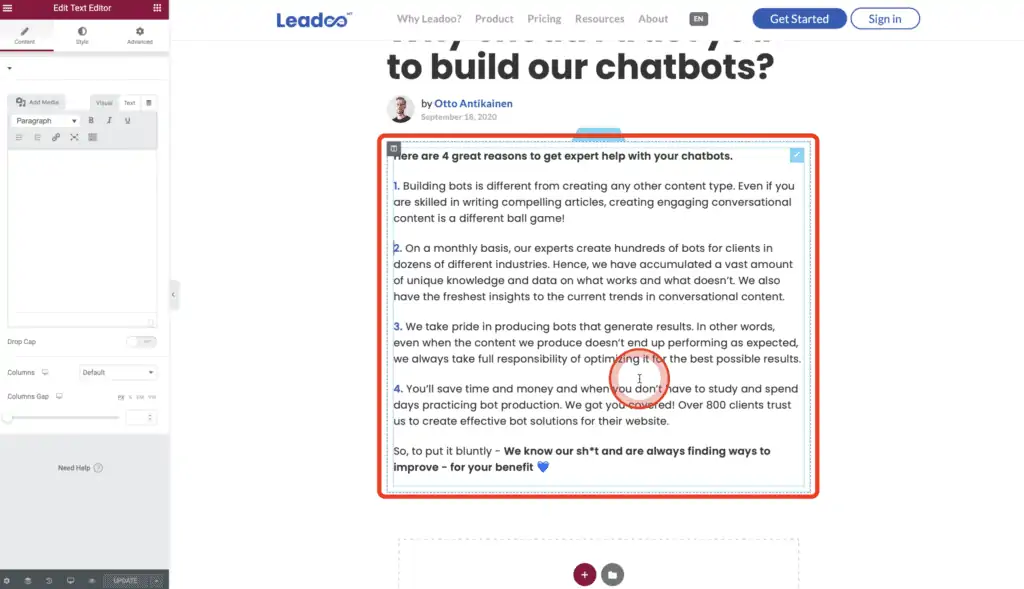
In the Text Editor you can see the visual editor and the text editor. What you want to do, is to work in the Text Editor because this is a HTML site of the website and this is where the bot will go. Switch to the text site and go to the place where you want to put the Bot.
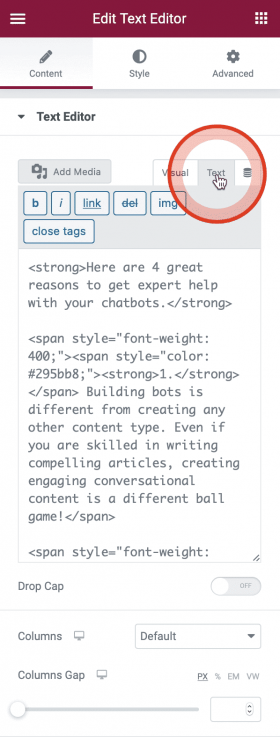
Add a little bit of space between the text and the bot code. Copy-paste the Bot to where you want it to show. And update the page to see the end result.
If you want to embed your Visualbots or Inpagebot using simple script, you can follow the same steps as you would with dynamic embedding. Only difference would be picking a different code. You also don’t have to create bot slots.
Click the “copy” icon to get the code to your clipboard. After this you can move on to Step 2

Leadoo bots are much smaller than many other embedded tools you may be using on your site. We take extra steps to ensure that the bots themselves are small (transfer-size wise) and don’t impact page load performance. We also ensure that our caching rules are flexible enough to allow for caching on the browser-side so that subsequent navigations through your site don’t incur extra transfer costs in downloading our bot(s) more than once.
Leadoo AI uses a CDN (Content Distribution Network) to store cached copies of our bots close to all of our potential users.
Due to these features, Leadoo AI strongly recommends against attempting to improve page performance by including third party tools or custom tweaks to improve the performance of our bots. Doing so will, in most cases, result in a less efficient setup or our bots simply failing to run.
More information can be found on https://docs.leadoo.io/docs/config-page-performance
Content is king. The cliche that we as marketers are quite used to hearing by now. We’ve invested heavily into content marketing, as many companies have, and yet the rewards of those efforts are not as great as we’d hoped. It’s a scenario many find themselves in – being seemingly unable to drive conversions using content marketing – and that’s because their current strategy needs a few tweaks.
Content marketing is the process of creating and distributing valuable, relevant, and consistent content to attract and retain a clearly defined audience – creating content that helps attract buyers and piques their interest in your products in a more covert way; gently, and nurturing. Content marketing gives your brand authority within your space, helps with your SEO efforts, and allows you to target each of your buyer personas with the content most appropriate for them, leading to them spending more time on your site and giving you lots of information about their intent (which you can act upon later).
It’s probably a good idea to cover some of the conversion basics before we launch into how content marketing can help improve your conversion rate. If you’re a seasoned marketer and don’t need a reminder, you could remind yourself of the conversion rate benchmarks for your industry, or skip to the meat of the article below 👇
Conversion
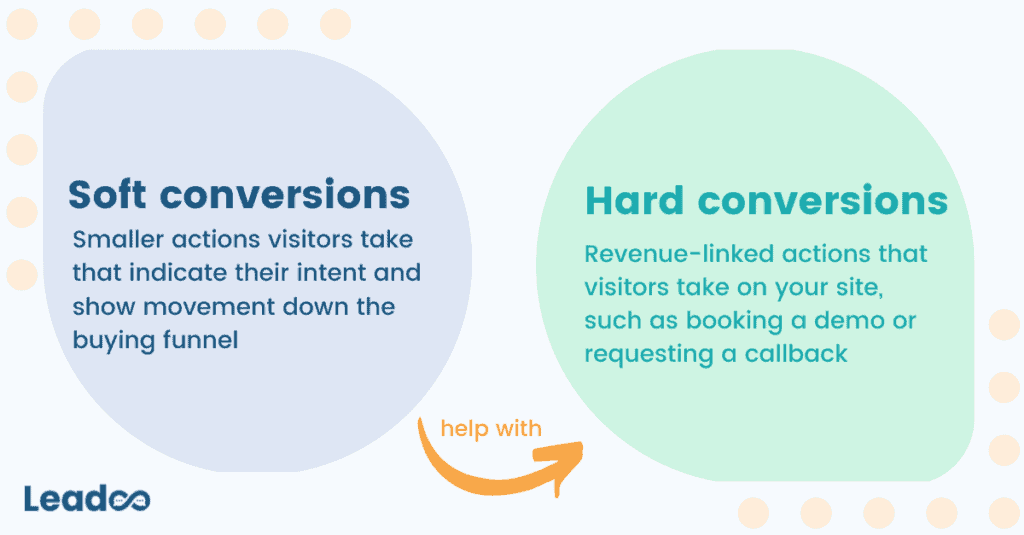
A conversion is any desired action a visitor takes on your website, and these can be split into hard and soft conversions. Hard conversions are the final click of the button when a customer requests a demo or discovery, or checks out their basket in a B2C situation. These are the actions that directly contribute to revenue and so are important. But soft conversions can be just as vital – these are smaller actions customers take on your site, such as downloading a guide or subscribing to a newsletter. Whilst these actions don’t link immediately to revenue, they do give us an insight of customer intent (and therefore potential revenue in the future). Focusing on soft conversions too provides us with the opportunity to understand, and be able to nurture, our prospects and encourage them towards making that final purchasing decision no matter where they are in the buying funnel.
Conversion Rate
The conversion rate of your site can be calculated using a simple equation, but is also available for you to see on Google Analytics (or some other analytics platforms, like Leadoo). Your conversion rate tells you what percentage of visitors are converting into leads on your website. It’s calculated using the following formula:

Or, if you’re like us and you like it when technology does things for you, you can use our free Conversion Rate Calculator to work your conversion rate out.
Conversion Rate Optimisation
This simply means taking action to improve your conversion rate. There are many things you can do to optimise for conversion, and we’ll be looking at some ways that you can optimise your conversions by optimising the content on your site.
Most marketers are familiar with the AIDA model, or some variation of it. The model exists to describe the buyer’s journey, and the phases they go through when they are considering purchasing a product or service. The model works as follows:
Attention (also known as awareness): If a prospect is in the awareness phase, then this is where you’re aiming to provide awareness of your company, brand, products, and the value you can offer. At this stage, you are looking to grab the attention of your prospects in a positive way. This could be through meeting some charming members of your team at an event, or through informative and helpful content on your blog. The theme of the day is demonstrating high value to them, delivered concisely.
Interest: When a prospect is in the interest phase, your job is to convince them that they have a potential need for your product or service – ideally to the point that they’re ready to do more research into the product. This is again a critical point in their journey to explain the value you can bring to your prospect, as often they’ll be researching and comparing with competitors. At this stage, you’re looking to garner their interest so that they want to learn more. This could be via content on your website such as industry and business relevant case studies that resonate with your prospects and evidence the value your solution can bring.
Desire: You’ve successfully grabbed their attention, and piqued their interest so they’re looking for more. Now your job is to make them want your product, to think of nothing but your product… Ok, maybe that’s a bit far (although it would make the next step a little bit easier if that’s how they felt). This is the point where they’re starting to seriously consider the product, and so you want to provide materials such as competitor comparison whitepapers, success stories and case studies, as well as pricing and FAQ information.
Action: Action is the phase where you’ve finally convinced them with enough evidence that they should take action to buy the product or service you’re offering.
During each phase of the buyer’s journey, prospective buyers have different wants and needs for the types of content they’d like to see relating to their level of intent. This is something that businesses often get wrong, but if you want to drive conversions then you need to do that during all stages of the process, and not just at the end.
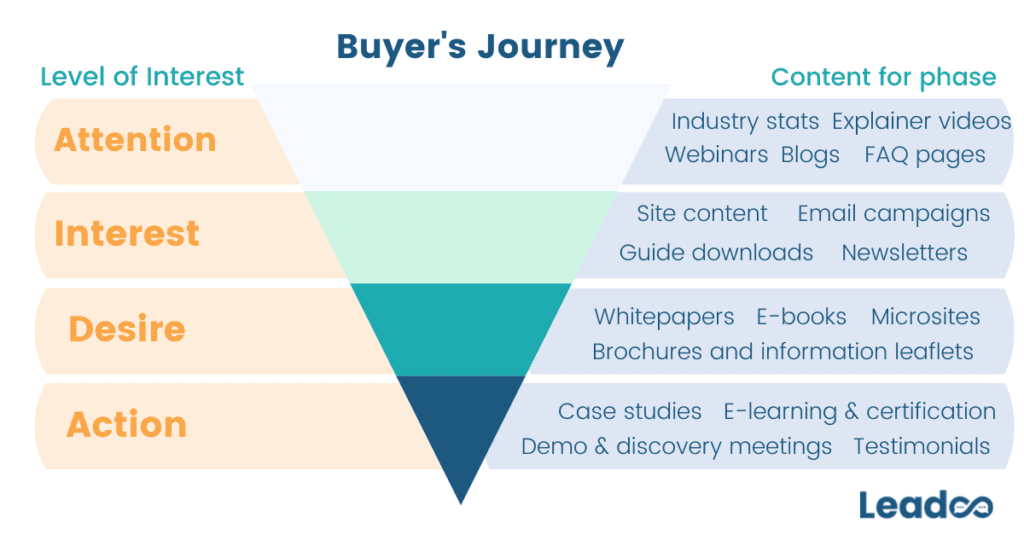
The type of content your buyers are selecting to read or engage with as they move through their journey also makes a difference in determining their intent – we refer to these as soft conversions (for example, a prospect downloads a guide or signs up to your newsletter). They’re not final conversions linked directly to revenue generation, but they do give us an insight into each visitor’s wants, needs and position in the buying funnel.
We can even take the information gleaned from our content creation and customer engagement to further improve the offer we provide and come closer to meeting customer needs. Let’s say you realise that customers who tend to visit Page A, also tend to immediately visit Page B. This could mean a few things;
A simple fix would be to look at the time spent on each page and what was interacted with to work out what people are seeking on Page B, then look to move some or all of this over to Page A – shortening the time it takes your average visitor to convert.
We’ll take a dive into how you can optimise your content marketing efforts for conversions using 3 easy steps.
Every customer that visits your website isn’t ready to convert there and then; 96% of people who visit your site, on average, aren’t. Only 2% on average actually convert. So your job, on top of trying to increase the number of hard conversions you get, is also to focus on the vast majority – the people who aren’t at the bottom of the funnel quite yet.
This means you need to create content that speaks to the prospect at each stage of the journey. You wouldn’t, for example, publish a white paper text in its entirety as an advert. Not only because logistically – and visually – it would be a mess, but because someone you’re targeting with an advert has a different level of intent to someone who would be willing to take the time to read a white paper. With an advert, you’re tailoring your message to those in the Attention (and potentially even Interest) phase of the buyer’s journey – providing them with the facts that will make them look for more.
With a white paper, you’re looking to provide detailed, analytical information which often provides a formal comparison or explicit value offering.
Your content should have the same consideration given to it – who is going to see this content? What are they likely to be looking to get out of this content? How am I going to make them want more or take the action I want them to take?
You can easily create content with generative AI tools like WPSEOAI.com that isn’t only great to generate content, but especially to generate SEO optimised content as well.
One of the first issues our Conversion Experts tend to identify regularly across many clients who we work with in their initial phases is that they usually aren’t using their Call to Actions effectively. They have poor placement, bad phrasing, or a lack of CTAs all together. There isn’t a correct answer for what works perfectly for your customers, so much of this optimisation relies on A/B testing different phrasing and button placement/visuals to find the most optimal CTAs for your customers.
In addition, many clients also simply don’t have CTAs (instead offering a contact form only – or perhaps worse, just a telephone number or email address), or don’t have enough of them. Placing CTAs isn’t an exact science, as mentioned above, but having them on the page in the first place is an excellent place to start. They should be located in places that make sense for the journey each customer goes through – for example, after a paragraph of important information has been given that might help a customer decide they’d like to get in touch or to be able to arrange a demo.
Within longer form content pieces, you should look to provide a CTA at least at the end of the article. You can also provide links throughout to other pieces of your own (or external) content, to signpost the reader to other articles which they might find useful and to push them down the funnel and closer to converting.
Personalised experiences are the gold standard of our time, and so it’s important that any content you’re providing is not only tailored to the visitor’s location in the funnel, but also to their interests and needs. This be achieved by creating more dynamic CTAs through carefully crafted bot conversations – through a single bot you can offer for the visitor to read more, and signpost them to other relevant articles, book a demo, find answers to FAQs and more, all in one place to meet needs of customers at the different stages of the funnel.
In addition, by using high-quality bots, such as the Leadoo InpageBot, you can embed a contextual conversation straight into the content you’re working with. For example, if your visitor is looking at your pricing page, then the bot on that page will only discuss pricing packages and topics you deem relevant to this with that visitor. The same approach can be taken across the whole site, ensuring customers receive valuable help and guidance alongside the content itself that is always in context and in tune with the customers’ needs.
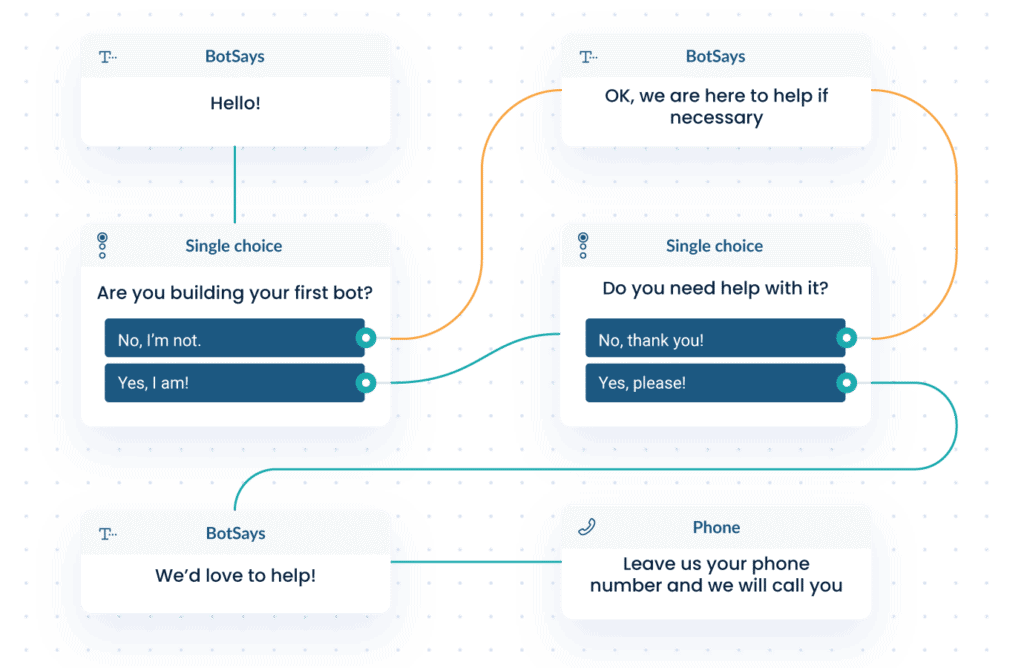
By placing Leadoo bots, this also allows you to understand a prospect’s position within the buyers’ funnel and analyse their intent through conversation-level analytics, as to well as the support of our Conversion Experts – here to continuously optimise your bots to meet the needs of the visitors coming to your site.
Content marketing can be easily utilised to help optimise your site for conversion by providing a seamless experience for every visitor – no matter their intent or stage in the funnel. By focusing on soft conversions and accommodating for these, you can ensure your content speaks to more visitors on your site, and increases the number of conversions along the way.
This post has been brought to you by our friends from Cookie Information! They are true experts when it comes to cookie consents and staying extra safe with GDPR.
98% of your website visitors just leave, without any kind of conversion. What if you could turn some of these 98% into loyal customers? Here’s how you can better understand your customers’ journey to target new audiences and retarget existing clients.
The rest just come and go.
Wouldn’t you like to know who they are? And how you make them convert?
So do we.
That’s why we are always looking for new ways to get to know our potential clients a little better. Understanding customer journeys has been the soul of online marketing for years; and it continues to be.
Getting to know your customers requires a lot of data. This probably is not news to anyone. After GDPR it has become crucial to ask website visitors for a consent to collect their data.
Why?
We are constrained by law.
Yes, privacy laws like the ePrivacy Directive (the European cookie law) and the GDPR require us to obtain valid consent from our visitors before we collect their data.
This rule applies to us all.
Transparency and privacy are key factors for how buyers perceive your business.
So, now we’re going to show you how you can collect your users’ data to better understand your customers’ journey; all while being GDPR compliant!
First, you should look for a good CMP.
What’s a CMP you might ask?
A Consent Management Platform (CMP) is a tool that collects your users’ valid consent to cookies on your websites and apps.
But why should you get a Consent Management Platform?
Because obtaining consent to cookies isn’t simply showing your visitors a banner on your website saying: “we use cookies – ok”.
GDPR consent is much more complex.
So, here is GDPR consent in a simplified form:
When you use cookies on your websites or apps that collect your visitors’ personal data (cookies from Google Analytics, Facebook, LinkedIn, TikTok or any other third-party service), you must:
And of course, remember to store all the consents securely for 5 years so you can show them to the Data Protection Authorities if they come knocking at your door. They do that sometimes.
Still sounds complicated?
Don’t worry, it’s not.
You can easily collect valid GDPR consent.
There are actually only a handful of Consent Management Platforms in the world that will enable you to collect a cookie consent that complies with the GDPR.
Cookie Information is one of them.
· Collect valid GDPR consent to cookies from your users
· Stay compliant with national cookie rules and the GDPR
· Get the support you need to implement and maintain your Consent Solution
· Get through an audit by the Data Protection Authorities (we have your back!)
With a solution like Cookie Information, your websites and apps are always up to date with current legislation, so you can focus on collecting the data you need to grow.
Data, of course, is only information until you put it together in the right way. At that point it becomes insights; something you can act upon.
One of the ways to transform all the data you collect into insights is by using a Conversion Platform.
Now, what’s that?
A conversion platform is a tool designed to collect and analyse your website’s conversions.
“Yeah, but I got Google Analytics“, you might say.
Sure, it’s undoubtedly a great tool. Still, GA will only take you so far if you sell B2B.
A conversion platform is more than just endless amounts of raw data in graphs and pie charts. It activates and converts your visitors with deeper insights and automation.
A conversion platform has many built-in conversion tools to convert and nurture your website visitors.
One platform we have been happy to discover is Leadoo.
Leadoo is a Conversion Platform. It collects and displays your potential buyers’ data so your marketing and sales department can understand each step of the buyers’ journey.
Leadoo activates and engages your leads, so you start building a rapport with them. This means that you can nurture them all the way to a hard conversion. 🚀
And that is the goal of any business, right?
But as said earlier, collecting data requires attention to data privacy regulations like the GDPR.
When you use a conversion platform like Leadoo, it is built on the premise that you ask your website visitors’ permission to collect and use their data.
When Cookie Information is your Consent Management Platform, it’s easy to integrate it with Leadoo.
You can use this simple javascript, which is actually the only thing you need to do to integrate the two tools.
if (!window.ldanalytics) window.ldanalytics = [];
window.ldanalytics.push(function(a) {
    a.toggleTracking(true, false);
});Spark up a discussion with our friendly little helper right here 👇🏻
Let’s go then!
This webinar is about to tickle your sales fancy, and all about helping you to close more deals from your existing pipeline.
In this webinar we’ll be covering the following topics:
💡 How to max your demo scheduling rate
💡 How to decrease leads to deals time (we’re all about that fast closing!)
💡 How to increase sales rep productivity, and activity rates
Sign up and get ready to collect chubbier commission checks in the future! 🚀

